- DORA requires financial institutions to maintain precise, auditable records with unique identifiers and locations for all ICT assets.
- Wireless technologies like RFID and BLE offer scalable solutions for different asset visibility needs without mandating specific technology deployment.
- Not all ICT assets require continuous real-time tracking; visibility levels should be matched to asset criticality and mobility.
- Custody tracking systems combining RFID with controlled access enhance accountability and complement physical localization.
- Combining technologies such as RFID, BLE, UWB, and GNSS enables comprehensive asset management from building interiors to remote locations.
DORA is raising expectations for how European banks and financial institutions identify, document and protect their ICT assets. RFID, NFC, BLE, UWB and wide-area IoT tracking can automate parts of this physical asset visibility, but not every asset requires the same technology or level of location data.
DORA Makes ICT Asset Management More Concrete
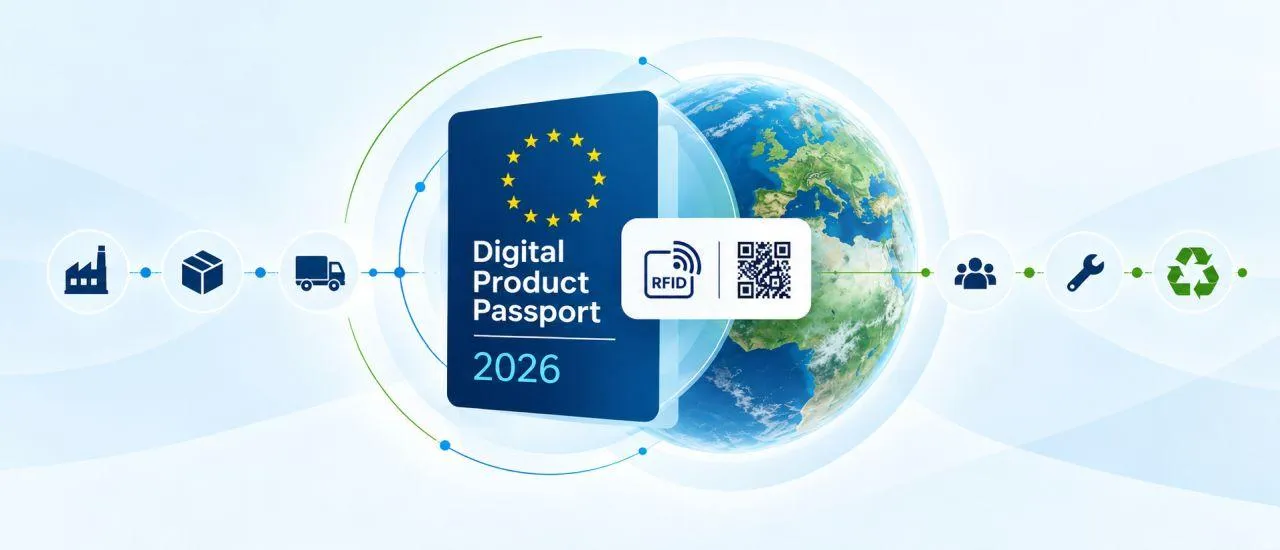
Since January 17, 2025, the EU Digital Operational Resilience Act, DORA, has applied across the European financial sector. Its scope extends beyond cybersecurity software and networks to the ICT assets on which financial services depend.
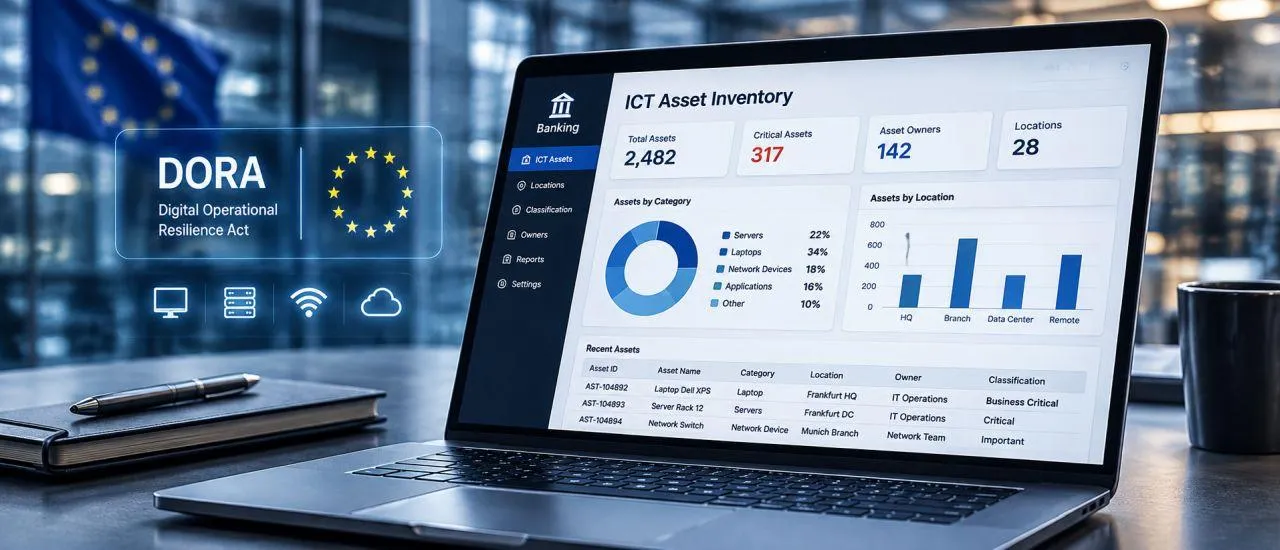
The associated Delegated Regulation (EU) 2024/1774 makes the asset-management requirements particularly tangible. Financial entities must maintain records including a unique identifier for each ICT asset, its physical or logical location, its classification, its owner and the business functions or services it supports.
Physical security is part of the framework as well. Financial entities must establish measures to protect ICT assets inside and outside their premises and control physical access to areas where ICT and information assets reside.
None of this means that banks must deploy RFID, Bluetooth or real-time location systems. DORA is technology-neutral.
The operational question is therefore different: How can a financial institution keep information about physical ICT assets accurate, current and auditable without creating another layer of manual administration?
Not Every ICT Asset Needs Real-Time Location
A laptop, server component, mobile device or other ICT asset does not necessarily need to appear as a moving dot on a map.
Asset visibility can range from simple identification to continuous tracking. Depending on the use case, a financial institution may need to know which asset is involved, whether it is still present, whether it has crossed a defined checkpoint, where it is currently located, or who has custody of it.
These questions require different levels of wireless visibility.
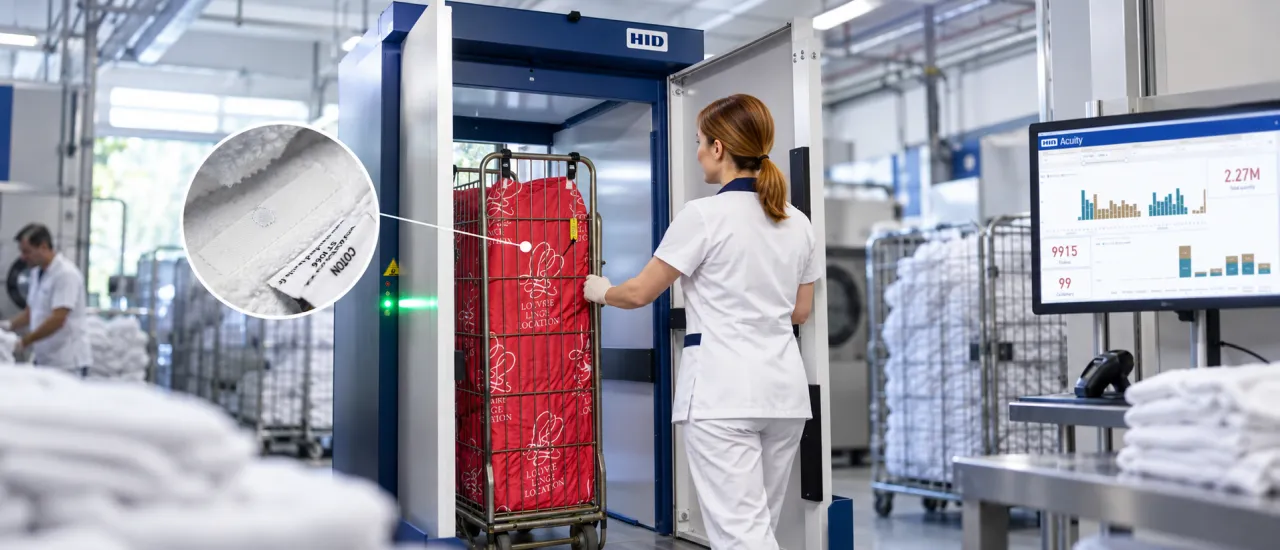
Passive UHF RFID (also called RAIN RFID) can identify large numbers of tagged assets and support automated inventories or checkpoint detection without requiring batteries in the tags. HF RFID and NFC support intentional close-range identification.
But identification is not limited to RFID. Bluetooth Low Energy can also identify active tags or devices. BLE advertising allows devices to announce their presence to scanning infrastructure, making BLE suitable for active asset identification and presence detection. With additional infrastructure and positioning methods, the same BLE tags can also support proximity, zone detection or location services.
UWB becomes relevant when significantly more precise continuous positioning is required. For assets moving outside a building or between sites, GNSS, Wi-Fi positioning and LPWAN or cellular connectivity can extend visibility beyond the local facility.
The appropriate technology therefore depends not on DORA itself, but on what the bank actually needs to know about each asset class.
HID: From Passive Identification to BLE Asset Visibility
HID demonstrates how different levels of asset visibility can coexist within one portfolio.
For passive asset tracking and inventory, HID offers RFID tags and reader technologies across LF, HF and UHF/RAIN RFID. For active tracking, HID provides Bluetooth Low Energy-based RTLS with both zone-based and object-based approaches.
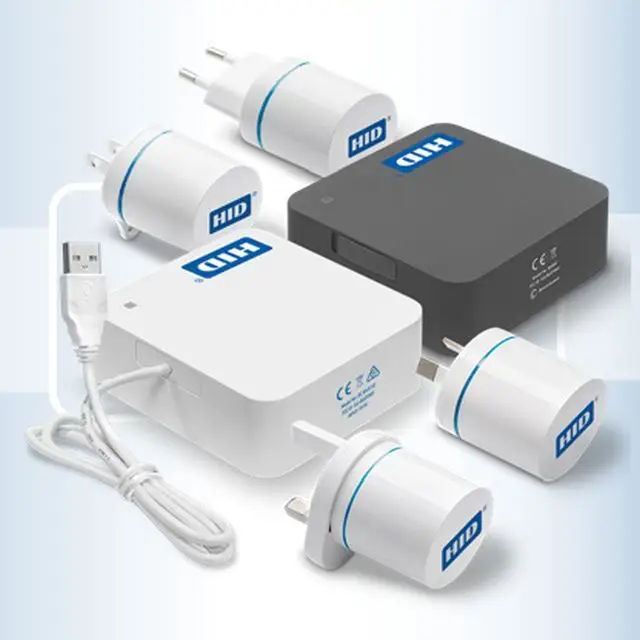

BluFi™ BLE – WiFi Gateways
HID BluFi™ BLE–WiFi Gateways provide secure, flexible, and scalable connectivity to enable real-time IoT data integration and management.
That distinction is important. Passive RFID can be appropriate when a bank wants to identify assets, accelerate inventories or detect them at defined reading points. BLE tags can actively announce their presence and, when combined with the necessary RTLS infrastructure, add zone or location information.
This points toward a tiered architecture: use passive identification where inventory information is sufficient and active BLE tracking where continuously updated presence or location creates additional operational value.
deister electronic Connects Assets With Authorized Users
Location is not always the most important information. In many banking processes, accountability may matter more.
deister electronic's proxSafe systems combine RFID-based identification with controlled cabinets and lockers. Authorized users identify themselves before accessing keys or valuable equipment, while withdrawal and return events are automatically recorded. The platform also provides reports for audit and compliance purposes.
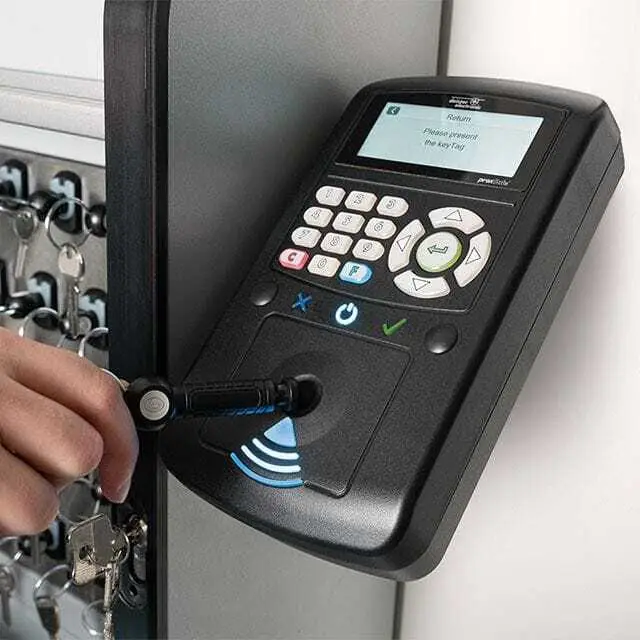

For equipment stored in such systems, the relevant question becomes: Who took which asset, and when was it returned?
deister also supports the controlled storage of equipment and valuable objects and centralized management across multiple locations.
For financial institutions, this approach could be relevant wherever shared ICT equipment, keys or other sensitive objects are issued to authorized employees.
It illustrates another important point: physical asset visibility is not necessarily the same as localization. Sometimes a reliable custody record provides the more useful information.
RFID for Identification, Inventory and Checkpoints
Several other Think WIoT suppliers address the layer between manual inventory and continuous RTLS.
IDCRAFT explicitly includes IT equipment among its asset-tracking applications. The company offers HF/NFC and UHF/RAIN RFID technologies and describes complete RFID architectures involving tags, readers, middleware and integration into higher-level systems.
Such an architecture is particularly relevant when financial institutions want to replace manual or barcode-based inventory processes with automated identification and bulk reading.
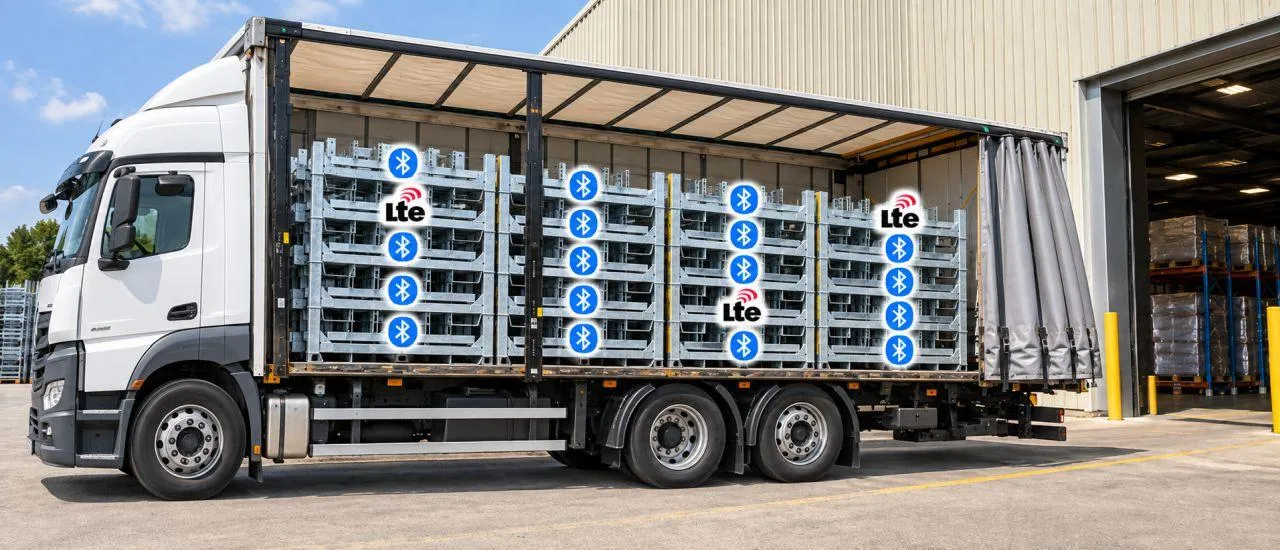
iDTRONIC approaches asset tracking with both RFID and IoT technologies. For stationary RFID deployments, the company describes checkpoint detection zones that define and monitor logical areas within a facility. For assets travelling beyond the local site, its associated IoT tracking solutions use LTE-M and NB-IoT connectivity.
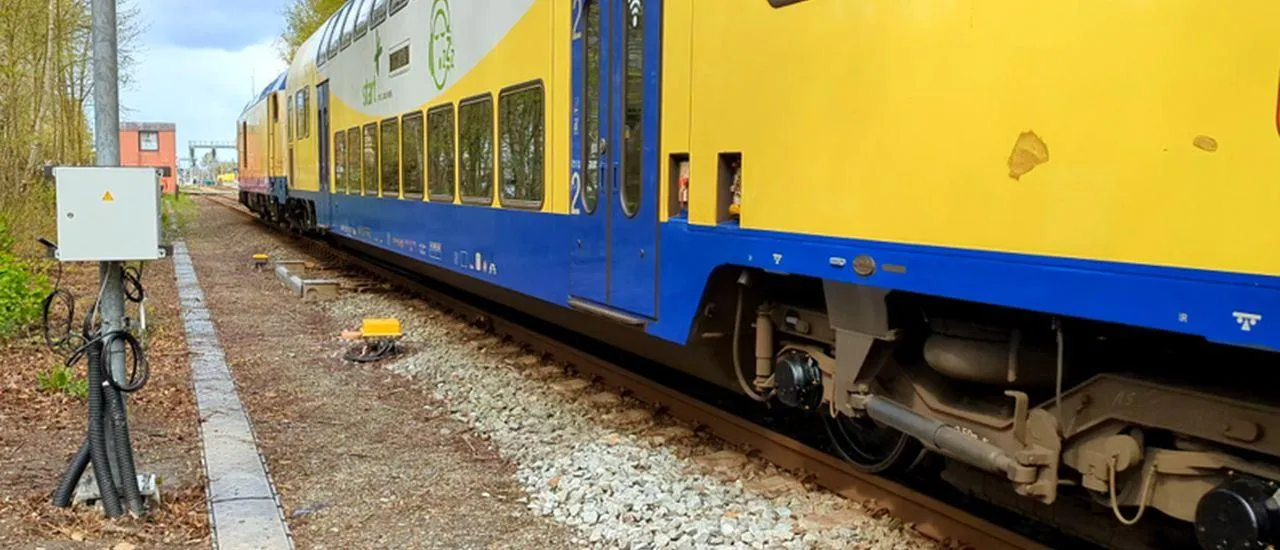
This demonstrates a useful architectural distinction: a fixed RFID reader can document that an identified object passed a specific checkpoint, while a connected active tracker can provide information across a much larger geographic area.
FEIG ELECTRONIC provides RFID reader infrastructure for automated identification and asset management. Depending on the application, mobile HF RFID systems can support controlled inventory and document identification, while UHF/RAIN RFID infrastructure enables longer-range and automated asset detection.
microsensys similarly addresses mobile identification and documentation. Its mobile data-capture solutions use HF/NFC or UHF RFID for unique object identification, while the iID DATAcollector supports inventory objects, authorization levels, documentation and integration into existing software or cloud environments.
Related Suppliers




These approaches are particularly relevant where the primary requirement is: Which assets are present and correctly documented? rather than: Where exactly is every asset every second?
BLE Extends Identification Into Presence and Location
BLE can cover several levels of asset visibility. At its simplest, a BLE tag periodically advertises its presence and serves as an active wireless identifier. With receivers distributed across a building, detections can also provide room- or zone-level visibility.
Bluetooth Channel Sounding, introduced with Bluetooth Core 6.0, extends this capability with secure fine ranging. Using Phase-Based Ranging (PBR) and Round-Trip Timing (RTT), it enables much more precise distance measurement than conventional RSSI-based estimation, with centimeter-level ranging as the target.
Channel Sounding measures distance between devices, but it is not a complete positioning system. Determining a unique 2D or 3D position still requires suitable infrastructure and additional reference information.
For banks and financial institutions, BLE can therefore support active identification, presence detection, zone visibility and more precise ranging or location services, provided battery-powered tags and the required infrastructure are appropriate for the use case.
When Precise Location Really Matters
There are also cases where presence or checkpoint information is insufficient.
Kathrein Solutions distinguishes between RFID for point-based detection and RTLS for continuous positioning. Its RTLS material discusses BLE, Wi-Fi and UWB as indoor positioning technologies, with UWB particularly suited to applications requiring precise object location.
For a financial institution, such infrastructure would probably not be justified for every monitor, desktop computer or standard laptop.
It could, however, be relevant for selected high-value, critical or frequently moving assets where knowing an exact or continuously updated position creates sufficient operational or security value.


From the Building to Remote Assets
Once an asset regularly leaves a bank building or campus, another technology layer becomes relevant.
Truvami offers active LoRaWAN tracking devices that combine GNSS, Wi-Fi scanning and Bluetooth connectivity. Its Tag L, for example, can obtain location information through GNSS and Wi-Fi scanning and transmit tracking and status information via LoRaWAN.
The current device portfolio includes trackers for small valuable assets, vehicles, containers and other mobile equipment.
This type of architecture would be excessive for thousands of stationary office assets, but it illustrates how asset visibility can continue when selected equipment moves between branches, service locations or external sites.


From DORA Requirement to Wireless Architecture
The important conclusion is not that DORA creates an obligation to install RFID or RTLS.
DORA raises the importance of maintaining reliable information about ICT assets, including their identity and physical or logical location. Wireless IoT technologies can automate different parts of that information chain.
The architecture should therefore start with the information requirement:
Identification: Which asset is this?
RAIN RFID, HF RFID/NFC or BLE active tagsInventory and Presence: Is the asset here?
RAIN RFID or BLEMovement and Zone Visibility: Has it entered or left a defined area?
RAIN RFID checkpoints or BLE-based zone detectionCustody: Who currently has the asset?
Controlled asset storage combined with user and asset identificationIndoor Location: Where is it within the building?
BLE-based RTLS or UWB, depending on the required positioning accuracyRemote Tracking: Where is it outside the site?
GNSS or Wi-Fi positioning combined with LPWAN or cellular connectivity
This also avoids a common misconception: RFID is not only identification, and BLE is not only localization. Both can contribute to identification and presence detection. BLE can additionally support increasingly detailed location information when the appropriate positioning infrastructure is added.
For European banks and financial institutions, the goal should therefore not be to track every ICT asset continuously. It is to match the level of wireless visibility to the criticality, mobility and risk profile of each asset class.
That turns DORA from a purely regulatory discussion into a practical Wireless IoT question: What does a financial institution need to know about each physical ICT asset, and which technology can provide that information with the least necessary infrastructure and complexity?