
- RFID success in industrial laundries relies on the integration of tags, system design, and operational processes rather than hardware alone.
- High read accuracy requires planning around reader configuration, antenna placement, textile density, and movement for reliable large-quantity tracking.
- Effective RFID integration must complement existing ERP and laundry management systems through clearly defined APIs and interfaces.
- Costs are often underestimated in software integration and process design, which are critical alongside hardware investment.
- AI can enhance RFID data by enabling predictive analytics for inventory forecasting, loss detection, and lifecycle management.
UHF RFID in industrial laundries is not just a matter of the tag itself. Read accuracy, reader infrastructure, software integration, process design, and data quality all work together to determine whether a viable solution can be created.
In an interview with Think WIoT, Christophe Moutot, Product Director – RFID Tags and Hardware at HID Textile Services, examines both sides of the project: What must the integrator master, and what benefits can the laundry facility expect? His answers range from bulk data capture and ERP integration to costs, lifecycle data, and AI.
RFID projects combine technical architecture with day-to-day operations. Tags, readers, antennas, interfaces, and data models must work together in such a way that inventory becomes more transparent, losses are reduced, and processes can be automated.
“Successful implementations require the right combination of tag technology, system design, and operational integration,” Moutot notes.
With this, the HID manager sets the framework: A high-performance transponder is essential. It only realizes its full potential within an architecture that is tailored to the actual laundry process.


How does an RFID tag become digital textile management?
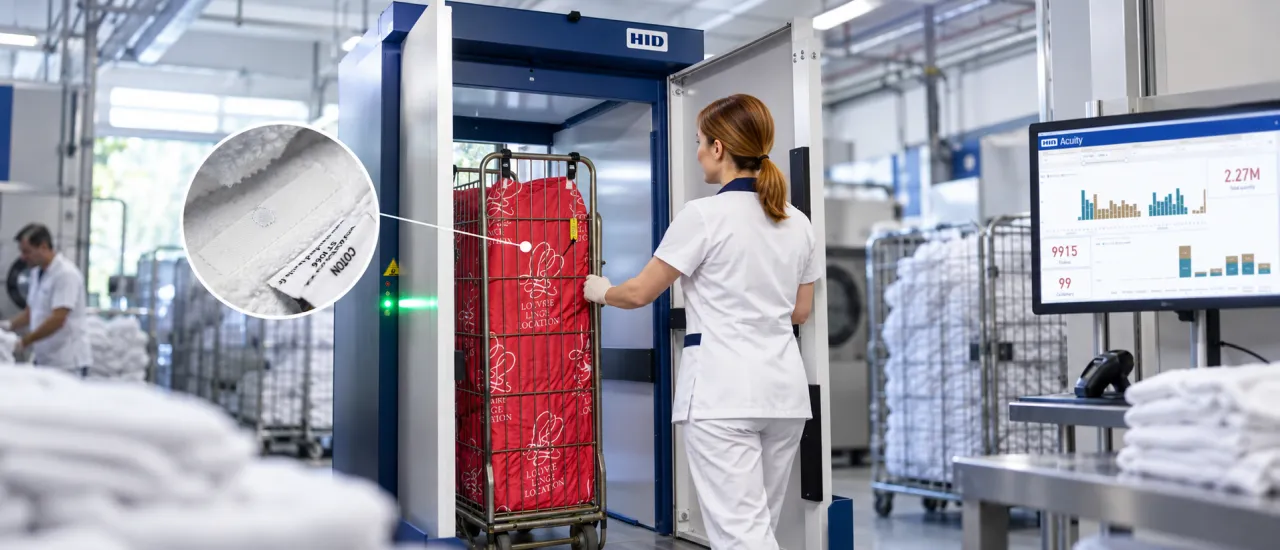
RFID tags form the basis of HID’s offering. Moutot, however, focuses on the overall system. Textile RFID tags, mobile and stationary readers, automated gates, cloud-based software, and analytics all work together. This allows textiles to be tracked from goods receipt through issuance, laundering, and inventory management all the way to decommissioning.
The tag itself typically carries only a unique serial number. Information such as item type, owner, purchase date, location, wash cycles, lifecycle status, and movement history is stored in the database, the Product Director explains.
For system integrators, the task is to permanently and accurately link the physical textile, the capture point, and the data record. This provides the laundry facility with transparency regarding inventory, circulation, and the lifecycle.
For integrators
Capture points, the data model, and backend integration are just as much a part of the solution as the RFID tag itself. The UID alone does not yet create a usable process.For industrial laundries
The information behind the identifier is what matters: inventory, location, wash cycles, usage history, and lifecycle.
What level of reading accuracy does UHF RFID require in laundries?
UHF RFID enables the simultaneous tracking of large quantities of textiles without line-of-sight contact. Hundreds of items can be identified over distances relevant to the process. This opens up potential for automated counting, sorting, inventory management, and logistics.
However, specific conditions are crucial during project planning. Reader configuration, antenna position, textile density, tag orientation, and movement speed all influence performance.
Moutot therefore uses a different benchmark than maximum range:
“It’s not necessarily about the longest read range, but about capturing large quantities of textiles as precisely and consistently as possible.”
Water, tightly packed textiles, and metal surfaces can also affect UHF systems. According to the RFID manager, advances in tag design, reader infrastructure, and solution engineering have helped to largely mitigate these influences in commercial laundry environments.
For Integrators
The key metric is reproducible read reliability. Tag design, antenna position, reader configuration, textile density, and movement must all be planned in conjunction.For Industrial Laundries
The key factor is the detection rate within your own workflow: Are large quantities captured quickly and reliably, without the need for recounting or manual corrections?
Why isn’t the right RFID tag enough?
“One of the most common misconceptions in RFID projects at laundries is the assumption that success depends solely on the tag,” warns Moutot.
The transponder must withstand industrial washing processes, and its position must not compromise readability or durability. Equally important are the reader infrastructure, antenna placement, data architecture, and integration into existing workflows.
The HID expert therefore advocates for a holistic approach. Textile properties, operational processes, RFID technology, and business goals should be considered together. He sees the greatest benefit when RFID becomes part of a broader digital transformation rather than being used as an isolated tracking technology.
For Integrators
A high-performance transponder cannot compensate for a weak system design. Hardware, data architecture, textile properties, and workflow must all be compatible.For industrial laundries
The entire process—from data capture to usable information—should be evaluated, not the performance of a single component.
How can RFID be integrated into ERP and laundry systems?
Moutot articulates a clear principle for this: “The key to successful RFID integration lies in adapting the technology to existing business processes—not the other way around.”
RFID platforms can be connected to ERP and laundry management systems via APIs and data interfaces. There, RFID supplements current asset data, while existing applications can remain the leading systems for operational and business processes.
For users, the advantage lies in being able to continue working with familiar applications while simultaneously receiving more precise, automatically captured information. Additional transparency should not come at the cost of increased operational complexity.
For integrators
Define APIs, interfaces, and system-of-record logic early on. RFID should complement existing enterprise systems rather than creating parallel data environments.For industrial laundries
Better data doesn’t have to mean a new software process for employees. Ideally, the quality of information improves within familiar workflows.
What costs are frequently underestimated in RFID projects?
Tags represent a recurring cost factor when used in large quantities. The method of attachment, durability, and required performance all play a role here. Reader infrastructure may also require a significant initial investment, especially in dense or wet textile flows.
However, Moutot sees software integration and process design as the areas where effort is most often underestimated.
ERP or laundry systems must be integrated, data models established, and workflows tailored to automated data capture. Data maintenance and operational discipline also influence the long-term quality of the system.
“The difference between a successful project and one that performs below average rarely lies solely in the hardware,” Moutot summarizes based on his experience. Rather, system design and process integration are the deciding factors.
For integrators
Software integration, data modeling, and process design must be included in cost estimates and project planning from the very beginning.For industrial laundries
The per-item price is only one aspect. The decisive factor is the overall cost-effectiveness, taking into account the investment, operating costs, and achievable process improvements.
How can AI further advance RFID-based laundry processes?
Today, RFID provides information about which textiles are available, where they were recorded, how often they have been washed, and how they move through the cycle.
Moutot looks beyond this. Artificial intelligence could serve as an “intelligence layer” over the RFID data. Usage patterns and seasonal fluctuations could support inventory forecasting. Notable losses could be linked to potential process leaks, misrouting, locations, or customers. Replenishment and redistribution could also be automatically triggered in the event of foreseeable bottlenecks.
Other approaches focus on lifespan and quality. Wash cycles, usage history, and the age of an item can provide indications of the end of its life or unusual wear and tear. Deviations in circulation patterns can reveal textiles that were misdelivered, remain stuck in process loops, or are underutilized.
This changes the role of data: The system no longer merely documents the past but can also identify future needs for action.
Moutot sums up this developmental step succinctly: The value of AI lies in “translating RFID-based transparency into optimization and automation.”
For integrators
AI requires reliable event data. Data quality, process logic, and system architecture thus become even more important.For industrial laundries
The next layer of added value lies in forecasts regarding demand, losses, turnover, service life, and unusual process patterns.
RFID bridges technology and operations
The integrator lays the technical foundation. The industrial laundry evaluates the solution based on its performance in daily operations.
Moutot’s perspective brings both sides together: A high-performance RFID solution impresses not by the number of its components, but by the reliable interplay of technology, data, and processes.