Digital Product Passport in the Wireless IoT Context
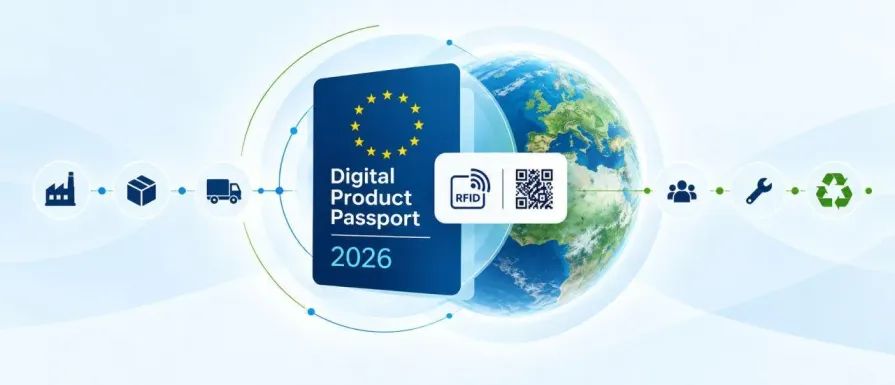
The Digital Product Passport, or DPP, links physical products with structured digital information. It makes data on materials, origin, sustainability, repairability, use, return and recycling accessible through a product-specific digital record.
This is where Wireless IoT technologies become relevant. The DPP needs a reliable connection between the physical item and its digital passport. At the “things frontend”, technologies such as QR codes, RFID, NFC and, in the future, chipless RFID can identify the item and provide access to the passport ID, product record or related data source.
Why DPP Is a Technology Issue
Today, QR codes are often seen as the most direct entry point for DPP access because they are low-cost, visible and readable with smartphones. However, many products in retail, logistics and supply chains are already tagged with RFID. This creates a strong technology bridge between existing item-level identification and future DPP requirements.
For the RFID industry, the Digital Product Passport could become an additional driver for item-level tagging. If more products require a persistent digital identity, RFID and NFC can support automated reading, bulk capture, secure identification and integration into enterprise systems. This is especially relevant where manual scanning of individual QR codes is not practical.
From Product Identity to Data Architecture
A DPP project starts with the question of how a product is uniquely identified and connected to a digital data record. Depending on the application, QR codes, NFC, RFID, secure identities or hybrid approaches may be used. Readability, cost, lifecycle, security, data access and system integration determine which technology is suitable.
Beyond identification, the DPP requires a robust data architecture. Product data from different systems must be consolidated, structured, updated and made accessible in a controlled way. Standards and interoperable interfaces are essential to avoid isolated DPP implementations.
RFID, NFC and Chipless RFID in the DPP Landscape
RFID and NFC can add value where products need to be identified automatically, without line of sight or in larger quantities. NFC can support direct consumer interaction through smartphones, while UHF RFID is relevant for logistics, retail inventory, supply chain visibility and automated process capture.
In the mid term, chipless RFID may also become relevant for selected DPP use cases. It offers a potential path toward very low-cost identification without a conventional silicon chip. For now, it should be considered as an emerging option rather than a standard DPP technology.
Content, Solutions and Expert Knowledge on DPP
This Topic Hub presents relevant Think WIoT content on the Digital Product Passport in one place. It includes technical articles, news, videos, interviews, solutions and resources. The search within the hub helps users find content on terms such as RFID, NFC, QR code, OPC UA, battery passport, EDC, CEN/CENELEC, circular economy or product data.
Additional resources such as “Understanding DPP” provide a compact foundation, while the content list leads deeper into individual technologies, standards and implementation questions.



 Olaf Wilmsmeier
September 24, 2026
Article
Olaf Wilmsmeier
September 24, 2026
Article