
- Custom RFID transponder development begins by defining application-specific requirements rather than selecting existing tags.
- Antenna design, connection technology, material choice, and housing are integrated factors that influence RFID performance.
- B-ID’s development process includes prototyping, rigorous testing, and preparation for reproducible mass production through tooling.
- The company’s approach allows RFID hardware to be adapted to existing industrial processes, minimizing the need to change production workflows.
Standard transponders are not sufficient for every industrial RFID application. B-ID therefore develops custom RFID hardware that integrates the antenna, material, design, and manufacturing process. The key factor is the transponder’s performance under real-world operating conditions.
The Application Defines the Transponder
In industrial RFID projects, development does not begin with the question of which existing tag can be used. First, it must be determined what the transponder is expected to accomplish in the process.
What read range is required? On what material will the transponder be mounted? How much installation space is available? Must the design withstand high temperatures, chemicals, or mechanical stress?
These parameters directly influence the antenna, material, housing, and mounting. As an OEM and ODM partner, B-ID therefore develops RFID hardware based on the specific requirements profile and, if necessary, adapts existing transponders to new operating conditions.
Industrial Projects Led to Specialization
The focus on customer-specific RFID transponders evolved from specific industry requirements.
B-ID founder and CEO Yiwen Jin first came into contact with RFID while working at a German mechanical engineering company. He later founded B-ID in Europe. Initially, the company focused, among other things, on smart cards, access control, and key fobs.
As these standard products became more widespread, a new focus emerged. Discussions with German industrial companies revealed requirements that could not be met solely by variants of existing products. Temperature resistance, defined read ranges, and specialized designs became development priorities.
This need led to the creation of prototypes and, ultimately, custom RFID transponders for industrial applications and production processes.


From Specifications to a Functional Prototype
The integration of various development disciplines is crucial here. A change in the housing geometry can affect the antenna. A different material can influence RFID performance. Greater temperature resistance, in turn, can impose new requirements on the housing, connection technology, and manufacturing process.
B-ID therefore draws on expertise in antenna development and tuning, materials science, tooling, plastic injection molding, and antenna manufacturing.
Technical parameters for the transponder are first derived from the process requirements. This is followed by the selection or adaptation of the antenna and materials, as well as the design of the housing and mounting. A prototype is then manufactured and tested against the defined requirements.
Only when the design and RFID performance meet the requirements and the prototype has been approved does the transition to mass production take place.
This means that mass-production readiness is already an integral part of the RFID development process and not merely a downstream production issue.
This connection is particularly relevant for system integrators. The question is not merely whether a tag can be read in principle, but whether the required performance can be consistently achieved on the actual object and within the intended reader infrastructure.
The Antenna Is Part of an Overall System
The technical performance of an RFID transponder is not determined solely by the IC used. Antenna geometry, conductive material, the connection between the chip and the antenna, the housing, and the installation environment all interact.
B-ID relies on SMD technology for its UHF RFID transponders. SMD stands for “Surface-Mount Device.” In this process, the RFID chip is die-sorted from the wafer, packaged in a protective housing, and prepared as a compact component with defined electrical contacts for further processing.
For custom ODM transponders, B-ID uses copper antennas, among other materials. These allow the SMD component to be soldered directly to the designated contact areas of the antenna structure. Compared to a connection using conductive adhesive, this creates a mechanically robust electrical connection between the component and the antenna. Copper provides the necessary solderability as well as high electrical conductivity and elasticity.
The connection technology is therefore not an isolated production detail. It is part of the structural design of a transponder and must be considered in conjunction with antenna design, materials, and future operating conditions.
Material and Form Factor Influence Function and Integration
The housing also fulfills several functions in industrial RFID transponders. It protects the electronics, defines the mounting, and determines how the transponder can be integrated into a machine, a tool, a container, or another object.
B-ID therefore produces various designs, including transponders in the form of screws or cable ties, on-metal solutions, and special versions for increased temperature or chemical resistance.
Related Hardware

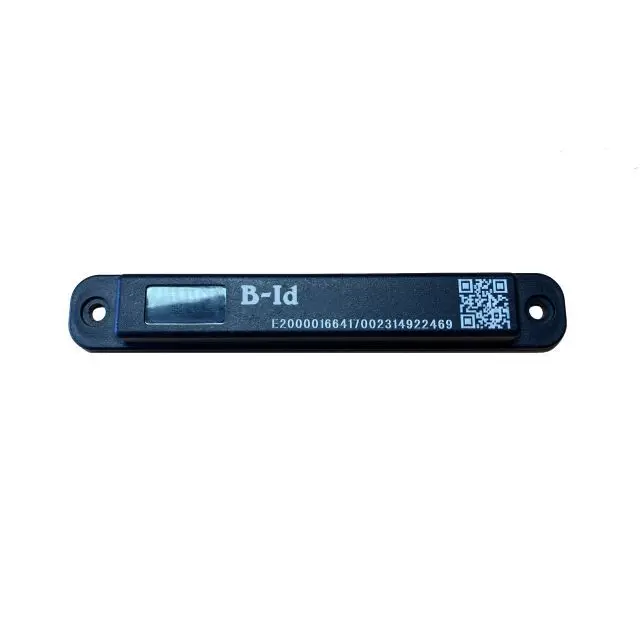
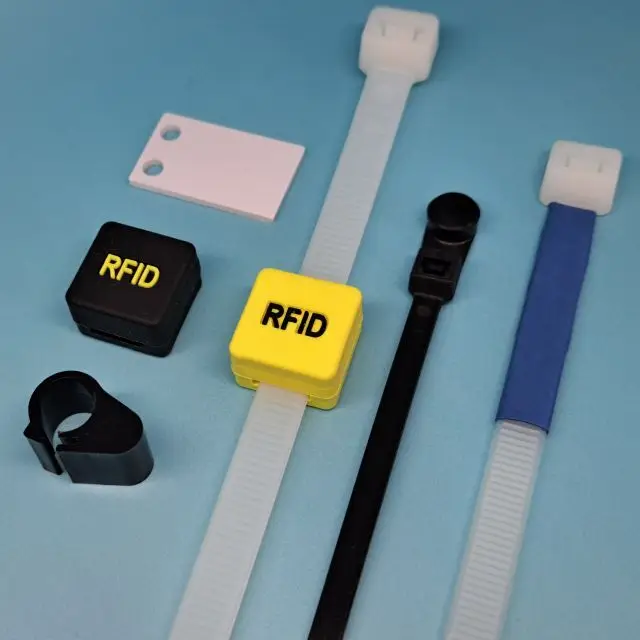
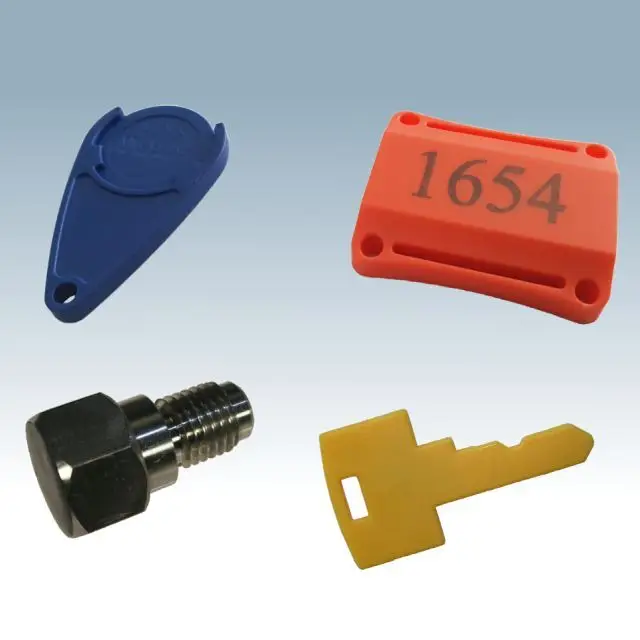
However, the design cannot be considered in isolation from the radio technology. For example, metal in the immediate vicinity of a UHF RFID antenna alters its electromagnetic properties. Material selection, distance from the object, and antenna design must therefore be considered together.
It is precisely at this point that a custom development differs from simply selecting a catalog product.
Antenna Tuning Instead of Process Adaptation
Not every application requires a completely new development. Existing RFID hardware can also be adapted to changing requirements.
To achieve this, B-ID optimizes, among other things, antennas, materials, programming, and design characteristics. The goal is to tailor the transponder as precisely as possible to the object and process.
For users, this can make a significant difference: The production process does not necessarily have to be adapted to an existing standard transponder. Instead, the RFID hardware can be modified so that it can be integrated into the existing application.
Tooling Determines Series-Production Capability
A technically functional prototype is not yet an industrial mass-produced product. For mass production, geometries must be manufactured reproducibly, materials must be processed under controlled conditions, and design tolerances must be maintained.
That is why tooling is an integral part of the development process at B-ID. The company works with custom molds and injection molding tools, processing plastics such as ABS, PC, and PVC.
This allows housings, fasteners, RFID components, and production processes to be coordinated with one another even before mass production begins.
This step is particularly important when an RFID transponder is not retrofitted but is intended to be an integral component of a product or piece of equipment.
From Standard RFID to Application-Specific Hardware
The development of B-ID also reflects a shift in the RFID market. In the early stages of the market, volume and price were the primary considerations for many products. However, as industrial use grew, new requirements emerged that could not be addressed through standardization alone.
B-ID therefore increasingly shifted its focus from standardized products to specialized RFID transponders. In this context, customization no longer refers merely to printing, color, or logos, but involves modifications to antenna design, materials, geometry, and manufacturing processes.
As a result, RFID hardware itself becomes an engineering component of the industrial system.
Real-World Process Performance Is What Matters
For industrial users and system integrators, this has a key implication: The suitability of an RFID transponder cannot be assessed in isolation based on a data sheet.
The transponder always operates as part of a system consisting of a tag, a tagged object, the environment, a reader, an antenna, and the process. Changes to any of these factors can alter the achievable performance.
B-ID therefore integrates product development, antenna expertise, material selection, tooling, prototyping, testing, and mass production. This approach is particularly relevant for applications where standard transponders reach their limits due to design, material, environmental stress, or required RFID performance.