- Supply chain visibility requires tracking asset location, movement, condition, and turnaround time.
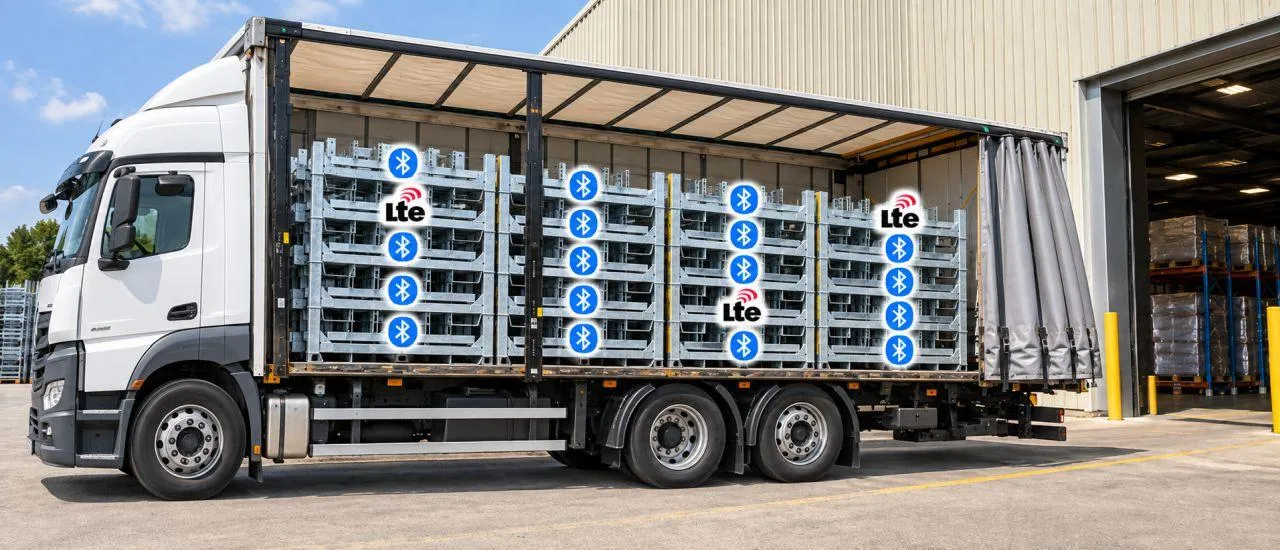
- IoT Invent uses a combination of global LTE and local BLE technologies for scalable asset tracking.
- Sensor data such as temperature and movement enhances condition monitoring alongside location tracking.
- Cloud analytics consolidate tracking data to reveal inefficiencies, idle assets, and inventory imbalances.
Where are containers and load carriers located, how long do cycles take, and where do losses occur? IoT Invent combines global asset tracking, local location tracking, sensor technology, and cloud analytics to make movements traceable and to derive insights for asset management from tracking data. Supply chain visibility means providing transparency into the location, movement, condition, and turnaround times of assets along the supply chain.
The practical questions behind this are simple: Where is a load carrier located? How long has it been at a particular location? Is a container actually following the intended route? Which assets are barely moving anymore? And how many are actually needed for the ongoing process?
For Martin Dobler, CEO of IoT Invent, this is precisely where the real value of asset tracking lies. Wireless technology is indispensable, but for him, it is not the core of the solution.
Dobler sums it up this way:
“The hardware is, after all, just a means to an end.”
IoT Invent at a Glance
IoT Invent was founded in Ismaning, Germany in 2020. The team has more than 20 years of experience with identification and localization applications. The company develops hardware, firmware, and software, focusing on industrial localization and asset tracking solutions.
Among other things, the company focuses on containers, load carriers, and other industrial assets in manufacturing, logistics, and cross-location supply chains.
How Does Asset Tracking Create Transparency in the Supply Chain?
A digital identity alone says little about what actually happens to an asset. For supply chain managers, tracking becomes important when actual movements and dwell times can be traced.
In Dobler’s experience, actual workflows are not always as straightforward as they appear in a planned process. It is therefore crucial to first understand the actual structure of the supply chain: How many locations are involved? Are there logistics hubs? Are containers exchanged directly between the plant and the customer, or do they pass through additional suppliers and intermediate stops?
Dobler describes the effect as follows:
“The interesting thing is that it immediately brings transparency to the process.”
Tracking can, for example, reveal whether a load carrier actually follows the expected route or turns up at a different location. It also allows for the recording of dwell times and unusual deviations within a cycle.
For asset management, this provides a much more meaningful basis than simply knowing that a container has passed through a process point somewhere.
How can assets be located globally and locally?
The required level of accuracy varies along the supply chain.
At a supplier’s site or during long-distance transport, the primary concern may initially be the location of an asset. Within a logistics center or production facility, however, a significantly more precise determination may be required.
IoT Invent therefore combines different levels of tracking. For global applications, the company relies on 4G-LTE with the xTag LTE BLE. Bluetooth Low Energy (BLE) is used for local tracking and positioning. Wi-Fi scanning can also provide location information. For more precise local applications, BLE infrastructure and RTLS functions are available.
As Dobler explains, this architecture can be expanded step by step. A company could first track global movements, then add presence detection within a logistics center, and, if necessary, implement more precise localization within production.
This eliminates the need to set up the same tracking infrastructure everywhere. Rather, the choice of technology depends on what information the specific process actually requires.
How can a large number of containers be tracked cost-effectively?
A key issue in asset tracking is scalability. The larger the number of containers, load carriers, or equipment, the more significant the cost per asset becomes.
IoT Invent therefore combines LTE-enabled trackers with more cost-effective BLE tags. The company refers to this approach as a “swarm solution.”
An LTE/BLE tracker can also function as a mobile or stationary Bluetooth gateway and detect additional BLE tags in its vicinity. The information collected is then transmitted via the existing cellular connection. This feature enables the integration of a “swarm” of cost-effective BLE tags into the system.
According to Dobler, this approach allows the technical equipment to be tailored more precisely to the value, number, and movement profile of the respective assets.
Consequently, not every load carrier necessarily requires the same hardware.
What sensor data is relevant for asset tracking?
For many supply chains, location information alone is not sufficient.
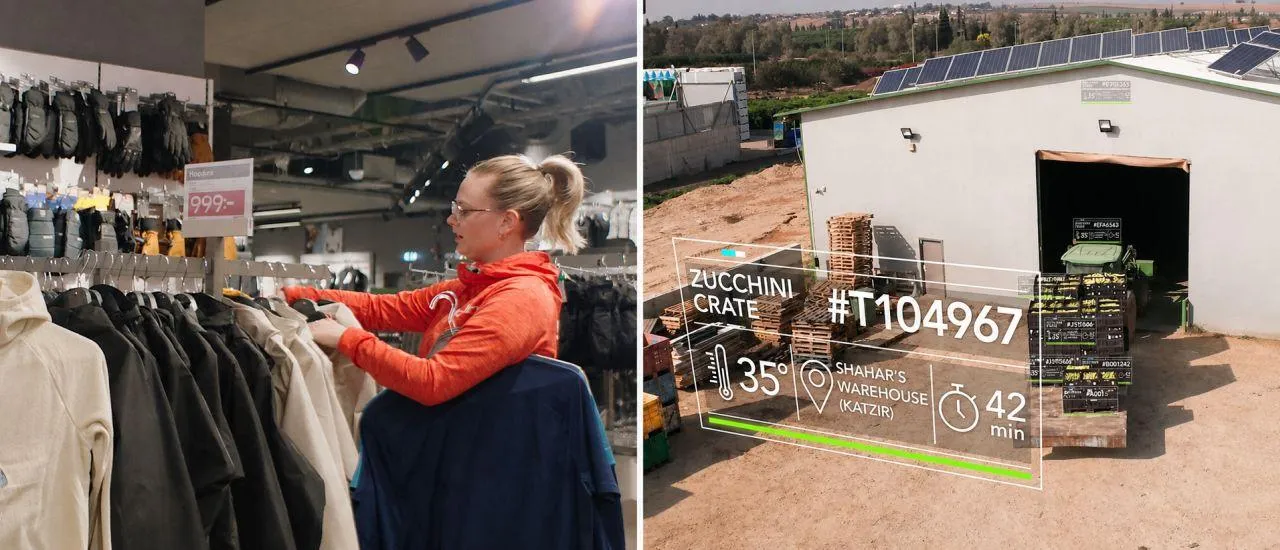
For temperature-sensitive goods or materials, for example, it must also be possible to verify whether defined conditions were met. Movement data can also be relevant for evaluating a process.
Dobler points out that temperature and movement are already among the key sensor metrics for trackers. Humidity or other parameters could be added depending on the specific application.
This is how asset tracking and condition monitoring are intertwined. The operator not only receives information about where an asset is located but can also incorporate additional condition data into the evaluation of the process.
This increases the informational value of tracking data, particularly in longer or international supply chains.
How does tracking data become supply chain intelligence?
For Dobler, the crucial question is not how many points can be displayed on a map. What is far more interesting is what conclusions can be drawn from the movement data.
IoT Invent consolidates the data for this purpose in a cloud environment. There, implausible or erroneous measurements can first be filtered out. Based on the remaining information, container and asset cycles can then be analyzed.
Dobler describes one possible result in very concrete terms:
“You have 10 percent of your assets here. They aren’t moving at all.”
His project experience also shows that analyses can reveal when assets are in the wrong cycles or when the existing inventory exceeds the actual required quantity, including a defined safety reserve.
This also changes the central question in asset management. It’s no longer just about where an asset is located, but about how it’s used, how long it’s idle, whether it’s moving through the correct cycle, and how many assets are actually needed for an efficient process.
How does asset tracking become asset management?
At this point, localization becomes the foundation for operational asset management.
Concrete decisions can be derived from the movement and inventory data collected. Companies can determine where load carriers are tied up for unnecessarily long periods, which containers need to be returned to other cycles, and whether existing inventory aligns with actual usage.
Accordingly, IoT Invent positions its rtls cloud not merely as a tool for displaying locations. The platform is designed to integrate real-time inventory, tracking, and the control of logistics processes.
Rapid analysis is particularly important to Dobler in this context. Employees at large companies often do not have the time to constantly analyze tracking systems. This makes a visualization in which deviations and key metrics are immediately recognizable all the more relevant.
In this way, asset tracking evolves from a mere location-tracking tool into a source of information for operational decision-making.
Supply Chain Visibility Begins with Two Simple Questions
Complex supply chains connect suppliers, plants, logistics centers, warehouses, production facilities, and customers. With each additional stage, it becomes more difficult to track an asset’s actual movement based solely on individual handoff points.
Global and local tracking, sensor technology, and cloud analytics provide different building blocks for this. IoT Invent aims to bring these layers together within a modular asset-tracking architecture.
Dobler boils the initial question down to two points:
“Where are they? How long will they take?”
For supply chain managers, these questions are just the beginning. The real value emerges when the answers reveal how container cycles, inventory, and assets can be managed more efficiently.