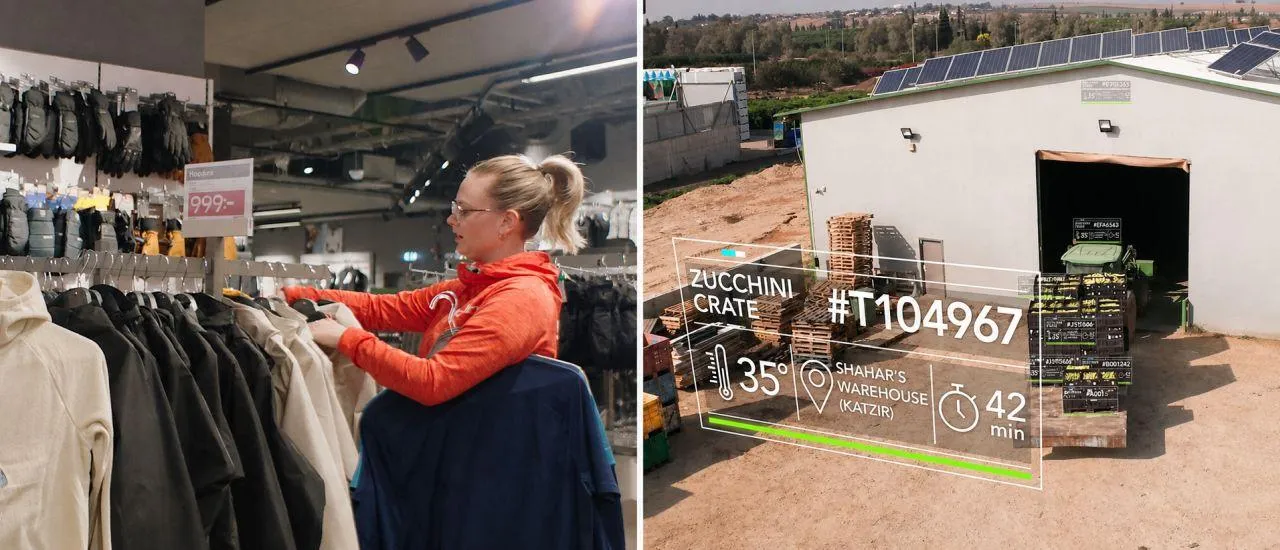

- Walmart plans to track 90 million battery-free Bluetooth-tagged pallets by 2026, demonstrating large-scale BLE deployment at the pallet level.
- Decathlon uses UHF RFID at the individual-item level with established infrastructure supporting retail processes, showcasing mature mass item identification.
- Both UHF RFID and battery-free BLE require RF infrastructure, though BLE can leverage existing ubiquitous Bluetooth radios while UHF RFID is moving toward processor-level integration.
- Physical AI capabilities depend on data capture and analytics architecture rather than the underlying radio technology, with both methods feeding cloud AI systems.
- Battery-free BLE offers new sensing possibilities, such as continuous temperature monitoring, aiming for disposable label economics unlike traditional battery-assisted UHF RFID sensors.
Walmart is scaling Wiliot’s battery-free Bluetooth Ambient IoT while Decathlon shows what UHF RFID already delivers at item level. With UHF RFID moving into mobile processors, the mass-label battle is shifting to infrastructure, sensing, data, openness and cost.
Wiliot is challenging established UHF RFID with battery-free Bluetooth labels, sensing and what the company calls Physical AI. Its comparison paper portrays RFID largely as a checkpoint technology dependent on scans and fixed gates, while Wiliot promises continuous visibility, sensor data and substantially lower infrastructure costs. These are vendor claims and depend heavily on deployment architecture and measurement methodology.
Behind the marketing is a much more interesting question: Can battery-free Bluetooth become a mass-market smart-label technology alongside, or eventually in competition with, passive UHF RFID?
Why This Comparison Matters Now
Walmart: Wiliot targets up to 90 million IoT Pixel-tagged pallets by the end of 2026.
Decathlon: UHF RFID already operates at individual-item level across retail processes.
Qualcomm: Dragonwing Q-6690 integrates UHF RFID into an enterprise mobile processor.
Bluetooth: The radio is already integrated into billions of smartphones, gateways and access points.
AI: Both UHF RFID and BLE architectures can feed cloud analytics and Physical AI. Intelligence is not tied to the radio technology.
UHF RFID Did Not Begin With RAIN
Decathlon began working with UHF RFID in 2008. At that time, there was no RAIN brand. EPCglobal had already published the EPC UHF Gen2 air-interface protocol in 2004. The RAIN Alliance was established only in 2014 and subsequently created an industry identity around passive UHF RFID based on GS1 UHF Gen2 / ISO/IEC 18000-63.
RAIN therefore did not introduce a new physical technology. RAIN RFID is UHF RFID operating with this standardized air interface.
The distinction matters because standardization primarily establishes interoperability. It does not make every RFID system perform equally well. Read reliability still depends on tag and antenna design, materials, liquids and metals, polarization, orientation, reader placement, power and the surrounding RF environment.
The standard provides interoperability. Engineering determines how well the application works.
Walmart and Decathlon Prove Different Things
Decathlon is a benchmark for mature UHF RFID at item level. By 2019, the retailer had extended RFID tagging to its complete product range, supported by infrastructure across manufacturing, logistics and stores. Inventory, receiving and checkout are among the processes enabled by the technology.
Walmart represents a different milestone. Wiliot says its Ambient IoT deployment is expanding toward 4,600 stores and more than 40 distribution centers, with a target of tracking 90 million pallets by the end of 2026. The resulting data is intended to feed Walmart’s AI-driven supply-chain processes.
That is major commercial validation for Ambient IoT, but not yet an equivalent item-level comparison.
Walmart demonstrates battery-free BLE at enormous pallet scale. Decathlon demonstrates UHF RFID at enormous individual-product scale.
RELATED CASE STUDY
RFID-Controlled Supply Chain at Stadium
30 million items were already RFID-tagged at Stadium, while inventory accuracy increased from around 70 to nearly 97 percent. Weekly inventories now take only two to three hours per store.
Read the Stadium UHF RFID case study:


RFID-Controlled Supply Chain at Stadium
Implementing an end-to-end RFID system materially improves retail inventory accuracy, operational efficiency and sustainability across Stadium's distribution and store network.
Is UHF RFID Really Just a Checkpoint Technology?
This is where Wiliot’s comparison becomes too broad.
Continuous visibility is primarily an infrastructure and data architecture question, not an exclusive Bluetooth capability. UHF RFID events can be generated by handhelds, dock-door portals, overhead antennas, smart shelves, conveyor readers or robots. They can then be combined with business context and processed by edge systems, cloud platforms, digital twins, analytics and AI.
The important difference is found lower in the stack, in how the battery-free label is energized and how it communicates.
Passive UHF RFID
UHF reader transmits RF energy → tag harvests energy → reader interrogates tag → tag responds by backscatterBattery-free Wiliot Pixel
Energizing-capable network device transmits RF energy → Pixel harvests energy → Pixel senses/processes → Pixel broadcasts via BLE → Network device receives the transmission
Both architectures therefore require RF infrastructure to make a battery-free label communicate. The fundamental difference is reader-controlled backscatter interrogation versus energy-harvested BLE broadcast.
This can lead to different coverage models, infrastructure designs and frequencies of observation. It does not mean that UHF RFID cannot support continuous or near-continuous visibility when sufficient reader coverage is deployed.
BLE’s Infrastructure Advantage Is Real, but Not Absolute
Bluetooth has a major strategic advantage: BLE radios are already embedded in smartphones, tablets, computers, gateways and many Wi-Fi access points.
UHF RFID traditionally requires specialized reader hardware. But this distinction is starting to change.
Qualcomm’s Dragonwing Q-6690 integrates UHF RFID reader functionality directly into an enterprise mobile processor alongside technologies including 5G, Wi-Fi, Bluetooth and UWB. The Chainway MC80, introduced in the DACH region by IDCRAFT, demonstrates this processor-integrated approach in practice.
That does not suddenly make every smartphone a UHF RFID reader. RF front-end and antenna engineering remain necessary. But it marks an important development: UHF RFID is beginning to move from add-on reader modules toward processor-level integration.
Bluetooth has the much larger mobile installed base today. Whether that remains a decisive structural advantage is less certain.
TECHNOLOGY DEEP DIVE
UHF RFID Moves Into the Mobile Processor
The Chainway MC80 uses Qualcomm’s Dragonwing Q-6690, integrating the UHF RFID reader directly into the application processor alongside 5G, Wi-Fi 7, Bluetooth 6.0 and optional UWB.
See the processor-integrated UHF RFID architecture.
Wiliot Also Needs Infrastructure
The statement “Bluetooth is already everywhere” can suggest that Ambient IoT requires virtually no dedicated infrastructure. That is not the case.
Wiliot uses bridges and gateways to receive BLE transmissions and to provide RF energy for nearby Pixels. Data can then be forwarded through existing network connectivity such as Wi-Fi, Ethernet or cellular networks.
The comparison is therefore not between an RFID reader and a reader-free Bluetooth architecture. Both approaches require RF infrastructure. The difference is how that infrastructure interacts with the battery-free label: UHF RFID uses dedicated readers to energize and interrogate tags, while Wiliot combines RF energizing with BLE-based data reception.
BLE can potentially reuse more existing network hardware. UHF RFID provides a highly optimized infrastructure specifically engineered for bulk identification.
Actual infrastructure cost depends on read-zone requirements, building geometry, tag density, existing networks and the application itself. Wiliot’s claim that its infrastructure can cost around one tenth as much as RFID should therefore be understood as a vendor claim, not as a generally applicable technology ratio.
Physical AI Is Not a Bluetooth Feature
Wiliot links its Pixels to a cloud platform in which software, ML and AI derive information such as movement, dwell time, inventory changes or temperature excursions.
That is one possible Physical AI architecture. But the intelligence layer is independent of BLE.
From Wireless Label to Physical AI
A wireless label identifies an object and generates identity, location or sensor data. Software adds process context, while edge or cloud systems analyze the information, predict relevant events and trigger actions in ERP, WMS, MES or other automation systems.
None of these six steps belongs exclusively to Bluetooth or UHF RFID. The competitive difference lies in how efficiently, frequently and economically the physical-world data can be generated.
This is where Wiliot’s proposition becomes more interesting: Can battery-free BLE labels produce sufficiently rich and frequent data to make AI-driven decisions practical across very large populations of objects?
RELATED INTERVIEW
How RFID and BLE Feed Real-Time AI in the Supply Chain
Ashley Burkle, Director of Sales and Business Development at Identiv, explains why AI in the supply chain depends on timely, high-quality physical-world data. The interview looks at how RFID and BLE can work together to create scalable visibility and turn goods movements into actionable intelligence.
Read the interview with Ashley Burkle:

Temperature Shows Where the Technologies Diverge
Wiliot Pixels combine battery-free operation with temperature and other sensing functions. But sensing is not new to UHF RFID.
Passive UHF RFID chips and labels with integrated temperature sensing have existed for years. The important distinction is between sensing and autonomous logging.
A passive UHF sensor can measure temperature when sufficient reader energy is available. A logger that continues measuring and storing values while no reader is present needs energy for the sensor, timer and memory. This is why sophisticated UHF RFID temperature loggers often use battery-assisted architectures and are considerably more expensive than ordinary passive identification labels.
Wiliot takes a different approach: harvesting RF energy, sensing without a conventional battery and sending data via BLE.
Its technological argument is therefore not that RFID cannot sense temperature. It is the attempt to move repeated sensing closer to the economics and form factor of a disposable mass-market label.
BATTERY-FREE BLE IN PRACTICE
Shufersal Tracks Vegetable Crates With Wiliot Pixels
Shufersal deployed Wiliot Pixels on reusable vegetable crates to monitor location and temperature across the fresh-food supply chain.
See the Shufersal Wiliot deployment:


Two Open Radio Technologies, Two Different Ecosystem Strategies
The ecosystem debate also deserves closer examination.
UHF RFID is built on a standardized air interface and a broad ecosystem of competing chip, tag, reader, antenna, middleware and software suppliers. This allows companies to combine products from different vendors within the same system instead of depending on a single supplier. The RAIN Alliance provides a common industry identity for this ecosystem, while the underlying communication between tag and reader remains based on an open standard.
Wiliot also builds on an open and globally established radio technology, Bluetooth LE. However, the architecture above the radio layer is more vertically integrated. Wiliot Pixels, their encrypted communication, infrastructure integration and the Wiliot cloud platform form a closely connected system.
The distinction is significant:
UHF RFID / RAIN
Open standardized air interface + broad multi-vendor hardware and software ecosystemWiliot
Open Bluetooth radio + proprietary battery-free sensing and cloud platform
It would go too far to characterize either side as creating a monopoly. But both illustrate how companies and industry alliances seek to establish market positions around technologies whose underlying radio interfaces are standardized.
For users, therefore, openness is not only a question of the radio standard. It is also about hardware choice, data ownership, APIs, cloud dependency and future migration options.
Does Bluetooth HDT Change the Equation?
Bluetooth itself continues to evolve. Bluetooth High Data Throughput, HDT, is expected to increase BLE data rates from currently up to 2 Mbps to as much as 7.5 Mbps.
For battery-free mass labels, that is not the decisive development. Identity, temperature and movement events require little bandwidth.
HDT is relevant because it demonstrates the continuing evolution and investment behind the wider Bluetooth ecosystem. For Ambient IoT, however, the more important advantages remain low-power communication, broadcast operation, a huge receiver installed base and integration into existing network devices.
BLUETOOTH TECHNOLOGY UPDATE
Bluetooth LE High Data Throughput Targets 7.5 Mbps
Bluetooth HDT introduces a new PHY with data rates of up to 7.5 Mbps. It is not essential for low-data-rate Ambient IoT labels, but shows how quickly the broader Bluetooth ecosystem is evolving.
Read the Bluetooth HDT technical analysis.
UHF RFID vs. Battery-Free BLE at a Glance
Question | Passive UHF RFID | Battery-Free BLE / Wiliot |
|---|---|---|
Mass item identification | Highly mature | Emerging |
Item-level retail deployment | Proven at very large scale | Still developing |
Battery-free | Yes | Yes |
RF infrastructure | Dedicated UHF infrastructure | Energizing + BLE reception |
Smartphone ecosystem | No broad native support today | BLE ubiquitous |
Processor integration | Emerging | BLE established |
Bulk inventory | Core strength | Continuous-detection approach |
Condition sensing | Specialized tags available | Central proposition |
Autonomous temperature history | Often battery-assisted | Energy-harvesting approach |
Cloud and AI | Architecture-independent | Integral to Wiliot proposition |
Multi-vendor ecosystem | Very broad | Narrower today |
Deployment maturity | Decades | Large-scale expansion underway |
The Real Competition Has Only Just Started
Wiliot’s strongest argument is not that UHF RFID is obsolete. It is that digital identity becomes more valuable when it is continuously enriched with information about where an object is, whether it moved and what condition it is in.
UHF RFID’s counterargument is equally strong. It already provides extremely cost-efficient battery-free identification at massive item scale within a mature and highly competitive supplier ecosystem.
Walmart now demonstrates that battery-free Bluetooth Ambient IoT can enter very large enterprise deployments. Decathlon demonstrates that UHF RFID already works at universal individual-item level across retail processes.
The decisive question is therefore not whether Bluetooth will replace RFID.
What happens when battery-free Bluetooth labels approach the price, production volume and ecosystem maturity of today’s passive UHF RFID labels?
UHF RFID already owns mass-scale digital identity. Battery-free Bluetooth is competing to extend mass labeling toward physical-world sensing.
The real contest is no longer simply RFID versus Bluetooth. It is about which architecture can generate the most useful physical-world data at mass-label economics, with the least infrastructure and the greatest freedom for the user.