
- Wireless assistance systems detect when residents with dementia cross predefined safety zones and trigger alerts to caregivers.
- The technology allows residents freedom of movement within safe areas, activating protections only at critical transition points.
- Care facilities must balance safety measures with respect for residents' autonomy and legal requirements related to restrictions.
- Successful implementation depends on integrating technology with clear procedures, staff training, and data protection compliance.
Wireless assistance systems detect critical situations early on, support caregivers, and give people with dementia greater freedom of movement.
Protecting people with dementia without unnecessarily restricting their autonomy is a key challenge for care facilities. Editor-in-Chief Anja Van Bocxlaer spoke with Martin Hartwigsen, Business Development Manager at deister electronic, about how RFID-based assistance systems detect critical situations early on, relieve the burden on caregivers, and at the same time allow for greater freedom of movement.
When a Perceived “Runaway” Is Actually a “Run-Toward”
A resident leaves her room, walks down the hallway, and heads toward the exit. Perhaps she believes she needs to pick up her children. Perhaps she is looking for her former home or wants to return to a job that hasn’t existed for decades.
What appears from the outside to be aimless wandering often follows its own internal logic for the person involved. Experts are therefore increasingly referring to this as a tendency to walk toward a destination. People with dementia aren’t simply running away. They are often searching for a familiar place, a former job, or a loved one. Their behavior is an expression of a need, not a conscious misbehavior.
This presents a difficult challenge for care facilities: they must prevent dangerous situations while at the same time preserving residents’ freedom of movement.
“Effective wandering prevention doesn’t start at the front door. It begins with the question of how much freedom a person can continue to have and at what point an individual risk actually arises.” — Martin Hartwigsen
More People with Dementia, Growing Need for Protection
According to estimates by the German Alzheimer’s Association, approximately 1.84 million people with dementia were living in Germany at the end of 2023. Without significant progress in prevention or treatment, this number could rise to between 2.3 and 2.7 million by 2050.
Consequently, the number of people who require individual protection due to disorientation is also expected to grow.
The reasons for leaving one’s living area can vary widely:
Disorientation
searching for their former home
the desire to go to work or to see family members
the urge to move
Fear or inner restlessness
Overwhelm in an unfamiliar environment
Not everyone with dementia exhibits a tendency to wander. However, if this behavior is observed, the individual’s risk must be carefully assessed and regularly reevaluated.
A few minutes can make all the difference
Especially in the evening and at night, a small number of caregivers often look after many residents at the same time. Even a brief period without supervision can be enough for a person at risk to leave a living area, enter a stairwell, or reach an unsecured outdoor area.
In cold or hot weather, heavy traffic, or unfamiliar surroundings, a movement that goes unnoticed at first can quickly turn into a serious danger.
If it is not noticed until later that a resident has left the facility, several staff members often have to begin searching at the same time. This ties up staff, increases stress, and causes anxiety among family members. Added to this are documentation requirements and potential liability issues. It is not possible to reliably quantify how often such incidents occur in Germany, as there are neither official statistics nor a central reporting registry.
“Technology cannot replace attention or personal care. However, it can provide caregivers with exactly the extra reaction time that makes all the difference in a critical situation.” — Martin Hartwigsen
Safety Must Not Automatically Mean Restriction
Even people with progressive dementia retain their fundamental rights. Care facilities must therefore always weigh the duty to protect against self-determination, freedom of movement, and proportionality on a case-by-case basis.
Measures that restrict freedom, such as physical restraints or doors that are locked regularly or for extended periods, are permitted only under strict conditions. Depending on the specific measure, its duration, and the resident’s capacity to consent, approval from a guardianship court pursuant to Section 1831 of the German Civil Code (BGB) may be required.
Technical assistance systems can reduce risks without indiscriminately restricting the freedom of movement of all residents. However, their use must also be assessed on a case-by-case basis and designed in compliance with data protection regulations.
The guiding principle of modern care is therefore: As much freedom as possible, as much safety as necessary.
Protection is provided at critical transition points
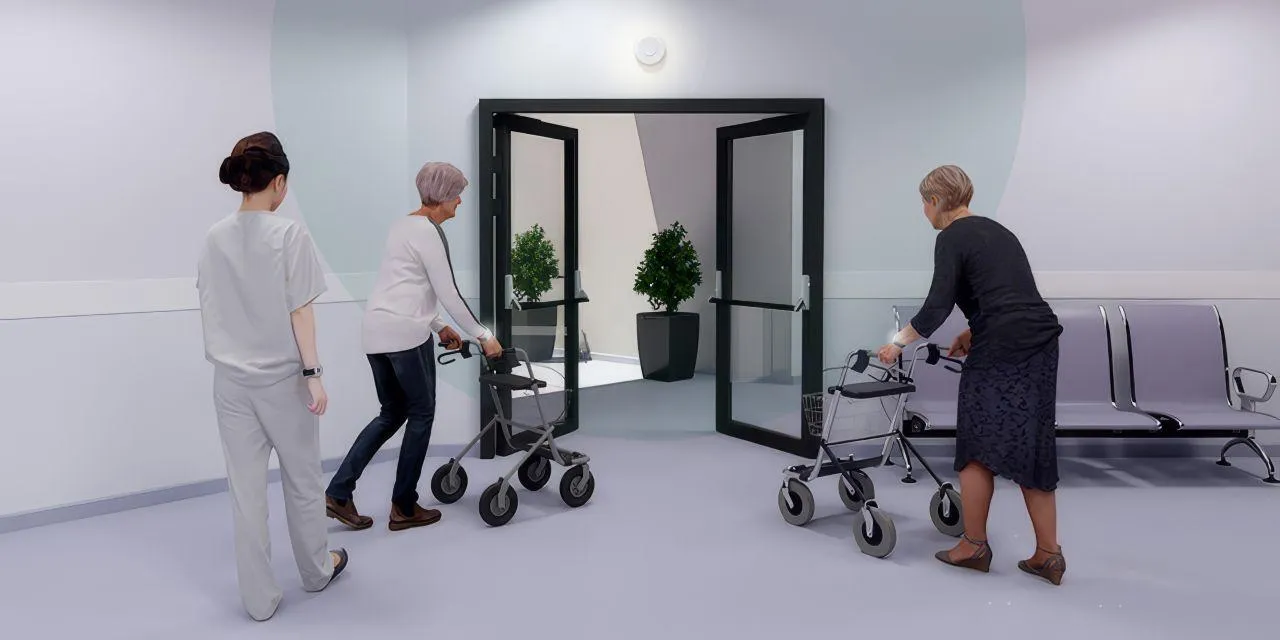
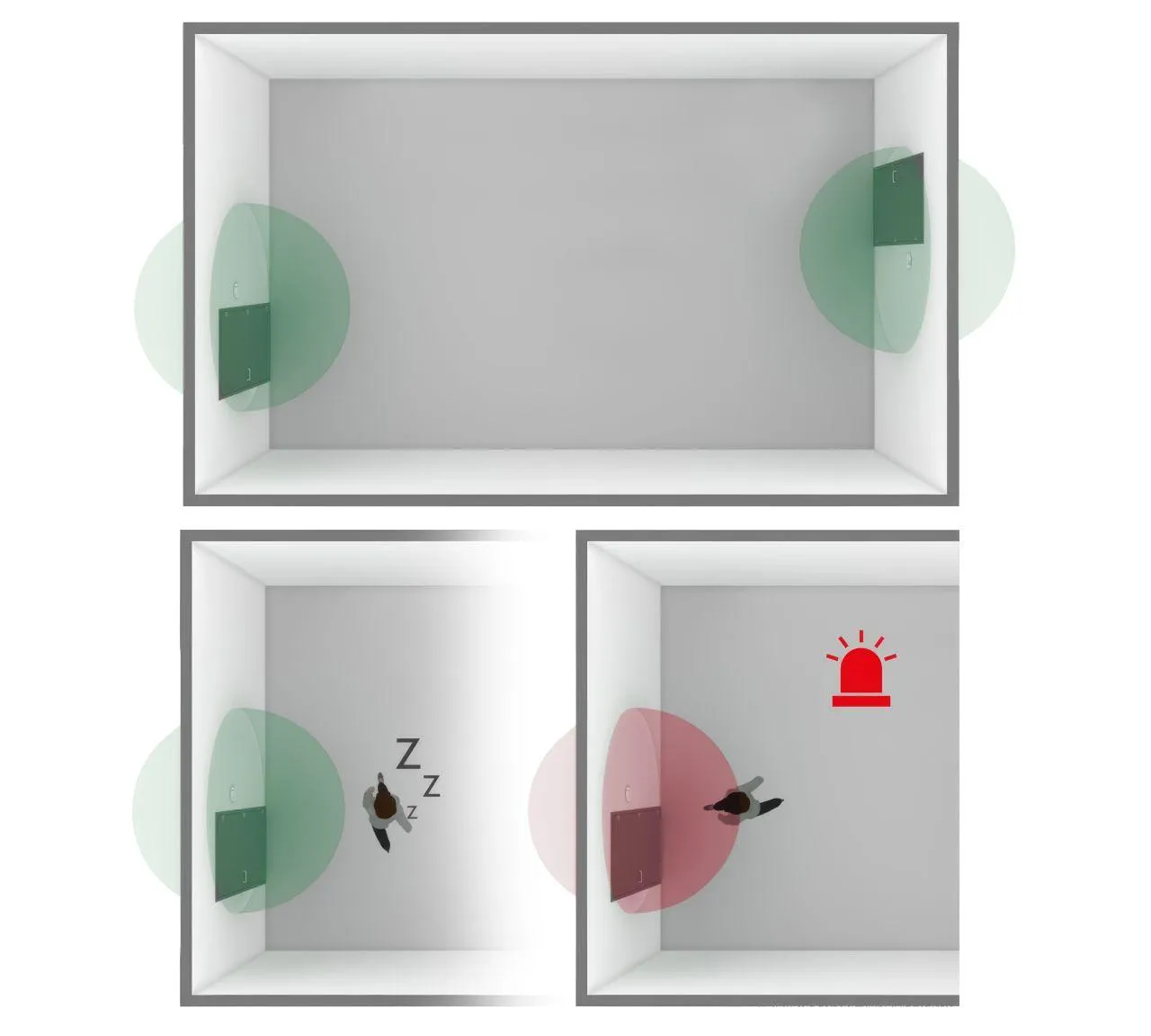
Wireless wander-prevention systems typically combine a body-worn transponder with reading points at designated doors, passageways, or hazardous areas.
This does not require the person to be monitored continuously and without interruption. Depending on the chosen system architecture, the technology specifically detects when an assigned transponder enters or crosses a defined safety zone.
The system can then automatically trigger an alert. This appears, for example,
directly on-site,
in management software,
on a mobile device, or
in a connected call, alarm, or control center system.
This allows caregivers to respond before an unnoticed movement turns into an acute danger.
For residents, this ideally means they can continue to move freely within areas that are safe for them. A protective process is triggered only when an individually defined boundary is reached.
Not every facility needs the same system
Buildings, living areas, and organizational processes vary considerably. Therefore, there is no single technical architecture that is equally suitable for every care facility.
Generally, two approaches can be distinguished.
1. Active transponders for continuous location information
Active—or continuously transmitting—transponders broadcast their identifier at short intervals. With the appropriate infrastructure, this enables continuous tracking. Location data is available regularly; however, continuous transmission places a greater strain on the battery.
2. Semi-active transponders for defined protection zones
Semi-active standby transponders do not transmit continuously when in standby mode. They are activated only when within the radio range of a defined reading point. This enables long battery life while simultaneously reducing radio activity within the building.
Which option makes sense depends on the desired level of security. For some facilities, it is sufficient to secure individual exits or stairwells. Others require multiple security zones or additional information about movements within the building.
“The best solution isn’t automatically the one with the most features. What matters is that it fits the facility’s specific security needs, the building, and its operations.” — Martin Hartwigsen

From Local Warning Lights to a Central Alarm Platform
A modern runaway protection system should be designed to be modular and expandable later on. Depending on the existing infrastructure, it can
operate independently with local audible and visual alarms,
be connected to central management software, or
communicate with existing call, alarm, and control center systems via interfaces such as ESPA-X.
Door controls or electronic access control systems can also be integrated, depending on the configuration. This allows a door to be conveniently unlocked for authorized individuals. If, however, a person at risk approaches, the system triggers an alert or initiates a predefined protection process.
This is particularly important for facilities that already have nurse call systems, electronic door hardware, or central alarm platforms. Flexible integration protects existing investments and enables a phased expansion.
An alarm alone does not constitute a security concept
A technical system is only as reliable as the processes into which it is integrated. Therefore, the following must be clarified before commissioning:
Who receives an alert? Who responds first? What happens if a caregiver is currently occupied? How is an incident documented? And who regularly checks the functionality of the transponders and reader points?
Radio coverage areas must also be planned and tested on-site. Battery levels should be monitored, and responsibilities for maintenance, alarm handling, and technical failures should be clearly defined.
Only the interplay of technology, trained staff, and clear procedures creates reliable safety.
“Wander prevention is not a single product that is simply installed on a door. It is a coordinated process involving radio planning, alerting, responsibilities, and the appropriate responses from staff.” — Martin Hartwigsen
Data protection must be incorporated into the planning
Alarm and motion events may contain personal data. Therefore, it should be determined as early as the planning phase
what data is actually needed,
who is authorized to access it,
how long it will be stored, and
how access and events are documented.
Role-based access rights, secure system connections, and coordinated consent and authorization frameworks are essential components of data protection-compliant operations.
The following principle applies: Not every technical capability needs to be utilized. A system should only collect and process the information necessary for the respective security process.
The transponder can do more than just trigger an alarm
Some systems enable two-way communication. Residents can press a button to request help themselves and receive confirmation—for example, via a visual signal—that the call has been triggered.
When used in conjunction with electronic door hardware, the transponder can also activate individual door access permissions. The door can then be opened without a mechanical key. This makes daily life easier for people who have difficulty using a key.
As a result, the transponder evolves from a mere alarm device into a personal assistance tool that can combine protection, comfort, and independence.
More Time for Personal Care
Technical assistance does not replace empathy or human care. However, it can relieve caregivers of the burden of having to constantly monitor high-risk doors and areas.
As a result, residents gain freedom of movement and independence. Caregivers gain additional time to respond. Family members gain peace of mind because their loved ones are protected without their daily lives being unnecessarily restricted.
“Technology is successful when it works reliably in the background, thereby creating more space for what care is all about: personal care, closeness, and human attention.” — Martin Hartwigsen
Conclusion: Safety Through Targeted Information Rather Than Blanket Restrictions
Demographic change will continue to pose challenges for long-term care facilities in the coming years. At the same time, demands for quality, documentation, and person-centered care are increasing.
Intelligently designed wandering prevention systems can make an important contribution. When used correctly, they combine flexible system architectures, early alerts, maximum self-determination, and integration into existing infrastructure.
Their greatest benefit does not lie in completely preventing movement. Rather, they enable critical situations to be identified early and allow for targeted responses.
This results in greater safety for residents, reduced strain on staff, and increased trust among family members.