

- Thin UHF RFID antennas enable integration into tight industrial spaces while supporting precise tag reading in complex environments.
- Antenna geometry and placement critically affect the reading zone and the reliability of object identification on automated conveyor systems.
- Metal structures and materials in manufacturing environments influence UHF signal propagation, necessitating careful antenna configuration and testing.
- Integration of RFID data with manufacturing execution and management systems enhances production visibility and process optimization.
Precise reading zones, limited installation space and metal-intensive environments present challenges for RFID in manufacturing. Thin UHF RFID antennas offer new integration possibilities – but reliable identification requires more than a compact design.
In automated factories, workpieces, material carriers and components move between machines, conveyor systems and processing stations. To coordinate these processes, production systems need reliable information about which object has arrived at which location. RFID enables automatic identification without requiring employees to scan each item manually.
Yet integrating RFID into existing machinery is not always straightforward. Conveyor belts run close together, metal structures influence radio signals, and installation space around machines is often limited. Even when an RFID reader successfully detects a transponder, the information may be of little use if the system cannot reliably assign it to the correct production step.
The challenge is not simply to read an RFID tag, but to read the right tag at the right place. Antenna geometry and positioning play an important role in achieving this.
Thin, elongated UHF RFID antennas, such as those developed by Czech technology company BARCO under its FlexiRay brand, provide alternative ways to integrate identification into industrial equipment. Their development illustrates how RFID hardware can be adapted to the requirements of manufacturing processes.
Two Conveyor Belts, One Identification Challenge
An early application in the food industry demonstrates why antenna design matters.
In 2009, FlexiRay worked on an RFID project for Czech bakery Penam to track plastic crates containing finished goods. The production environment presented two challenges: limited installation space and conveyor belts operating close together.
Conventional antennas were difficult to position without also detecting RFID tags on neighboring conveyor lines. The challenge was not insufficient reading distance, but reliably distinguishing between crates moving along adjacent conveyors.
“The Penam project challenged us to develop a particularly thin, 3 mm RFID antenna with an elongated design that could fit into the limited space between conveyor lines while reliably identifying the right tags. By adapting the antenna’s dimensions and reading characteristics to the application, we laid the foundation for what would later become our FlexiRay ultra-thin antenna portfolio,” says Miroslav Jakšík, Managing Director of FlexiRay.
The antenna developed for Penam was the predecessor of today's SF5400. Measuring just 3 mm in thickness and approximately one meter in length, it was installed alongside the conveyor belt. Its design created a concentrated reading zone extending approximately one meter along the conveyor, ensuring that tagged crates were detected while preventing unwanted cross-reads from the adjacent line.
The application illustrates why RFID antenna selection depends on the production environment. While a warehouse portal may require a broad reading area, closely spaced conveyor lines demand more selective identification. Increasing the reading distance can introduce unwanted detections rather than improve the result.
Why Antenna Geometry Matters
Traditional UHF RFID installations frequently use rectangular patch antennas. Their dimensions and radiation characteristics make them suitable for many industrial applications, but they may be difficult to accommodate in narrow machine structures or alongside conveyors.
Thin antennas use a different form factor. Their elongated construction allows them to be positioned along machine profiles, conveyor frames, protective enclosures or other areas offering little installation depth.
FlexiRay's SF5 and SFR5 antenna families illustrate the available designs.
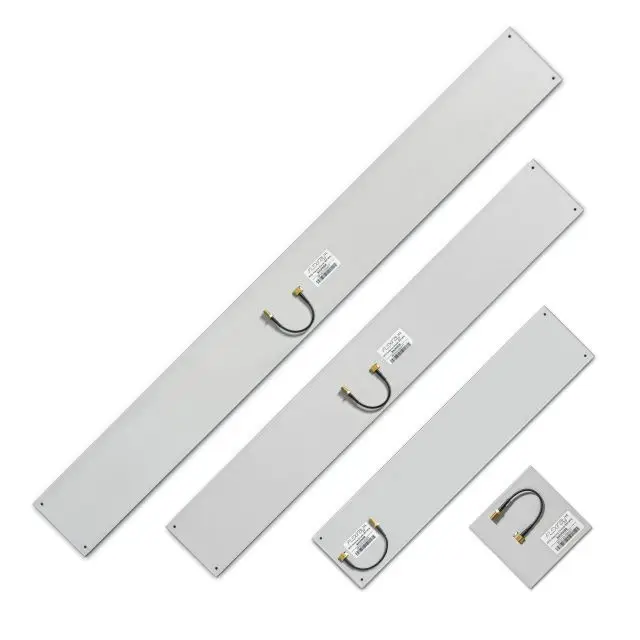

The ultra-thin SF5 series has a thickness of just 3 millimeters and is available in lengths ranging from 110 to 996 millimeters. The more rugged SFR5 series features a 14-millimeter profile, IP65 protection and lengths from 134 to 1,020 millimeters. All FlexiRay antennas feature right-hand circular polarization (RHCP).
Both are passive UHF RFID antennas, connected to compatible readers through coaxial cables. They do not require a separate electrical power connection at the antenna itself.
The different lengths provide options for adapting the antenna arrangement to a particular machine or identification point.
However, a slim housing does not automatically produce a narrow reading zone. Antenna geometry influences the radiation characteristics, but the actual area in which tags can be detected depends on the complete RFID configuration.
Reader power, antenna orientation, transponder sensitivity, tag positioning and the surrounding materials all affect reading performance.
For European variants, FlexiRay specifies antenna gains of approximately 2 to 7.8 dBi, depending on antenna length. Depending on the application, the SFR5 series offers reading distances of approximately 7 to 11 meters. These figures indicate the capabilities of the antenna family, not guaranteed performance in a production environment.
RFID Between Metal Structures and Moving Machinery
Manufacturing environments place particular demands on radio-frequency systems.
Machine frames, conveyor structures, steel components and metal enclosures can reflect or shield UHF signals. The resulting field distribution may differ significantly from the behavior of an antenna in open space.
Thin antennas can make it easier to find suitable installation positions, especially where conventional housings would interfere with machinery or require structural modifications.
An antenna mounted directly against metal may behave differently from the same antenna installed on a non-metallic surface. FlexiRay offers configurations intended for different mounting conditions, including installations on or away from metal, but the suitability of a particular arrangement must be verified.
Other factors also influence reliability. Metal workpieces may require specialized on-metal transponders, while liquids and water-containing materials can affect UHF propagation. On moving conveyors, the available reading time depends on transport speed and the effective detection area.
For these reasons, antenna placement, tag selection and reader configuration should be evaluated together.
A thin antenna creates additional installation options. Whether those positions provide reliable identification must be established through testing with the actual machinery, materials and operating conditions.
Connecting Identification with Production Processes
The value of RFID in factory automation becomes apparent when identification data is connected to manufacturing operations.
At a defined reading point, an RFID reader captures the identifier of a tagged workpiece or material carrier. Software assigns the reading event to the corresponding location or process step and forwards the information to the relevant systems.
Depending on the application, this may involve programmable logic controllers (PLCs), manufacturing execution systems (MES), warehouse management systems (WMS) or enterprise resource planning (ERP) software.
Such integration can support material flow tracking, production documentation, automated routing decisions and workstation monitoring.
The implementation at IVECO Czech Republic provides a practical example.
In the company's bus paint shop, frames move between multiple workstations. Previously, employees identified them through manual barcode scanning, which limited the availability and accuracy of production status information.
BARCO implemented a UHF RFID system using FlexiRay technology. RFID transponders identify individual bus frames, while readers and antennas installed at transfer stations automatically capture their movements.
The identification data is transmitted to production planning and visualization software. This provides information about the position of each frame, its movement between workstations and the progress of the associated production order.
The system also monitors workstation occupation times. If a frame remains at a station longer than scheduled, an automatic notification helps production personnel identify potential delays.
“The RFID implementation has improved the accuracy of our work-in-progress data, increased visibility into production flows and helped us make better use of workstation capacity,” says Jan Beránek, Head of Paint Shop at IVECO Czech Republic.
The project demonstrates what RFID can contribute beyond the identification event itself: information about physical material movements becomes available for production planning and operational decisions.

Retrofitting RFID into Existing Equipment
Retrofitting RFID into existing production equipment requires attention to mounting conditions, cable routing and connections to existing control systems. Even with thin antennas, connectors, mounting brackets and the minimum bending radius of coaxial cables must be considered when determining the required installation space.
The software architecture presents a separate challenge. A passive RFID antenna does not communicate directly with production control systems. It requires a compatible reader, which processes the captured signals and provides identification data through its interfaces or connected middleware.
Protocols such as OPC UA, MQTT or industrial fieldbus connections depend on the selected reader and software rather than the antenna itself.
Which architecture is appropriate depends on the existing automation infrastructure, the required reading performance and how the identification data will be used.
Reliable Identification Starts with the Application
When upgrading an existing RFID installation, antennas, transponders and readers should be checked for compatibility and performance. Since RAIN UHF RFID uses a standardized air interface, existing readers and transponders can often remain in place. Depending on the installation, replacing the antenna may be sufficient to achieve the required reading characteristics.
“Thin RFID antennas give us more flexibility to integrate identification into existing machinery. We don't necessarily need to change the entire RFID system. The important thing is to find the right antenna configuration for the application,” says Miroslav Jakšík, Managing Director of FlexiRay.