
- A-BRID OS integrates printer control with advanced data processing within Toshiba’s BX industrial label printers.
- The platform supports legacy printer languages and direct PDF printing to simplify integration into existing manufacturing systems.
- Print Data Converter allows modifications to print data on the device, reducing the need for ERP or software changes.
- BX printers with A-BRID can incorporate barcode, QR code, and RFID labeling for improved traceability and automation.
Toshiba Tec’s A-BRID platform connects industrial label printers with automated production processes. Integrated data processing, flexible interfaces, and barcode and RFID capabilities facilitate labeling and traceability in manufacturing and logistics.
Industrial Labeling as Part of Factory Automation
In automated manufacturing processes, workpieces, components, materials, and transport containers are identified at numerous stations. Barcodes, QR codes, and RFID transponders link physical objects to digital information from production, logistics, and inventory management.
Labeling often takes place directly on the production line. An ERP system provides order and item data, a Manufacturing Execution System (MES) supplements this with production information, and an industrial label printer uses this data to generate the required labels.
However, integration is not always straightforward, especially in established production environments. Different printer languages, proprietary data formats, and older software generations complicate the replacement of printing systems or the customization of labels.
Toshiba Tec’s A-BRID operating system platform was developed for the new generation of BX industrial barcode and label printers. In November 2024, Toshiba introduced the BX410T as the first model featuring A-BRID. The platform now forms the foundation of the BX printer family, which offers a range of print widths and configurations.
The new architecture combines high-performance printer hardware with integrated software for data processing, communication, and process control. This enables BX printers to take on additional tasks directly on the production line and to integrate more flexibly with existing systems.
A-BRID Combines Print Control and Data Processing
The technical foundation of A-BRID is a dual-core architecture with two operating systems. A real-time operating system controls time-critical printing functions, while a Linux-based environment handles applications, data processing, and communication tasks.
This separation makes it possible to provide additional functions without interfering with the actual print control.
Among other features, the platform offers:
Direct PDF printing: PDF files are processed, automatically scaled, and aligned without the need for additional conversion software.
Automatic printer language detection: Various printer languages are detected and emulated, allowing existing applications to continue to be used.
Print Data Converter: Incoming print data can be modified, supplemented, or converted directly within the printer.
Embedded Applications: Integrated applications enable standalone printing workflows, for example, with connected barcode scanners.
Cloud Management: Printers can be centrally monitored and managed via e-BRIDGE CloudConnect or compatible management solutions.
For factory automation, the combination of data conversion, flexible system integration, and local processing is particularly relevant. It enables adjustments to labeling processes without always having to modify the central production software.

Integrate Existing Production Systems Without Complex Conversions
In many manufacturing facilities, label printers have been running for years using specially developed interfaces and print templates. Changing equipment may therefore require modifications to ERP applications, production software, or printer drivers.
A-BRID supports the automatic detection and emulation of common printer languages. This allows new BX printers to be integrated into existing infrastructures under suitable conditions without having to adapt all printing applications.
Direct PDF printing also simplifies system integration. Label layouts can be transferred directly as PDFs from compatible applications. No additional conversion programs are required.
A particularly interesting feature for industrial production is the Print Data Converter.
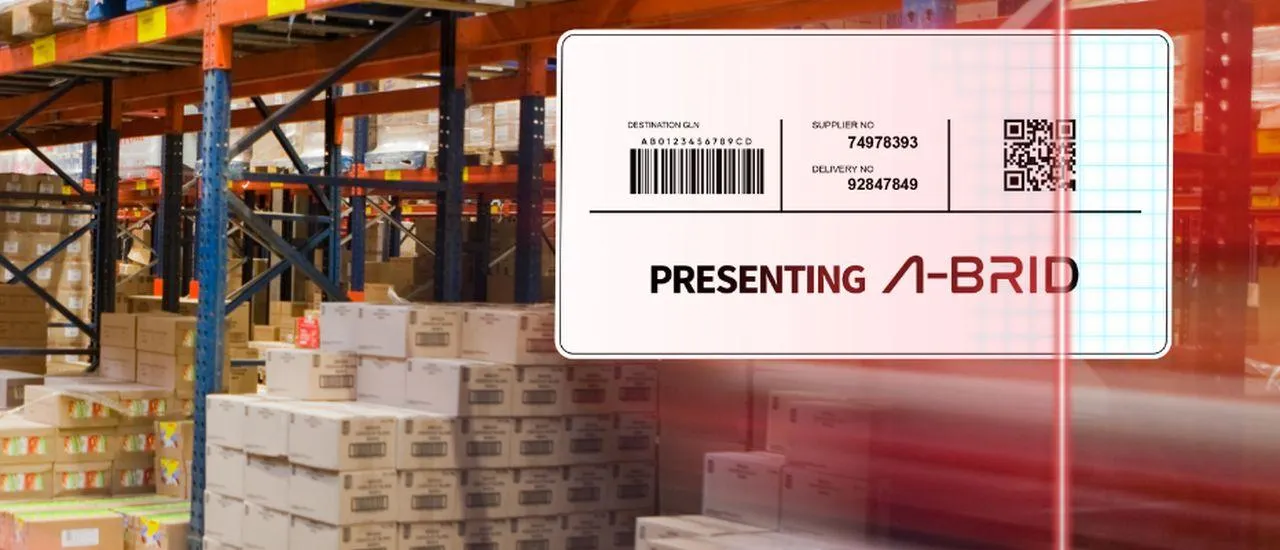
It modifies incoming print data directly within the device. For example, companies can integrate additional data fields, customize label layouts, or add QR codes without having to reprogram the application that generates the print data.
This offers advantages when older production systems can only be modified to a limited extent or when software adjustments would trigger time-consuming testing and approval processes.
This feature can also help implement uniform labeling requirements across multi-site production networks, even when different software solutions are in use.
Barcodes and RFID for Automated Identification
Barcodes and QR codes enable optical identification. RFID complements these methods with contactless data capture without a direct line of sight.
Toshiba BX printers support various identification methods. Depending on the model, they can be equipped with RFID modules to print on smart labels and encode their transponders.
For example, the BX410T offers optional modules for UHF RFID compliant with EPC Gen2, as well as HF RFID compliant with ISO 15693 and ISO 14443 Type A.

This allows for the production of labels that contain both printed information and an electronic identifier. Such combinations are particularly useful in production environments where visual markings and automatic RFID reading systems are used in parallel.
Possible applications include the labeling of workpiece carriers, the tracking of production batches, the identification of packaging units, and the automated recording of material movements.
The BX410T features an integrated RFID analyzer that determines the optimal position for reading and encoding transponders. This simplifies the setup of different RFID labels and increases the reliability of the encoding process.
For companies that have previously relied exclusively on barcodes, this opens up the possibility of integrating additional RFID processes into their labeling infrastructure.
Automated Labeling Directly on the Production Line
A typical application for industrial printing systems is labeling at the end of a manufacturing or packaging line.
As soon as a product has completed a specific production step, the required labeling data is provided. This includes, for example, the item number, production batch, serial number, date of manufacture, or order-specific information.
The BX printer processes the transmitted data and creates the label. The subsequent application can be automated.
For this purpose, Toshiba offers, among other solutions, the APLEX applicator, which can be combined with compatible BX printers. This allows printing and label application to be consolidated within a single production station.

With the integrated applications of the A-BRID platform, printing processes can also be controlled directly on the device. For example, employees can scan a barcode or enter data via a connected keyboard. The printer processes this information and automatically generates the appropriate label—without the need for an additional computer.
This simplifies the setup of compact labeling stations and reduces the number of additional computers and software components on the production line.
Centrally Monitor and Manage Printer Infrastructure
In larger manufacturing facilities, industrial label printers are often deployed across multiple production halls, logistics areas, or locations.
Unified management of these devices is becoming increasingly important as automation grows.
A-BRID supports centralized device management via Toshiba e-BRIDGE CloudConnect. Through this platform, administrators can, among other things, retrieve operational information, manage device configurations, and perform firmware updates.
The transfer of existing configurations to additional devices is also supported.
For manufacturing companies with numerous printing stations, this simplifies standardization and the replacement of devices. New locations or production lines can be set up using existing settings.
Centralized management also supports maintenance, as relevant device information is available without having to check each printer individually on-site.
This allows industrial printing systems to be more fully integrated into the overall management and maintenance of the production infrastructure.
Digital Product Passport: Integrating New Labeling Requirements into Existing Workflows
The European Digital Product Passport (DPP) introduces new requirements for the provision and linking of product-related information.
Depending on the specific product group and applicable regulations, products must in the future be linkable to digital information via suitable machine-readable media.
For industrial manufacturing, this means that existing labeling processes will need to be expanded in some cases. Existing labels may require additional QR codes, unique identifiers, or references to digital product records.
Toshiba A-BRID also offers features to address new labeling requirements related to the Digital Product Passport. The integrated Print Data Converter makes it possible to expand existing label layouts to include QR codes and additional product information without having to modify the underlying ERP or production systems.
Toshiba Tec demonstrates how additional QR codes for the Digital Product Passport can be integrated into existing labeling processes in a practical A-BRID video tutorial.
This flexibility is particularly relevant for automated production lines. New labeling requirements can be accommodated at the printer level, while established data flows and production processes remain largely intact.
Even for products that are already serialized or marked with barcodes or RFID transponders, additional identification features can be integrated.
The BX printer series thus bridges existing industrial marking processes with new requirements for digital product identification.
The full implementation of a digital product passport also involves the provision and management of the necessary product data. A-BRID supports the physical marking process required for this.
Conclusion: Smart Label Printers for Connected Production
With A-BRID, Toshiba Tec integrates data processing, flexible system connectivity, and centralized device management into its industrial BX printers. The platform facilitates the automation of labeling processes and enables adjustments to be made directly on the printer without extensive changes to existing IT systems.
Barcode and optional RFID functions support identification and traceability in manufacturing and logistics. New labeling requirements for the Digital Product Passport can also be integrated into existing production workflows.
Further information and videos on Toshiba A-BRID
Toshiba Tec demonstrates how A-BRID can be used to add QR codes to existing label layouts and integrate new labeling requirements for the Digital Product Passport into automated production processes.