Factory Automation: How Connected Technologies Control the Smart Factory
Factory automation achieves flexible, efficient, and secure manufacturing by integrating connected technologies, real-time data acquisition, wireless communication, and advanced control systems.
- Published: October 21, 2026
- By: Anja Van Bocxlaer
- Read: 8 min
- Factory automation depends on integrated sensors, identification systems, and machine controls for precise process management.
- Wireless technologies mitigate mobility and cabling limitations, enabling more flexible machine and transport operations.
- Data protocols like OPC UA and MQTT facilitate structured and message-based communication across automation layers.
- Condition monitoring and predictive maintenance use sensor data and AI to anticipate equipment failures and optimize tool usage.
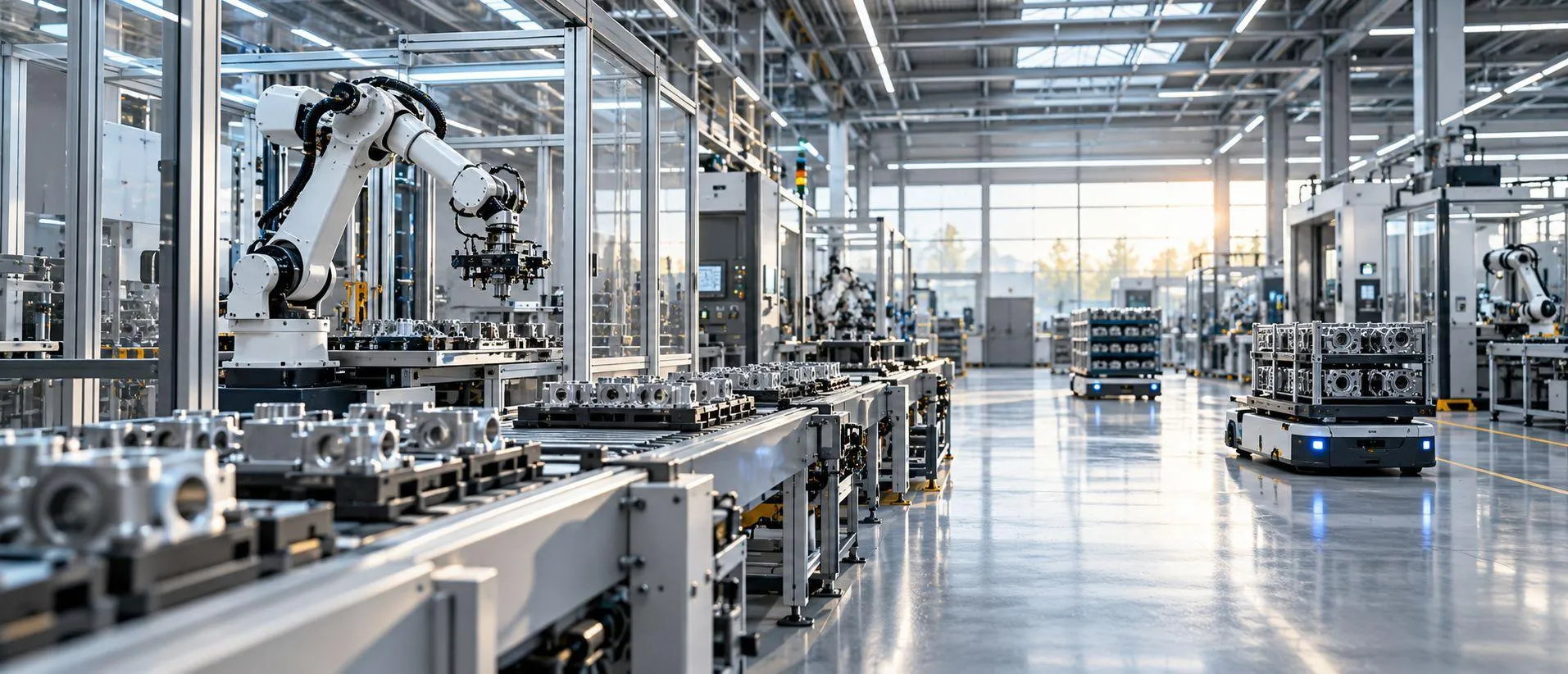
Optical technologies, RFID, positioning, and industrial wireless networks connect machines and workpieces to form flexible production systems.
A production line must continuously answer questions: Which workpiece is in transit, where is it located, and what processing is scheduled? Is it positioned correctly, did the assembly go smoothly, and where should the product go next?
In automated factories, identification and tracking systems, sensors, and cameras provide the necessary information. Control systems translate this information into machine actions, while software links orders, material movements, and results.
Optical methods detect distances, movements, and quality characteristics; RFID links physical objects to digital data; and tracking systems make material flows visible. It is crucial that the right information is available at the right time in the production process.
What is factory automation?
Factory automation refers to the automatic monitoring, control, and optimization of industrial manufacturing processes. To achieve this, machine controls, sensors, identification systems, robotics, and industrial communication networks work together.
Technologies such as RFID, machine vision, RTLS, and wireless IoT provide information about workpieces, machine statuses, and material movements. This data makes it possible to precisely control production processes, automate quality inspections, and efficiently organize material flows.
One Workpiece, Many Decisions
A workpiece is transported to the assembly station. Its position can be detected directly or derived from the position of its load carrier, a forklift, or an autonomous guided vehicle. Real-time location systems (RTLS) use technologies such as Ultra-Wideband (UWB), Bluetooth Low Energy (BLE), or RFID-based methods for this purpose. A prerequisite is that the workpiece and the transport vehicle are uniquely paired—and that the system detects when the workpiece is set down or transferred.
Even as the workpiece approaches, the production system can prepare for the next processing step. At the station, arrival can be confirmed using a photoelectric sensor, an RFID reader, or another sensor. An identification system retrieves the data associated with the workpiece; a camera or position sensor verifies that it is positioned correctly. Only when the necessary conditions are met does the machine control system authorize the processing step.
How Machines Perceive Their Environment
Inductive sensors detect metal parts, photoelectric sensors register the passage of objects, lasers measure distances, and encoders track axis movements. Force, pressure, and temperature sensors provide additional information, such as whether a gripper is holding a component securely or whether a machine is operating within its operating limits.
For more complex tasks, machine vision is also used. A camera captures components laid out in a random arrangement; image processing determines their position and transmits gripping coordinates to the robot controller. After assembly, another camera checks whether components are present and correctly aligned. The inspection result is assigned to the respective order.
Optical systems range from light sensors to 3D cameras. AI-supported image processing can evaluate varying object shapes, surfaces, and defect patterns that are difficult to describe. For inspection to function reliably in everyday production, lighting and image quality must be optimal, and results must be available within the specified cycle time.
Turning Information into Machine Action
Programmable Logic Controllers (PLCs) coordinate the operations of drives, grippers, valves, and machines. Sensors, decentralized I/O modules, and other components are connected via industrial networks such as PROFINET, EtherCAT, or EtherNet/IP. Intelligent sensors can provide not only process values but also diagnostics and settings via the wired IO-Link.
A PLC must take various pieces of information into account: The correct workpiece carrier has been identified, but the camera reports an incorrect position? In that case, machining remains blocked.
Where Wireless Communication Changes the Factory
Wireless technology is particularly useful where data cables restrict movement, are subject to wear and tear, or make retrofitting difficult. This applies to rotating turntables, robotic arms, grippers, and tool changers, as well as mobile manufacturing stations and transport vehicles.
IO-Link Wireless enables the wireless connection of sensors and actuators to the machine controller. Especially for robotic arms, grippers, rotating turntables, or tool changers, this technology can replace moving data cables, thereby reducing cabling effort and mechanical wear. Sensors can, for example, monitor the position of a gripper or the secure fit of a workpiece and transmit their data wirelessly to an IO-Link Wireless master, which forwards it to the machine controller.
Industrial Wi-Fi connects mobile operator terminals, cameras, and vehicles to the factory network. A transport robot can receive orders and report its status to fleet management. Private 5G networks are another option for serving larger areas and many mobile devices with varying communication requirements. DECT NR+ complements these options, particularly for industrial applications that require reliable communication with predictable transmission times, such as overhead monorails or mobile machines.
Other wireless technologies are better suited for different tasks. Bluetooth Low Energy (BLE) can transmit sensor data efficiently or assist with location tracking. Depending on the system, UWB enables precise positioning. LoRaWAN and mioty are suitable for certain widely distributed measurement points with small amounts of data; WirelessHART is primarily used in process automation.
In a factory, metal structures can block radio signals, machines move, and multiple networks operate simultaneously. Therefore, wireless connections must be planned and tested under real-world conditions. Whether they are suitable for a control task depends on how reliably data is received and what delays the process can tolerate.
When Materials Are Automatically Delivered to the Machine
Automated material supply connects manufacturing with the warehouse and internal transport systems. Automated guided vehicles (AGVs) and autonomous mobile robots (AMRs) deliver components and tools to the required stations. Their navigation and safety sensors help them move and detect obstacles; fleet management coordinates the tasks.
When an assembly station reports a material requirement, the production system can trigger a transport order. Wi-Fi or 5G transmits order and status information. RFID or optical labeling links the load carrier to the correct material and production order.
Upon handoff, the station verifies that the delivery is correct and confirms receipt. If the wrong container is detected, the process can be stopped before incorrect parts are processed.
From Machine Control to Production Management
Machine control requires up-to-date process signals; planning and quality management need an overview of orders, equipment, and results. Human-machine interfaces (HMIs) display machine statuses, SCADA systems monitor equipment, Manufacturing Execution Systems (MES) track production orders, and ERP systems connect production with business processes.
For information to be usable across these levels, data must not only be transmitted but also clearly described: From which machine does a measured value originate, to which order does it belong, and when was it recorded? OPC UA supports structured data exchange, while MQTT supports message-based transmission. Both methods can transmit information from wired or wireless networks.
Edge computing processes data close to the machine—for example, when a local industrial PC analyzes camera images and forwards only the inspection result. Higher-level systems can compare long-term trends across multiple plants.
Detecting Machine Conditions Before Problems Arise
Sensors for temperature, current, and vibration reveal changes in motors and machine components. Condition monitoring tracks such status data; predictive maintenance analyzes current and historical information to assess wear and potential failures early on. Wireless sensors can be particularly useful for retrofitting existing systems.
Tools are also included in this transparency. RFID identifies them and links them to service life, machining parameters, or maintenance information. AI-supported analyses can detect patterns in sensor data and camera images. The benefits only become apparent when actions are taken based on this information: a tool is replaced in a timely manner, a machine is inspected, or a process parameter is adjusted.
Reliability and Safety in the Connected Factory
The more closely machines and communication systems work together, the more important secure and robust operational processes become. Functional safety ensures that machines respond appropriately and safely in the event of hazards or errors.
Cybersecurity protects control systems, networks, and production data from unauthorized access; the IEC 62443 series of standards provides an important framework for this.
Sensors, antennas, connectors, and power supplies must also withstand dust, vibrations, moisture, and high temperatures. In potentially explosive atmospheres, additional requirements apply to devices and protective systems, including those specified by ATEX. Where safety-related information is transmitted via radio, the safety concept must also account for interrupted or faulty communication and ensure a safe response.
The Factory as an Integrated, Connected System
Factory automation does not only deliver value in completely newly built production lines. Existing facilities can also be expanded with additional sensors, identification systems, optical technologies, and wireless communication. Modular machine concepts and mobile transport systems also open up new possibilities for designing manufacturing processes more flexibly and responding to changing production requirements.
The interaction of these technologies enables the continuous collection and utilization of information about workpieces, machine statuses, and material movements. This allows production processes to be controlled more precisely, quality inspections to be automated, maintenance measures to be planned more effectively, and material flows to be organized more efficiently.
Increasing connectivity thus lays the foundation for more flexible, transparent, and efficient industrial manufacturing.