

UWB: Precise Positioning, Secure Ranging and the Next Wave of Wireless Sensing
UWB technology is a transformative platform that integrates precise spatial positioning, secure ranging, communication, and advanced sensing capabilities to enable spatial awareness across diverse applications.
- Revised: October 03, 2026
- By: Anja Van Bocxlaer
- Read: 10 min
- UWB achieves centimetre-level positioning accuracy using time-of-flight measurements enabled by wide bandwidth radio pulses.
- Secure ranging capabilities of UWB prevent relay attacks, critical for applications such as digital car keys.
- The IEEE 802.15.4ab amendment introduces new features including UWB sensing for environment mapping and presence detection.
- UWB complements other wireless technologies like Bluetooth LE, Wi-Fi, and RFID by providing precise spatial information rather than replacing them.
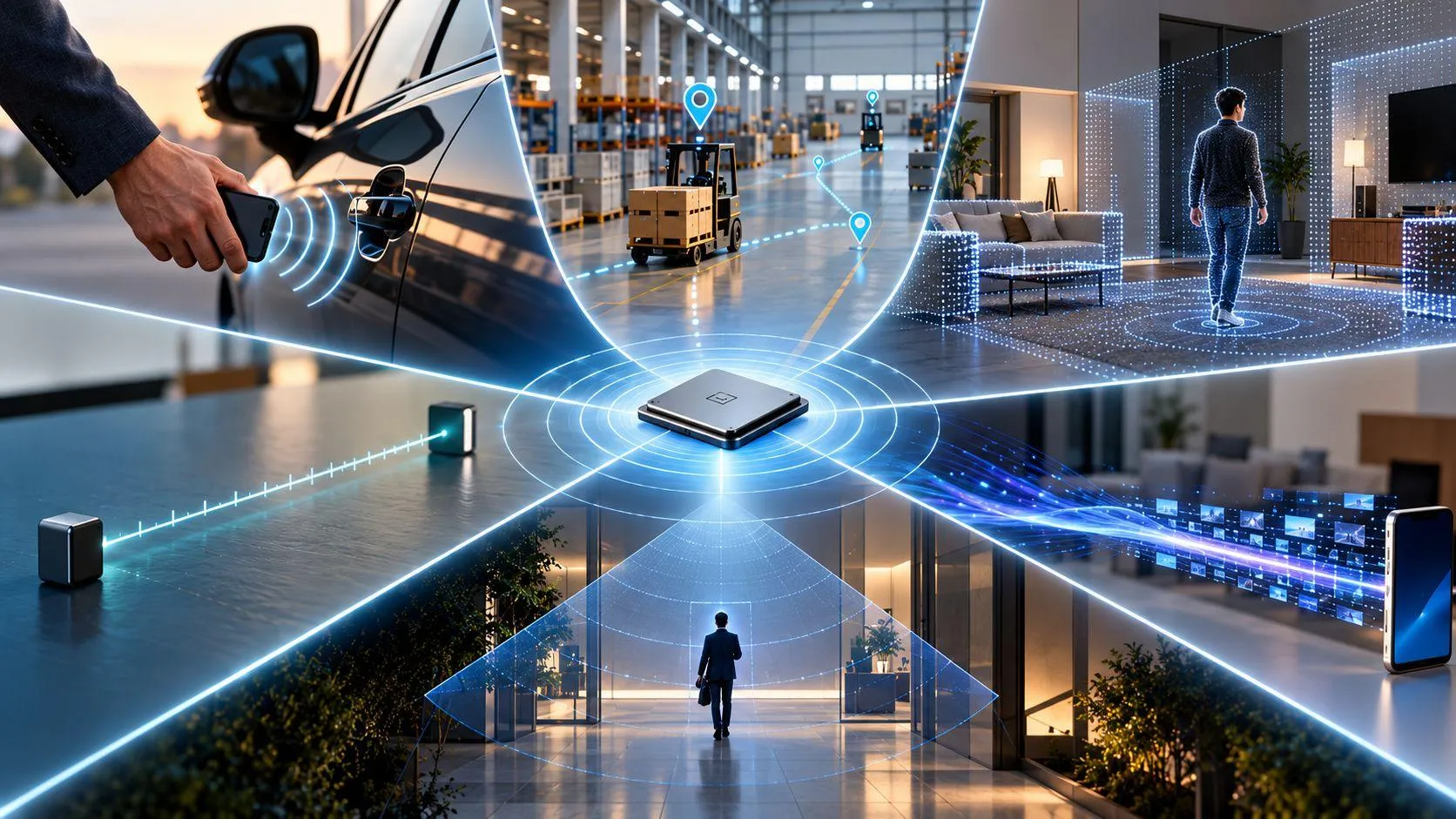
Ultra-Wideband, or UWB, has evolved from a specialist radio technology into one of the key technologies for precise positioning and secure distance measurement. Using extremely short radio pulses across channels at least 500 MHz wide, UWB can determine the distance and relative position between devices with centimetre-level precision.
Today it is used for digital car keys, real-time location systems, asset tracking, access control and indoor navigation. With IEEE 802.15.4ab, UWB is now expanding further into presence detection, environment mapping and radar-like sensing.
The defining difference between UWB and technologies such as Bluetooth LE or Wi-Fi is not simply another frequency band. It is the way the radio signal is generated and measured.
UWB spreads very low radio energy across a very wide bandwidth of 500 MHz or more and uses extremely short pulses, typically measured in nanoseconds. These characteristics allow systems to measure signal travel time extremely accurately and convert it into distance.
That ability gives connected devices something conventional wireless communication was not primarily designed to provide: spatial awareness.
How UWB Measures Distance
Most conventional wireless positioning methods estimate location indirectly.
A Bluetooth beacon system, for example, can infer distance from received signal strength. But signal strength changes when people, walls, machinery or other materials absorb and reflect radio waves. That limits the precision that can be achieved reliably in complex environments.
UWB uses Time of Flight, or ToF. A radio signal travels at approximately the speed of light. If two UWB devices precisely measure how long a signal takes to travel between them, the system can calculate the physical distance.
In Two-Way Ranging, devices exchange packets and measure the round-trip timing. Because UWB pulses are extremely short and use wide bandwidth, the arrival time can be identified very precisely.
Depending on the system architecture, several distance measurements can then be combined to calculate a two- or three-dimensional position.
Fixed UWB devices in an RTLS installation are usually called anchors. Mobile devices attached to assets, tools, vehicles or people are typically called tags.
The result can be real-time positioning with accuracy measured in centimetres rather than metres.
The UWB Frequency Spectrum
Ultra-Wideband describes the width of the transmitted signal rather than one specific frequency. Internationally, UWB can operate across roughly 3.1 to 10.6 GHz, although permitted bands, power limits and application-specific requirements vary by region.
Modern interoperable UWB systems increasingly focus on frequencies above 6 GHz. Two important IEEE UWB channels are:
Channel 5: centered at 6.4896 GHz, covering roughly 6.24–6.74 GHz
Channel 9: centered at 7.9872 GHz, covering roughly 7.74–8.24 GHz
Both use about 500 MHz of bandwidth. Channel 9 is especially important for automotive and other globally interoperable applications because of its broad international availability.
In Europe, ETSI defines application-specific requirements for UWB use, including spectrum within 3.1–4.8 GHz and 6.0–8.5 GHz.
The key principle is that UWB spreads very low transmit power across a very wide bandwidth. This supports precise time-of-flight measurements while allowing UWB to coexist with other radio technologies operating in overlapping spectrum.
Why Wide Bandwidth Creates High Accuracy
UWB's precision comes directly from physics.
A narrowband radio signal can be difficult to timestamp precisely because its waveform extends over a comparatively long period. UWB pulses are short and sharply defined.
With 500 MHz or more of bandwidth, receivers can distinguish very small differences in signal arrival time. That makes UWB particularly effective for Time-of-Flight ranging.
FiRa cites centimetre-level positioning performance and notes that UWB can remain accurate in challenging multipath environments where signals reflect from walls and objects.
Range depends heavily on antennas, transmit power, frequency and the environment. FiRa reports that practical UWB products can achieve around 100 metres line-of-sight, with some configurations reaching farther. Industrial positioning systems, however, are normally designed around the accuracy and reliability required by the application rather than maximum radio distance.
Secure Ranging: More Than Precise Positioning
Precision alone does not explain UWB's rapid adoption in automotive access.
The second major advantage is secure ranging.
Traditional passive-entry systems can be vulnerable to relay attacks. An attacker captures a wireless signal from a legitimate key located farther away and retransmits it near the vehicle, creating the impression that the key is physically close.
UWB measures actual radio propagation time.
Relaying the transmission creates additional delay, making it much harder to falsely shorten the measured physical distance.
IEEE 802.15.4z strengthened UWB specifically for secure ranging, including PHY-level mechanisms designed to protect ranging exchanges.
The automotive industry has made this one of UWB's most visible applications.
The Car Connectivity Consortium Digital Key combines Bluetooth LE, UWB and NFC. BLE establishes proximity communication and authentication, while UWB performs secure distance measurement to determine whether the authorized smartphone is actually close to or inside the vehicle. NFC remains available for close-range and low-battery scenarios.
UWB in Real-Time Location Systems
Long before smartphones and digital car keys brought UWB to consumers, the technology was attractive for real-time location systems, RTLS.
Factories, warehouses, hospitals and logistics environments can deploy UWB anchors throughout a facility and attach tags to moving assets.
Distance measurements between tags and anchors allow the system to calculate where an asset is located in real time.
Applications include:
production and material-flow tracking
tool and equipment localization
forklift and vehicle tracking
hospital asset management
worker safety
geofencing
automated process control
indoor navigation
UWB can support dense deployments with hundreds of anchors and thousands of tags because short transmissions and precise synchronization allow efficient scheduling of radio activity.
The value is not merely seeing a dot on a map. Position can become an input into digital production processes: a machine component can automatically be associated with a workstation, an autonomous vehicle can receive location context, or a workflow can trigger when an asset enters a defined zone.
UWB, Bluetooth LE, Wi-Fi and RFID Are Complementary
UWB is not intended to replace every other wireless technology.
Its strength is precise spatial information.
Bluetooth LE is widely used for low-power device communication and proximity applications. Wi-Fi delivers high-throughput local networking. RFID identifies tagged objects efficiently and, in the case of passive RFID, without batteries. Cellular technologies connect devices over wide areas.
UWB becomes valuable when an application needs to know distance, direction or precise position.
That is why hybrid architectures are increasingly common.
A smartphone may use BLE to discover and authenticate a vehicle and UWB to measure exact distance. An industrial asset may carry RFID for identification and UWB for real-time position. A mobile device may use Wi-Fi for data transmission while UWB provides spatial context.
The question is therefore rarely “UWB or another technology?” More often it is which technology should perform which function?
From Ranging to Direction
Distance alone is only one dimension of positioning.
UWB systems can also estimate Angle of Arrival, AoA, using multiple antennas to determine the direction from which a signal arrives.
Combining distance and direction allows a system to locate a device relative to another device with fewer infrastructure points than would otherwise be required.
This is particularly useful for applications such as indoor navigation, device pointing, access control and spatial interaction.
The same spatial awareness is increasingly appearing in consumer electronics, industrial equipment and vehicles.
IEEE 802.15.4ab: The Next Generation of UWB
UWB is now entering another major technical transition.
The developing IEEE 802.15.4ab amendment extends the UWB PHY and MAC beyond the capabilities established by earlier IEEE 802.15.4 and 802.15.4z implementations.
The project includes additional coding and modulation schemes, improved link budget, new channels and operating frequencies, interference mitigation, higher device density, improved ranging reliability, lower-power mechanisms and enhanced discovery.
It also introduces higher-performance communication modes, including support for low-power low-latency streaming and high-data-rate streaming of at least 50 Mbit/s.
But the most consequential addition may be UWB sensing. IEEE explicitly includes presence detection and environment mapping in the scope of 802.15.4ab.
UWB Becomes a Radar-Like Sensor
Traditional UWB ranging requires communication between UWB-enabled devices.
Radar sensing changes the model. The transmitter sends UWB signals into the environment and the receiver analyzes reflections from people, objects and surfaces. A detected object therefore does not necessarily need its own UWB tag.
Changes in reflected signals can reveal presence, movement and changes in the physical environment.
That creates an important new direction for the technology.
The same UWB platform could potentially support: secure ranging, precise positioning, presence detection, movement sensing and environment mapping.
This is especially interesting in automotive systems. UWB radios already installed around a vehicle for digital keys could potentially contribute to additional sensing functions. Industrial infrastructure built for positioning may similarly gain new forms of presence or environmental awareness.
IEEE and FiRa: Standards and Interoperability
IEEE provides the technical foundation for UWB. Within the IEEE 802 family of networking standards, UWB is specified in the IEEE 802.15.4 standard for low-rate wireless personal area networks and its later amendments, including IEEE 802.15.4z for enhanced and secure ranging and IEEE 802.15.4ab for the next generation of UWB capabilities.
IEEE therefore defines how the radio technology itself works at the PHY and MAC layers, including signaling, ranging mechanisms and other core technical functions.
Interoperability between commercial products requires an additional layer. The FiRa Consortium, founded in 2019 by HID, NXP Semiconductors, Samsung Electronics and Bosch, develops implementation specifications, certification programs and use-case profiles based on the IEEE standards.
FiRa builds on IEEE 802.15.4 and 802.15.4z and is preparing future specifications around capabilities introduced with IEEE 802.15.4ab.
Where UWB Is Heading
UWB has already gone through several technological identities.
It was once investigated as a high-data-rate communication technology competing with Wi-Fi. It later became strongly associated with precise impulse-radio ranging. IEEE 802.15.4z strengthened secure ranging, helping UWB become central to digital-key ecosystems.
The next stage is broader.
UWB is becoming a technology for spatial awareness.
UWB allows digital systems to understand where devices are, how far apart they are and increasingly what is happening physically around them.
As IEEE 802.15.4ab adds sensing, higher data performance and further improvements to ranging, UWB is evolving from a positioning technology into a broader wireless platform that combines location, security, communication and sensing.
For Industrial IoT and the smart edge, that makes UWB one of the key technologies for connecting digital information with the physical world.
Sources and Further Information
IEEE — Institute of Electrical and Electronics Engineers
An international professional and standards organization that develops technical standards for electronics, communications and computing. For UWB, IEEE defines the underlying PHY and MAC specifications within the IEEE 802.15.4 family, including IEEE 802.15.4z and the emerging IEEE 802.15.4ab. IEEE P802.15.4ab project overviewFiRa Consortium — Fine Ranging Consortium
An industry consortium focused on building an interoperable UWB ecosystem. FiRa develops implementation specifications, certification programs and use-case profiles based on IEEE UWB standards so that devices from different manufacturers can work together reliably. UWB technology, spectrum and rangingETSI — European Telecommunications Standards Institute
The European standards organization responsible for telecommunications, radio and digital communications standards. ETSI is particularly relevant for UWB spectrum use and regulatory compliance in Europe, including harmonized standards for different UWB device categories and frequency ranges. Worldwide UWB regulations between 3.1 and 10.6 GHzCCC — Car Connectivity Consortium
A global automotive industry consortium developing interoperable standards for connected-vehicle technologies. Its Digital Key specifications combine technologies including Bluetooth LE, UWB and NFC for secure vehicle access and digital key use cases. CCC Digital Key and UWB secure ranging