
- RFID gates provide fixed-point tracking of goods by identifying items as they pass through designated zones, enabling location-specific readings.
- Forklifts equipped with RFID readers increase mobility and can track goods throughout the warehouse, supplementing stationary gate readings.
- Correct antenna orientation and transmission power settings are essential to minimize false readings and improve RFID data reliability.
- Integration of RFID data into WMS and ERP systems is vital for transforming identification into actionable process automation.
A pallet has been put into storage – but is it in the right location? A shipment leaves the warehouse – but is it complete? RFID can automatically capture goods movements without interrupting material flow for individual scans. The key lies in combining RFID gates, tunnels and RFID-equipped forklifts. Hendrik Grumpe, Product Manager RFID UHF Systems at Turck, explains how companies can establish end-to-end material tracking and why warehouse management and ERP systems play a crucial role.
From Goods Receiving to Shipping: Every Movement Matters
In intralogistics, knowing which goods are in a warehouse is not enough. Companies also need to know where they were last identified, which order they belong to and which process step comes next. Missing or delayed information can lead to unnecessary searches, inaccurate inventory records and picking errors.
UHF RFID enables contactless identification of tagged materials, products and load carriers without requiring a direct line of sight. Goods can be identified while moving, eliminating the need to scan every item individually.
For Hendrik Grumpe, end-to-end RFID tracking often begins with raw materials. At goods receiving, incoming materials are recorded and inventory changes are automatically transferred to warehouse management systems. This information supports reliable production planning and can also trigger automated replenishment processes.
In production, RFID can additionally identify tools, workpiece carriers and materials. This helps ensure correct assignments and prevent manufacturing errors. In the warehouse, products, trays, reusable containers and other load carriers can be identified and their movements tracked.
The challenge is to connect these individual identification events across different process stages.
RFID Gates Capture Goods Without Interrupting Movement
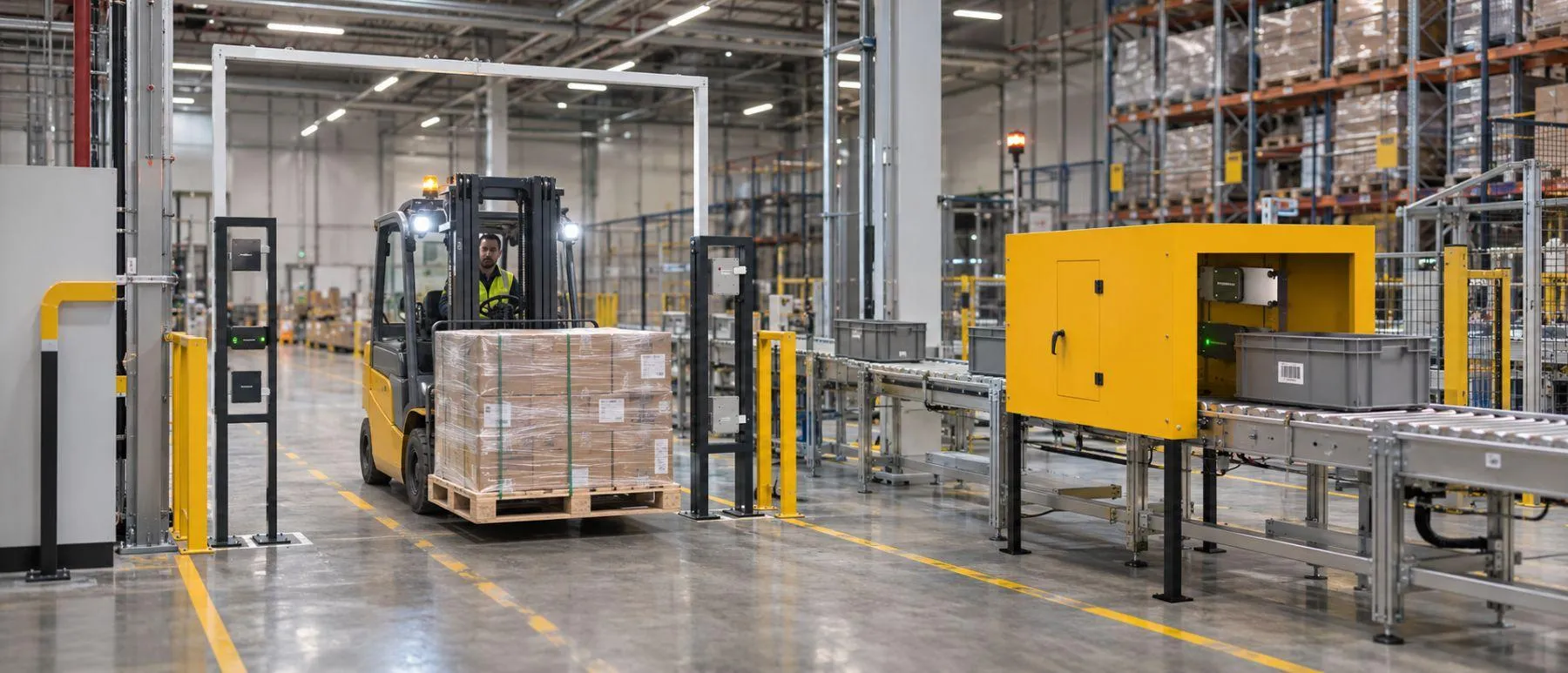
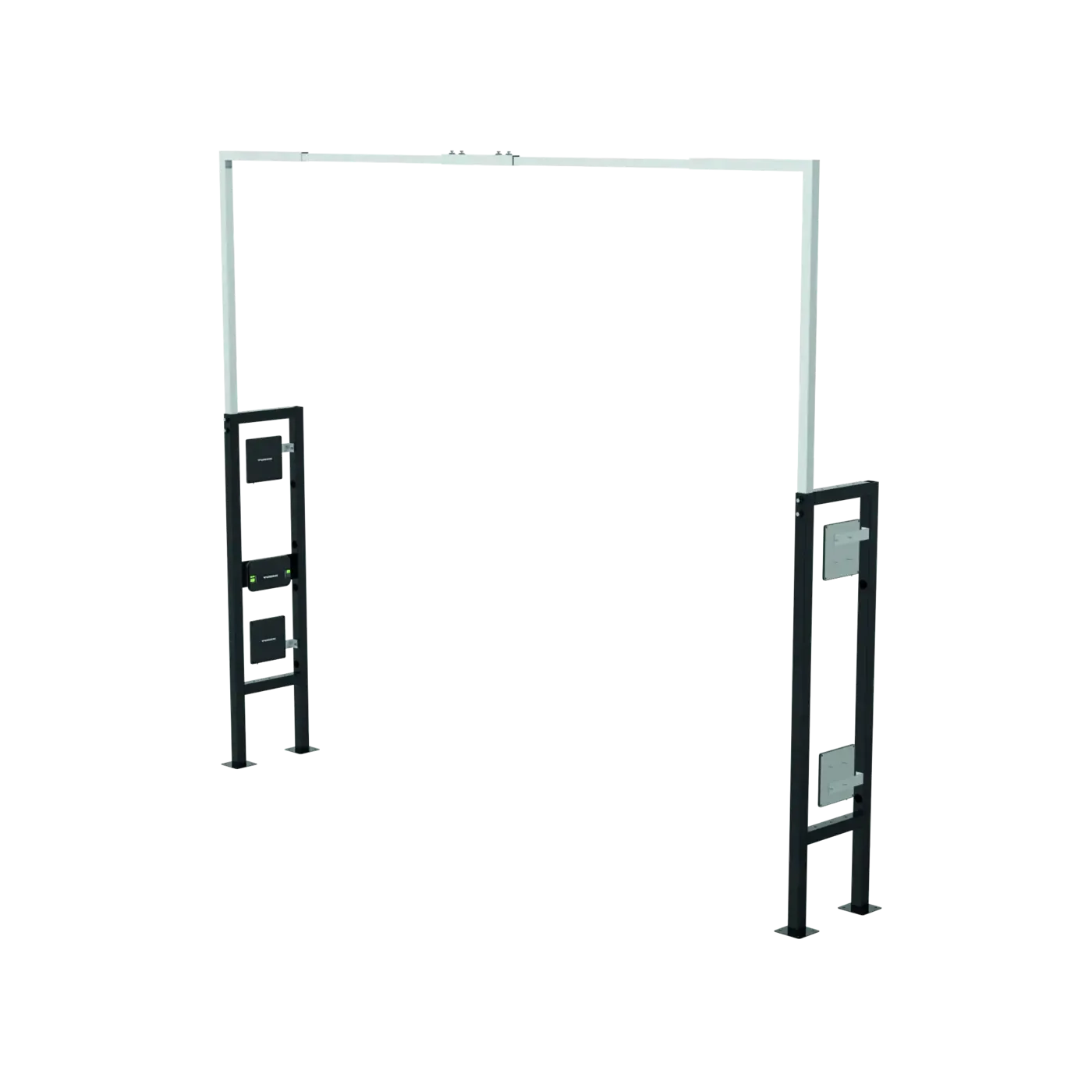
Stationary RFID gates play an important role at transfer points between goods receiving, storage, production and shipping. They identify tagged goods as they pass through a defined reading zone, providing information about which transfer point has been crossed.
"RFID gates capture goods movements between process steps," explains Hendrik Grumpe. "Because they are stationary, readings can be directly assigned to a specific location."
No additional scanning operation is required. Goods pass through the gate during an existing transport operation, allowing material movements to be documented automatically without introducing extra manual steps.

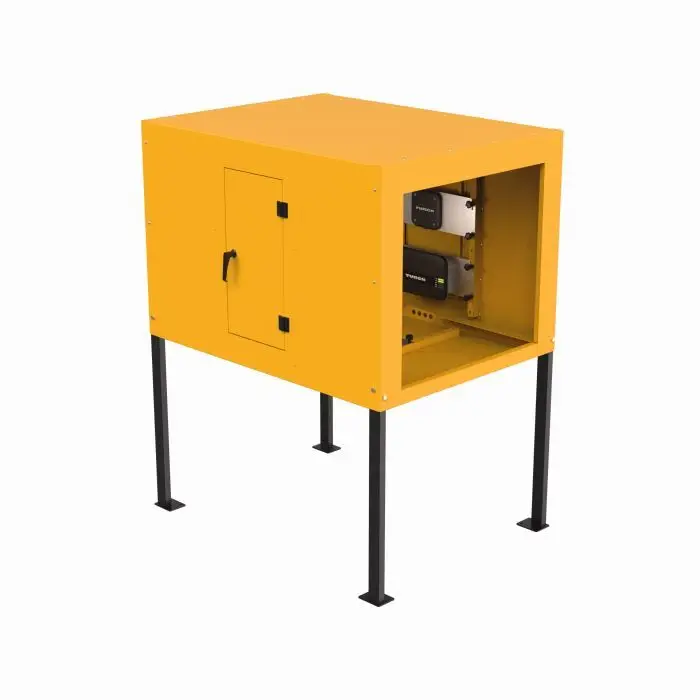
On conveyor systems, an RFID tunnel may be the better solution. Metal-rich environments present particular challenges for wireless identification. Conveyor equipment, supporting structures and nearby goods can influence the RF field and cause unwanted reads.
An RFID tunnel makes it possible to focus the reading zone on a defined section of the conveyor. This is particularly useful when large numbers of RFID tags must be identified reliably.
A typical application is automated completeness verification. While a box is being transported toward shipping, the system can compare its RFID-tagged contents against the expected items. Missing or unexpected products can therefore be detected before dispatch.
RFID Forklifts Bring Identification Directly to the Goods
Stationary RFID gates document movements at fixed locations. However, what happens between these points is not necessarily visible.
Forklifts equipped with RFID technology can provide additional information.
When a pallet is removed from a storage location or transported to a shipping area, the forklift can identify the goods during handling. Combined with storage location identification or order data from the forklift management system, these movements can then be automatically recorded in the warehouse management system.
"RFID forklifts operate more independently of fixed locations than RFID gates and can capture goods wherever they are needed," Hendrik Grumpe explains.
This is particularly beneficial in large warehouses and extensive outdoor areas where installing stationary readers at every location is impractical.
However, mobile identification cannot completely replace stationary systems. A forklift's reading zone is physically limited, meaning that individual items or smaller groups of goods are typically identified.
A stationary RFID gate, by contrast, can cover a larger reading zone using several appropriately positioned antennas. This becomes important when many packages are consolidated on a pallet and need to be captured simultaneously.
The strength of an end-to-end RFID solution therefore lies in combining both approaches: mobile systems accompany goods during handling, while stationary systems monitor defined transfer points.
When the RFID Reader Identifies the Wrong Pallet
If several pallets are positioned close together or goods move along a conveyor with insufficient spacing, RFID tags outside the intended reading zone may also be detected. These unwanted reads must be distinguished from duplicate reads, where the same tag is captured repeatedly.
Duplicate reads can generally be filtered by middleware or higher-level systems. Unwanted identification of nearby goods is more challenging because it can result in incorrect process assignments.
Grumpe therefore emphasizes the importance of proper system configuration. In UHF RFID applications, antenna orientation and transmission power must be adjusted so that the reading zone is focused as closely as possible on the intended goods.
The objective is to select "the antenna orientation and radiated power so that the transmission zone is directed as precisely as possible toward the area where the tags are to be identified," Hendrik Grumpe explains.
Received signals can also be evaluated. Tags detected outside the intended reading zone often produce weaker signals and lower read counts than the target tags.
Signal strength and read frequency can therefore be used to filter unwanted results, either directly in the RFID reader or at the middleware level.
Reliable RFID performance does not depend on powerful readers alone. Antennas, transmission power, reading zones and filtering rules must be adapted to actual operating conditions.
WMS and ERP Turn RFID Data into Operational Processes
An RFID reader initially identifies a tag. Whether that identification triggers a goods receipt, a warehouse transfer or a shipping verification is determined by the higher-level system.
This makes integration with warehouse management systems (WMS), enterprise resource planning (ERP) and middleware essential.
"RFID data only adds value when it is processed by higher-level systems," Hendrik Grumpe explains.
For example, forklift RFID readings, combined with the relevant process information, can trigger the transfer of a pallet to another storage location in the WMS.
At a shipping gate, captured RFID identifiers can be compared with a previously generated delivery note. If the expected and detected items match, the system can automatically verify that the shipment is complete.
To achieve this, individual reads from different RFID readers must be consolidated and assigned to their corresponding goods movements.
The actual process automation does not take place within the RFID tag. It results from connecting reliable identification data with the application logic of WMS, ERP or other higher-level systems.
Start with a Few Reading Points and Expand Later
Not every company needs to equip its entire material flow with RFID from the beginning. Implementations often start at a particularly important transfer point, such as goods receiving or shipping.
To develop these initial applications into a larger solution, future expansion should be considered during the planning stage.
Hendrik Grumpe recommends standardized hardware and software components. When an RFID gate consists of standard components, additional reading points can be installed without redesigning the entire technical solution.
At the same time, higher-level systems must be capable of integrating additional readers, data streams and process steps. Standardized interfaces and commands make these expansions easier.
The scalability of an RFID application therefore depends not only on wireless identification technology but also on the underlying software architecture.
The Right Reading Points Make the Difference
End-to-end material tracking does not require every item to be identified at every meter of its journey. What matters is reliably capturing relevant goods movements and assigning them to the correct processes.
RFID gates monitor defined transfer points, tunnels identify goods on conveyors, and forklifts bring identification directly to material handling operations. Combining this information within WMS and ERP systems creates a clearer picture of material flow.
For Hendrik Grumpe, the key is therefore not the number of installed readers, but the intelligent combination of stationary and mobile RFID identification points.