
RF receivers and gateways
RF receivers, readers, and gateways are the essential interfaces that determine range, reliability, energy efficiency, and scalability of wireless IoT systems by converting, processing, and bridging radio data to digital platforms.
- Published: October 28, 2025
- By: Anja Van Bocxlaer
- Read: 6 min
- Antenna, filters, LNA, mixer/IF, demodulator, and processor form the core receiver chain that determines sensitivity and selectivity.
- Readers are active transceivers that transmit carrier or query signals and decode responses; simple receivers only passively listen.
- Architectural choices (direct conversion, superheterodyne, SDR) and frequency bands directly influence range, energy consumption, and hardware complexity.
- Gateways aggregate heterogeneous radio data, perform protocol conversion, and forward information to cloud or edge platforms, forming the IoT backbone.
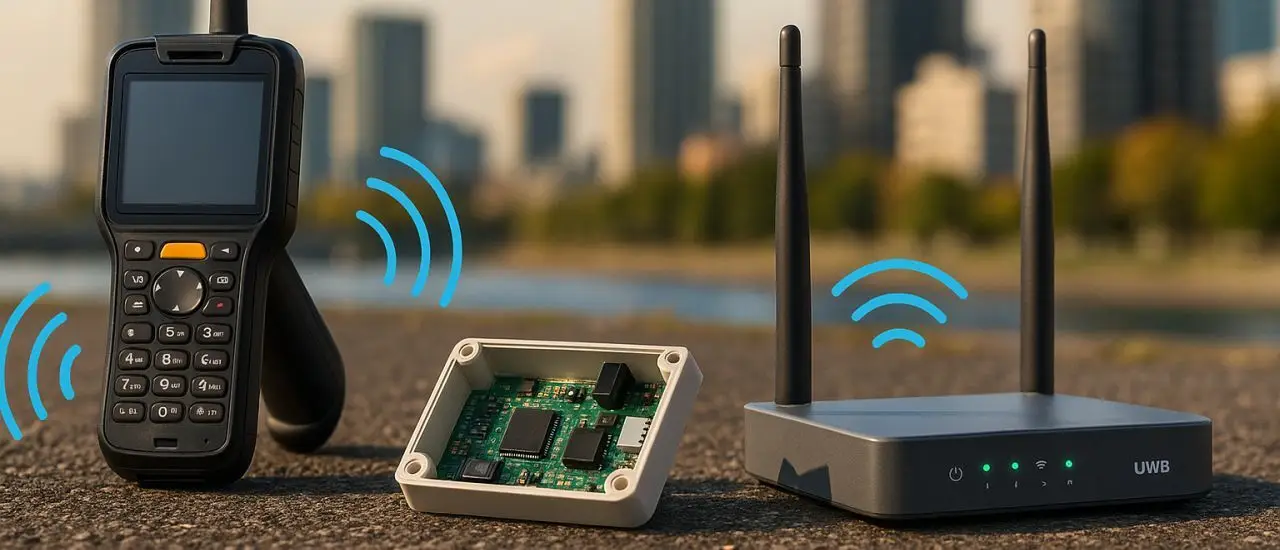
RF receivers and readers form the heart of modern wireless communication. They pick up signals from the air, process them, and convert them into digital data. Whether in RFID systems, LPWAN networks, Bluetooth infrastructures, Wi-Fi HaLow, or UWB positioning systems, they determine the range, reliability, and energy efficiency of a radio system.
While the classic receiver merely picks up signals, the reader goes one step further: it actively sends query or control signals and evaluates responses. In modern IoT applications, both roles often merge into a transceiver that can send and receive simultaneously. This architecture is complemented by gateways that serve as a link between the local radio world and higher-level IT systems or cloud platforms.
Basic structure of a radio receiver
Regardless of the frequency band or technology, the structure of a receiver follows a typical signal processing chain. The aim is to capture weak high-frequency signals, amplify them, and convert them into usable data.
Antenna
An antenna converts electromagnetic waves into electrical signals. The shape, polarization, and bandwidth determine the reception performance. Coils are used in near-field systems such as LF or HF RFID, while UHF, LoRa, or BLE receivers rely on dipole or patch antennas.Bandpass filter
It only allows the desired frequency range to pass through and blocks interference signals – crucial for operation in environments with many active radio sources.Low-noise amplifier (LNA)
The received signal is often millions of times weaker than the inherent noise of the electronics. An LNA (low noise amplifier) amplifies it with minimal additional noise, thus determining the sensitivity of the receiver.Mixer and intermediate frequency stage (IF)
Many systems convert the high-frequency signal to an intermediate frequency to simplify filtering and demodulation. This superheterodyne architecture improves selectivity and noise immunity.Demodulator
The demodulator converts the modulated high-frequency signal to baseband. Depending on the technology, amplitude, frequency, or phase modulation is used. In digital systems, error correction often takes place at this stage.Signal processing and decoder
Data packets are interpreted, protocols are decoded, and checksums are verified—in RFID readers, for example, according to ISO or EPCglobal standards.Control and communication
A microcontroller or system-on-chip (SoC) coordinates reception, monitors signal levels, and forwards data to the higher-level system via interfaces such as UART, SPI, USB, or Ethernet.Power supply and shielding
A stable power supply and EMC-compliant design prevent interference. Ferrite cores and conductive housings reduce feedback.
Architectures: Direct, superheterodyne, and software-defined
The internal structure of a receiver varies depending on the application:
Direct conversion receivers process the signal directly in the baseband. They are compact and energy-efficient – ideal for battery-powered sensors or BLE beacons.
Superheterodyne receivers rely on an intermediate frequency and achieve high selectivity. Standard in UHF RFID readers or LPWAN receivers, for example.
Software-defined receivers (SDR) digitize the signal early on and handle signal processing via software. This allows for multi-standard operation and flexible IoT modules.
Frequency-dependent differences
The physical properties of the frequency determine the design, range, and sensitivity of a receiver.
LF and HF range (125 kHz – 13.56 MHz)
Energy and data are transmitted inductively. Coil antennas and stable amplifiers are typical. Ranges: a few centimeters – ideal for NFC and access systems.UHF range (860 – 960 MHz)
UHF receivers operate in the far field and receive reflected signals. They require sensitive LNAs, precise filters, and careful impedance matching—for example, in UHF RFID, LoRa, or NB-IoT.ISM bands and Wi-Fi (2.4 / 5 GHz)
Reflection and multipath propagation require antennas with defined directivity, stable clock sources, and precise filters.Wi-Fi HaLow (900 MHz band)
Wi-Fi HaLow according to IEEE 802.11ah extends WLAN into the sub-GHz range. Receivers combine high sensitivity with energy-efficient OFDM modulation – ideal for IoT sensor technology and smart city networks.UWB and mmWave (> 6 GHz)
Ultra-wideband receivers process extremely short pulse sequences over large bandwidths. High precision and synchronization enable real-time positioning or radar.
Signal quality: filters, amplifiers, and ferrites
In addition to the main architecture, additional components determine reception quality:
Ferrites attenuate high-frequency interference on lines.
Multi-stage filters (SAW, ceramic, LC) separate useful and interfering frequencies.
Automatic gain control (AGC) adjusts the gain level.
Shielded housings prevent radiation and feedback.
High-performance receivers and readers often use multiple amplifier and filter stages to reliably evaluate even the smallest signals.
When do we refer to a reader?
A reader is more than a receiver: it performs active functions.
RFID readers transmit carrier signals, activate passive tags, and receive their responses.
BLE scanners listen to advertising channels but do not initiate direct queries.
UWB readers (anchors) coordinate pulse sequences for runtime measurement and enable precise positioning.
Readers are therefore intelligent receivers with control logic – usually full-fledged transceivers that operate both actively and passively.
Gateways – the bridge between radio and cloud
Gateways take communication to the next level in IoT systems. They receive data from receivers, readers, or sensor nodes and forward it to cloud or edge platforms via Ethernet, mobile communications, or Wi-Fi.
While receivers focus on local radio traffic, gateways bundle data from different sources and protocols. In LPWAN networks such as LoRaWAN, they take on the role of base stations, while in industrial plants they link hundreds of sensor nodes.
Gateways thus create the connection between the physical and digital worlds – they are the backbone of modern IoT infrastructures.
Systematic overview – who sends, who receives?
Technology | Transmitter/source | Receiver / remote station | Form of communication | Typical application |
|---|---|---|---|---|
LF / HF / UHF RFID | Tag / Transponder | Reader | Asymmetric, reader active | Object identification, logistics |
NFC | Card / Tag | Reader / controller | Asymmetric, inductive | Payment, access |
BLE | Beacon | Scanner / Receiver | Asymmetric, unidirectional | Location, monitoring |
LPWAN (LoRa, Sigfox) | Node / Sensor | Receiver / Gateway | Semi-asymmetric | Smart city, environmental measurement |
UWB | Tag | Anchor | Time-based positioning | Indoor navigation, robotics |
Wi-Fi / Wi-Fi HaLow | Client / Station | Access point | Symmetrical, bidirectional | Data communication, IoT |
Mobile communications (4G / 5G) | User equipment (UE) | Base station (gNodeB) | Symmetrical, bidirectional | Mobile communication |
Gateway | Local radio sources | Cloud / Server | Aggregating, multi-layered | IoT backbone, edge networks |
Gateways extend the classic sender-receiver principle by merging and converting data streams and forwarding them to higher-level systems.
Receivers in the IoT context
Receivers are central interfaces for data acquisition. In sensor networks, they receive measured values from battery-powered nodes; in production systems, readers enable the automatic identification of workpieces; and in smart cities, they collect environmental data.
Gateways connect these local systems, bundle information, and create the transition to cloud and edge platforms. Advances in semiconductors, antenna design, and signal processing are leading to receivers and gateways that are more compact, energy-efficient, and flexible—even software-defined multi-protocol systems that can handle multiple radio standards in parallel.
Conclusion
RF receivers, readers, and gateways are the key interfaces of wireless networking. They connect physical objects with digital platforms – from RFID tags to BLE beacons to Wi-Fi HaLow sensors.
Their common goal: to reliably receive, interpret, and forward signals. Developments show clear progress: greater integration, higher frequencies, lower losses, and adaptive software control. Modern receivers and gateways thus form the backbone of a networked, wireless future – in industry, logistics, mobility, and smart infrastructure.