Retail Perspective: RFID as a Confidence Engine, Not Just Accuracy


A shift in how RFID is positioned in retail is emerging. Instead of focusing on stock accuracy as a KPI, JD Group is reframing RFID as a foundational layer for decision-making and automation in retail environments.
Dan McGrath, Group Head of Customer Operations at JD Group, outlines this perspective in the context of a global RFID rollout, emphasizing the role of RFID in enabling reliable, real-time inventory data for operational and digital systems.
From Stock Accuracy to Stock Confidence
Traditional RFID deployments in retail have largely focused on improving stock accuracy through cycle counting and inventory visibility. While accuracy remains important, McGrath argues that it is no longer sufficient in increasingly automated retail environments.
The distinction lies between reporting and action. Stock accuracy provides a measured state, while stock confidence enables decisions. In environments where systems increasingly act autonomously, the ability to trust inventory data becomes critical.
This shift is particularly relevant as retailers move toward higher levels of automation in fulfillment, allocation, and customer interaction.
RFID as a Data Layer for Autonomous Systems
JD Group’s approach positions RFID not as a standalone store operations tool, but as part of a broader data infrastructure. The goal is to integrate physical inventory into digital systems in real time.
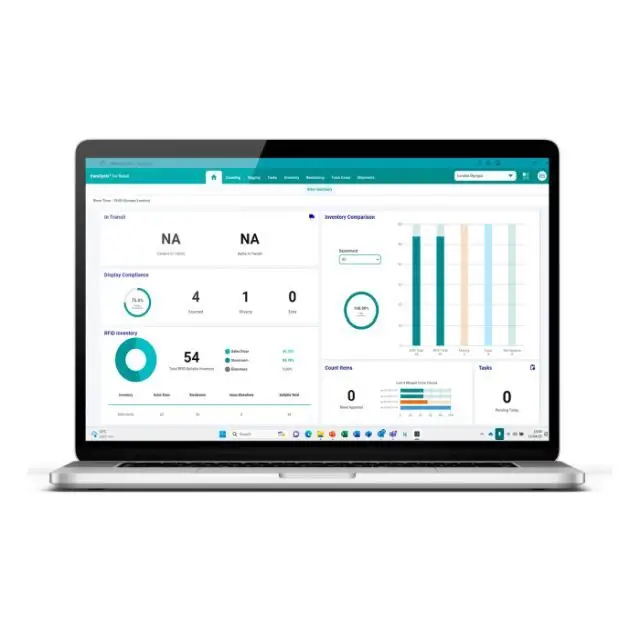
By implementing an API-first RFID platform from Checkpoint Systems and its ItemOptix solution, RFID data becomes accessible as a live data layer. This allows integration with enterprise systems, automation workflows, and future autonomous decision-making architectures.
In this model, stores evolve from static inventory locations into dynamic, queryable nodes within a distributed retail network.

Implications for System Integrators and Retail IT
For system integrators and solution providers, this shift has architectural implications. RFID must be considered as part of a broader system landscape, including APIs, middleware, and real-time data processing.
The focus moves toward:
reliable event-based data capture at item level
seamless integration into enterprise and cloud systems
enabling machine-driven processes such as automated allocation or fulfillment
This requires RFID systems that are not only accurate, but consistently available, scalable, and interoperable.
“Accuracy is a report. Confidence is a decision.”
Dan McGrath, Group Head of Customer Operations at JD Group
Enabling Agentic Commerce
JD Group’s perspective points to a shift toward agentic commerce, where software systems make operational decisions autonomously. These systems depend on real-time inventory data to allocate stock, confirm availability, and route demand across retail networks.
This changes the role of RFID. Inventory data must not only be accurate in reports, but reliable at the moment a decision is made. A human can interpret uncertainty or verify manually. An autonomous system needs trusted, machine-readable data.
For retailers, even small gaps in stock data can affect customer promises, fulfillment decisions, and store-to-store routing. In this context, RFID becomes more than an inventory tool. It becomes a data layer that helps autonomous systems act with confidence.
Beyond Cycle Counting
The industry has traditionally framed RFID around operational improvements such as cycle counting and shrinkage reduction. While these remain valid use cases, they represent only a subset of RFID’s potential.
JD Group’s perspective highlights a broader role for RFID as infrastructure. By providing a reliable digital representation of physical inventory, RFID enables new system architectures where machines can interact with and transact physical goods.
Partner with Checkpoint Systems to transform RFID into a trusted data foundation for modern retail.