- RFID technology is widely used to identify and track individualized window components throughout production and logistics stages.
- Localization precision requirements vary by process, ranging from simple zone detection to continuous exact positioning.
- Combining RFID with technologies such as BLE, UWB, and cellular tracking enables seamless tracking from manufacturing sites to construction locations.
- Integrating localization data with enterprise systems facilitates comprehensive process visibility and automated operational management.
From batch-size-one window production to reusable glass racks travelling across a country, localization challenges in the window and glass industry take many forms. RFID, RTLS, BLE, UWB, GNSS and cellular tracking provide different levels of spatial information across production, warehouse, transport and construction processes.
Projects at VELUX, Van de Vin, Viking Window, Toro Aluminum and VENTORA Glass Australia show how these technologies are already used in practice.
Window manufacturing is particularly well suited to digital identification and localization. Products are highly individualized, often visually similar and frequently produced for a specific building, floor, room or installation position.
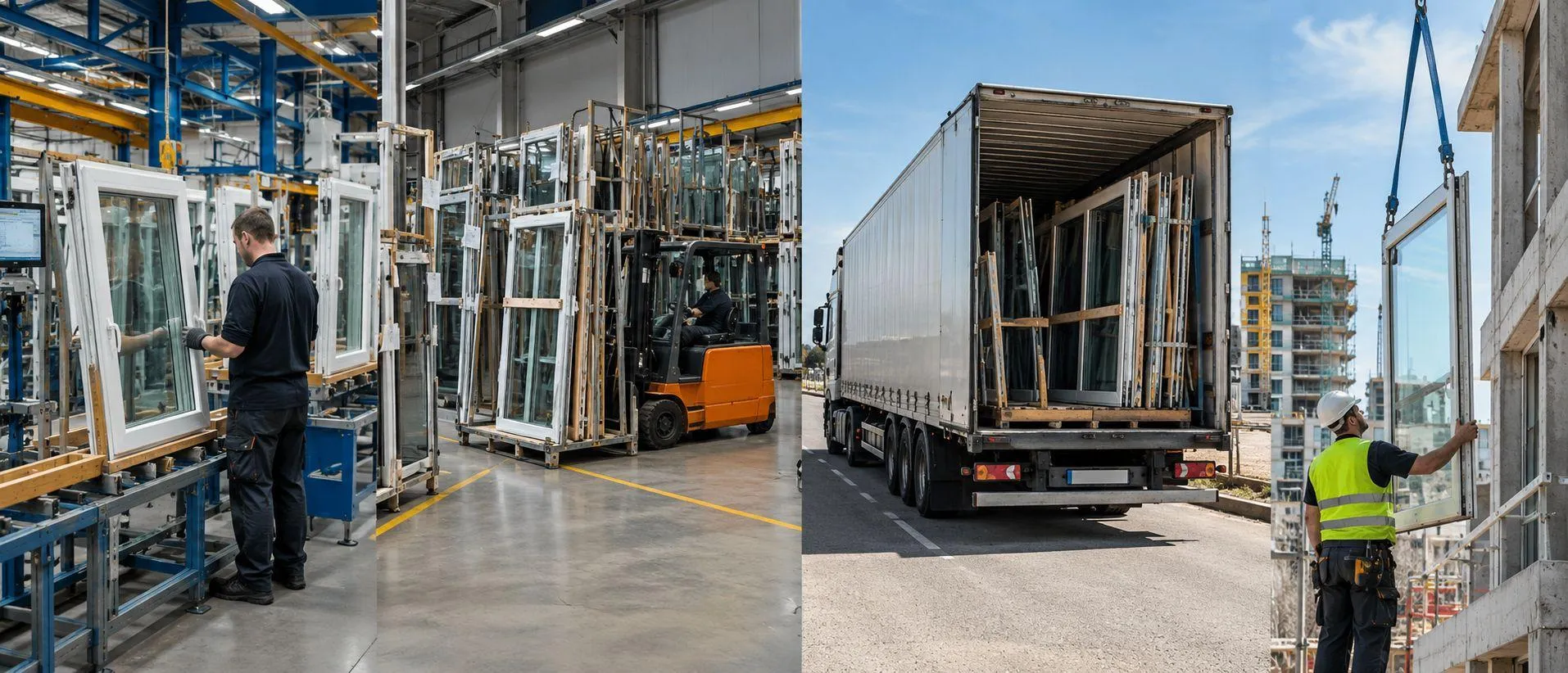
At the same time, the localization requirement changes throughout the process. A manufacturer may only need to confirm that a frame has reached the next workstation. Later, the warehouse needs to know where a pallet is stored. During transport, broad geographical location can be sufficient, while on a construction site the challenge may be finding the correct component among hundreds of delivered elements.
There is no single level of precision that is right for every process. Location can mean identification at a gate, detection within a zone, continuously updated coordinates, direction or exact distance. The relevant question is how accurately a process needs to understand spatial context.
VELUX: RFID Creates a Digital Production Flow
VELUX is an international manufacturer of roof windows, skylights and daylight solutions. At its JTJ Sonneborn Industrie GmbH production and logistics site in Sonneborn, Thuringia, Germany, UHF RFID supports paperless manufacturing in final assembly.
The plant produces wood and polyurethane/plastic roof windows for the German market and export. Window frames and sashes are equipped with UHF RFID transponders and identified throughout assembly and through to goods issue.
The RFID system is integrated with SIGMA’s GRAIDWARE LOS middleware. VELUX introduced the solution as production shifted from conventional mass production toward highly flexible single-part manufacturing. With many product variants and quantities down to batch size one, paper-based production documents were becoming increasingly difficult to manage.
Employees instead receive the relevant digital information for the specific window variant at each workstation. The RFID event therefore provides more than identification: it connects the individual component with its current production stage and the information required for the next operation.
The example illustrates an important form of localization that does not require continuous coordinates. An RFID read answers two process-critical questions at once: Which component is this, and which production step has it reached?
VELUX RFID reference project: paperless production at JTJ Sonneborn
Van de Vin: The Latest Production Data Follows the Frame
Van de Vin is a Dutch manufacturer of custom hardwood window frames, windows and doors based in Heeze, North Brabant. The company serves residential construction and renovation with products ranging from semi-finished frames to fully finished and glazed units.
Its production environment involves highly customized products and frequent project changes. Traditionally, technical information was distributed on large A0 drawings throughout the factory. When a design changed, outdated drawings had to be replaced, creating the risk that employees could continue working with obsolete information.
Van de Vin therefore introduced a passive UHF RFID solution developed with RFIDdirect and integrated with Matrix ERP and MES software. A specially developed RFID dowel tag is embedded into each wooden frame.
Fixed reading stations identify frames as they move through production. Matrix MES processes the RFID data and provides employees at each workstation with the latest instructions for that specific frame. Each RFID event therefore creates process context: the system knows which frame has reached which stage and which information is required there.
The RFID identity can also support later processes such as transport-rack registration, shipment control, after-sales service and long-term product information.
Van de Vin RFID case study by Cisper Electronics
Viking Window: Finding Products in Production and the Warehouse
Viking Window AS is an Estonian manufacturer of bespoke wooden and aluminium-clad windows and doors. The company is based in Mäo, Järva County, where its headquarters and production facilities are located.
The company introduced an RFID-based production tracking solution from IDsys to digitize production monitoring and warehouse processes. Before the implementation, products had to be located and identified manually using pallet or item labels.
With RFID, components are read automatically at different stages of production, creating a traceable history and a clearer overview of where orders and components are within the manufacturing process.
The same system extends into warehouse and dispatch. When a delivery note is processed, the software can display the relevant pallet location digitally, making finished goods easier to find. Packing and delivery lists are generated during dispatch, reducing manual searching and accelerating pallet handling.
The example shows how localization can evolve within one process. During manufacturing, the key information is which component has reached which production stage. In the finished-goods warehouse, the question becomes where the required pallet is stored and whether it is ready for dispatch.
Viking Window RFID production tracking case study by IDsys
Toro Aluminum: Tracking Windows from Production to Delivery
Toro Aluminum is a Canadian manufacturer of aluminum window and façade systems for high-rise and commercial buildings. Founded in Toronto in 1979, the company develops and manufactures products including window walls, curtain walls, railings, windows and doors.
Since 2023, Toro Aluminum has been using UHF RFID and RTLS technology to identify and localize prefabricated aluminum components across production, interim storage, goods issue and after-sales processes. More than 3,000 components are produced per week.
RFID printers integrated into CNC machines generate coded labels linked to production data and the ERP system. Components then move to assembly lines, where ceiling antennas automatically identify them as assembly begins.
Localization becomes particularly valuable when windows cannot move directly to final assembly. Components requiring additional parts, rework or inspection may enter a temporary holding area. Ceiling-mounted RFID antennas provide location information for these windows, including where they are stored and how long they have remained there.
At goods issue, RFID antennas identify each window passing through loading gates. The ERP system checks whether the component belongs to the respective order and can alert employees if a window is assigned incorrectly.
The RFID identity continues beyond the factory. On the construction site, customers use RFID handheld readers with RFID Canada’s RFID To Go software to verify whether a delivery is complete. Once the components have been confirmed, the ERP system can mark the order as delivered.
Before the larger rollout, Toro Aluminum and RFID Canada conducted a six-month proof of concept on one assembly line and one outgoing-goods gate. The pilot compared automated RFID detection with the existing barcode process and led to the broader implementation beginning in March 2023.
Toro Aluminum therefore shows how identification and localization can connect a complete operational chain, from CNC machining and assembly through interim storage and shipping to verification at the construction site.


VENTORA Glass Australia: Tracking the Reusable Assets Around the Product
VENTORA Glass Australia is a trade-focused glass processor and supplier serving residential and commercial projects. The company operates factories in Rowville, Victoria, and Stapylton, Queensland.
Its localization challenge did not concern the glass itself, but the reusable transport frames used to move glass through the supply chain. VENTORA Glass had limited visibility into where these frames were located and whether they were being returned on time. Delayed or missing returns could lead to frame shortages and additional administrative effort.
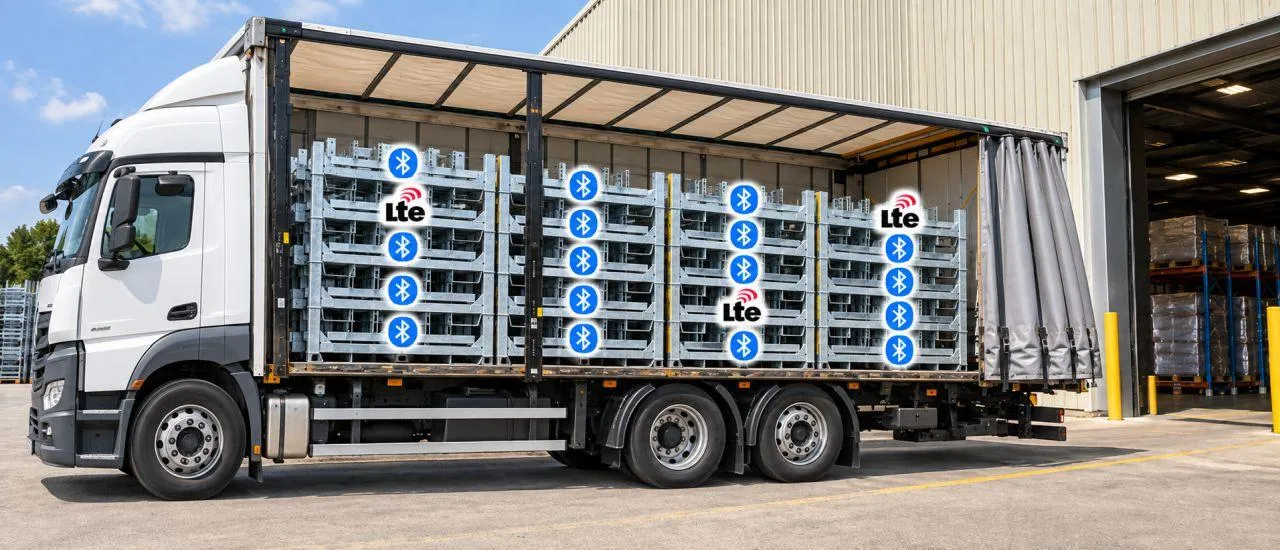
To improve visibility, the company implemented a battery-powered asset-tracking solution using the Telstra NB-IoT network. The system provides regular reports showing the current location of the glass frames, while historical trip data shows where an asset has travelled.
The deployed SU-6500 Edge trackers support indoor and outdoor use, daily location updates, motion-stop reporting, dwell-time alerts and geofence notifications.
This is a different localization model from the RFID-based production examples. A reusable frame may travel between factories, logistics operations and customer sites, so it cannot depend on fixed reader infrastructure at every location. Cellular connectivity allows the asset to remain visible across a much wider geographical area.
The case illustrates an important principle: sometimes the most valuable object to locate is not the finished product, but the reusable logistics asset that keeps the product moving.
VENTORA Glass asset-tracking case study by Simply Unified
One Journey, Several Localization Technologies
These projects show why modern locating architectures increasingly combine technologies.
RFID is primarily an identification technology, but every successful read also creates spatial context. A reader can confirm that an object has passed a gate, entered a zone or reached a machine. If more precise or continuous localization is required, RFID can be combined with BLE, UWB or other RTLS technologies.
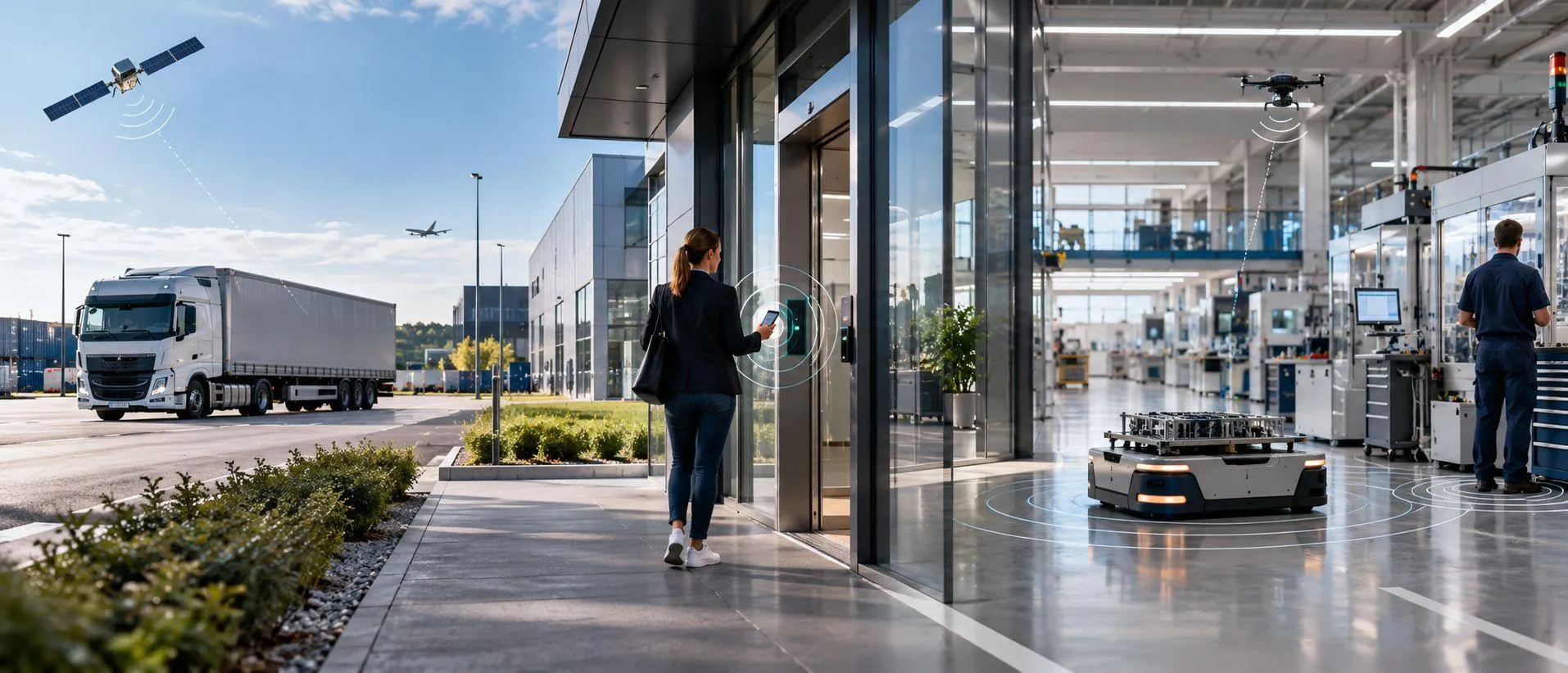
For window manufacturing, RFID can provide individual product identity, workstation detection, warehouse-gate events and shipment verification. BLE can support economical proximity or zone-level visibility of racks and mobile assets. UWB RTLS becomes relevant where continuously updated, precise indoor positions are required, while GNSS and cellular tracking suit trucks, racks and other assets moving between geographically separated locations.
The same object does not need maximum accuracy throughout its lifecycle. During long-distance transport, an approximate geographical position may be sufficient. Inside the plant, zone-level information may solve the process. At a critical assembly or automation step, much more precise positioning can become valuable.
From Window Location to Spatial Process Context
The real value of localization is not the map itself.
Identification tells the system what the object is. Localization adds where it is. Sensors can provide information about what is happening to it. When these data points are connected with ERP, MES, warehouse or construction-management systems, location becomes an input for automated decisions. Eingefügter Text
For a window manufacturer, the key question can therefore evolve from simply asking where a specific window is located to understanding its full process context. Instead of only knowing where window 4711 is, the system can show which order it belongs to, whether assembly and quality inspection are complete, where it is stored, whether it has been assigned to the correct transport rack and truck, and whether it has reached the construction site, including the building, floor and room where it is scheduled for installation.
The projects at VELUX, Van de Vin, Viking Window, Toro Aluminum and VENTORA Glass Australia already address different parts of this chain.
The next step is to connect these individual events more closely. When production identification, indoor localization, logistics tracking and installation data become part of the same digital context, localization stops being a tool for finding lost objects and becomes part of the process architecture itself.