
- Product data capacity may become an additional condition for suppliers seeking to remain in global value chains.
- Smaller suppliers may need financial, technical, and practical support to collect and provide reliable data.
- Compliance costs are immediate, while efficiency gains and other economic benefits depend on how companies use DPP information.
- The DPP is more likely to enable circular services and new value creation than to trigger widespread production reshoring to Europe.
The Digital Product Passport is intended to enhance transparency, the circular economy, and resource efficiency. But what does it mean for global supply chains, suppliers, and Europe’s competitiveness? Economist Frauke Steglich assesses the opportunities, costs, and risks.
The Digital Product Passport (DPP) is intended to make product data more transparent, facilitate the circular economy, and promote more efficient use of raw materials. To achieve this, information must be collected and shared along global supply chains. While this can improve processes, it may also increase costs and put pressure on smaller suppliers.
This article examines the DPP from a macroeconomic perspective. It focuses on the impacts on international supply chains, supplier structures, competitiveness, and Europe’s position in global trade.
Dr. Frauke Steglich is a Research Fellow at the German Institute for Global and Area Studies (GIGA). An economist with a Ph.D., she conducts research on international trade, global value chains, direct investment, and the social and environmental impacts of globalization. As part of the “Sustainability Governance of Global Value Chains” research network, GIGA also examines the impact of European sustainability regulations on producing countries. Previously, Steglich worked at the Kiel Institute for the World Economy.
The researcher supports the goals of European sustainability policy but consistently distinguishes between political intentions and economic effects. Her central question is: What happens when the goals of the DPP come into contact with real companies and international supply chains?
Challenge 1 – DPP Data Becomes a Competitive Factor
Price, quality, and delivery reliability have so far been key factors in determining who remains part of a supply chain. With the DPP, another requirement could be added: A supplier must also be able to provide the required data.
“It will no longer be enough for suppliers to produce cost-effectively, produce reliably, and deliver the quality that’s needed,” says Steglich. In addition, they must provide the required information.
However, the introduction of the DPP does not mean that every supplier must create its own Digital Product Passport or operate its own technical infrastructure. The European guidelines stipulate product-specific information requirements and interoperable solutions.
Legal responsibility generally lies with the relevant economic operator, in particular the manufacturer or importer in the EU. The data that suppliers must provide depends on the product group and the organization of the supply chain.
This is likely to be easier for large companies. The researcher takes a more critical view of smaller suppliers. “Who can even afford to make this data available and document it? Who has the capacity?” If IT, personnel, or financial resources are lacking, investments will be necessary. In the worst-case scenario, suppliers could be dropped from supply chains.
This raises the question of costs. Regarding suppliers outside Europe, the economist asks: “Who is supposed to collect this data? Who will bear the costs afterward?”
Steglich cites a textile factory in Bangladesh as an example. Smaller suppliers, too, may face greater demands in the future to provide information on materials, production processes, or environmental impacts. This information can be shared via existing systems or solutions provided by their customers. The greater challenge often lies in collecting and ensuring the quality of the data—such as on CO₂ emissions or water consumption—provided these are required for the respective product group.
Steglich sees a support gap here. Large companies have IT and compliance departments, while small businesses do not. Guidelines, best practices, and support in partner countries can therefore be crucial in ensuring that even smaller suppliers meet the requirements and remain competitive.
Challenge 2 – The Costs Come First
The introduction of the DPP comes at a time of economic strain for companies. Weak growth, trade disputes, and geopolitical tensions are already increasing the pressure.
“What’s clear is that it will be a burden in the short term,” the researcher emphasizes. Companies will have to adapt systems, coordinate processes, and allocate staff. “That will definitely incur costs.”
The extent of the additional costs depends on the implementation. The DPP is designed for standardized, interoperable data structures and allows for the use of existing systems and information. This helps limit additional expenses. The key factors are which data must be newly collected, which is already available, and how the costs are distributed among the companies.
For Steglich, this is not an argument against the DPP. For the economic assessment, what matters is whether efficiency gains will follow later: faster information exchange, better supplier selection, or more efficient use of raw materials.
Will the DPP remain a “paper tiger—or, in this case, a digital tiger”—or will it generate economic benefits? The costs are concrete. The future benefits have yet to be proven.
Challenge 3 – High Standards Could Strengthen or Weaken Europe's Market Power
The DPP can strengthen the European single market while simultaneously creating an additional barrier to entry for companies outside the EU, even though the DPP requirements apply equally to both EU and non-EU providers. But Steglich flips the perspective: “I would rather say the opposite—that this could pose a risk of Europe losing its relevance.”
Internationally competitive companies have alternatives. If Europe becomes too complicated or too expensive, they could shift more of their shipments to other regions. The continent would then have high standards and information requirements, but might lose “leverage and international bargaining power.”
This creates a trade-off: standards are effective internationally only as long as Europe remains an attractive sales market. If a supplier withdraws and builds relationships with other customers, there is no guarantee that it will return later.
The situation is even more difficult for weaker suppliers. They may be unable to meet European requirements or switch to other markets. “How can we ensure that they remain in European supply chains?” asks the economist. Here, the DPP also touches on Europe’s development and diversification goals.
If European standards are practical and internationally accepted, they can build trust and become a benchmark. Steglich links this opportunity to Europe’s ability to remain economically relevant.
Challenge 4 – Global Supply Chains Do Not Respond in the Same Way
The extent to which the DPP is effective depends on the structure of a given industry. According to Steglich, there is no single metric for Europe’s dependence on non-European suppliers. Trade statistics show direct imports; complete value-added networks can often only be reconstructed on an industry-specific basis.
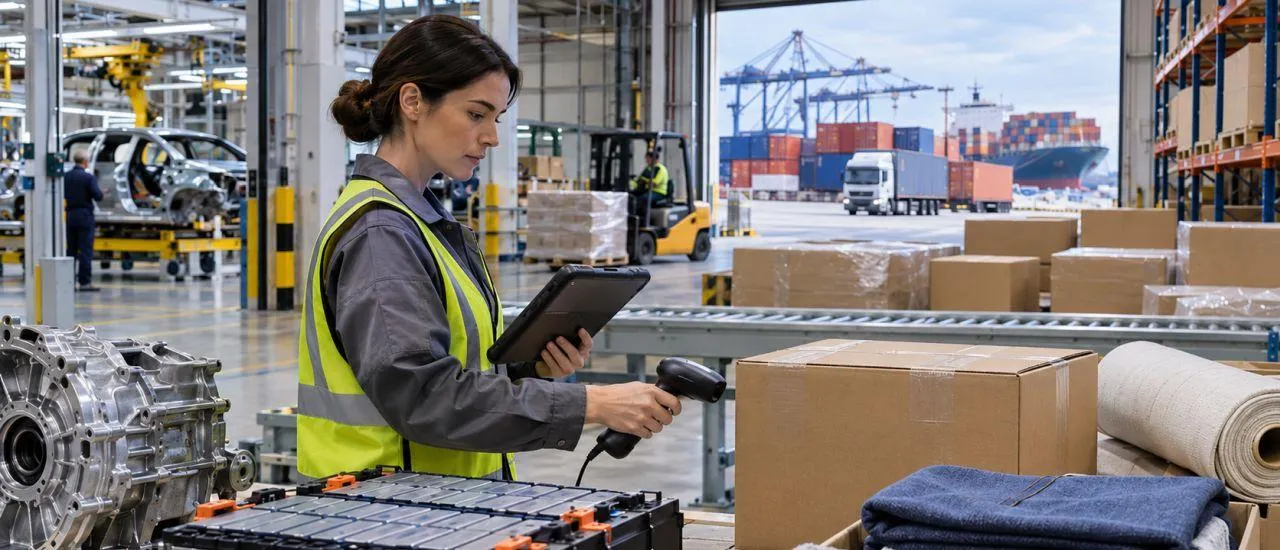
The automotive, battery, and textile sectors differ significantly: complex, specialized supplier networks in one sector; limited raw material deposits in another; and more fragmented production structures in the textile industry.
The automotive industry, in particular, illustrates why companies react differently. Vehicles themselves are not covered by the Ecodesign Regulation. However, the industry is affected by the battery passport and, looking ahead, by DPP requirements for intermediate products and components such as steel, aluminum, and tires. Highly specialized suppliers and manufacturers usually share a common interest in maintaining established relationships. Here, Steglich expects cooperation when it comes to new data requirements.
The situation is different for interchangeable products: “The risk actually lies more with items that aren’t so specialized for a particular customer, where it’s easier to say, ‘I’m going to go somewhere else now.’”
The DPP therefore does not affect “the global supply chain.” Its impact depends on specialization, market power, and alternatives.
Challenge 5 – Greater Regionalization Does Not Automatically Mean Reshoring
Steglich also puts into perspective the hope that the DPP will bring large-scale production back to Europe. “I wouldn’t assume at this point that we’ll see a widespread reshoring of production to the EU, for example.”
She considers selective shifts to be conceivable, for example, in the case of data-intensive products or production steps involving strict quality control. However, the researcher sees the greater impact on the single market elsewhere.
Greater transparency regarding materials and products can facilitate repair, take-back, reuse, and recycling. This can give rise to new services and business models. Success would then be measured less by the return of factories and more by new value creation surrounding products, raw materials, and data.
If materials are used longer or recovered more effectively, sustainability, raw material conservation, and cost efficiency go hand in hand.
Challenge 6 – Product Data Does Not Automatically Create Economic Value
A Digital Product Passport can provide large amounts of structured information. But data does not automatically create a competitive advantage.
If it is generated solely to meet regulatory requirements, the DPP remains merely a compliance tool. Value is created only through further use: for more efficient procurement, better supplier selection, repair, recycling, or new services.
According to Steglich, this is where the innovative potential lies. Greater transparency can conserve resources and facilitate the circular economy, while common standards can build trust. Whether these effects materialize depends on how companies actually use the information.
DPP data must be transformed into economic and environmental benefits.
Challenge 7 – The DPP Must Work Internationally and Learn from Experience
Global supply chains do not end at the EU’s borders. Technical requirements and standards must be internationally compatible. Added to this are data security and access rights. “That’s no trivial matter,” the researcher notes.
Partner countries and suppliers must also be included. Where capacity is lacking, support can prevent new standards from excluding precisely those suppliers that Europe needs for diversification.
Steglich views the phased introduction by product group positively. This allows Europe to learn: “What didn’t work? What went well?” Lessons from the initial implementations should be incorporated into subsequent product groups.
The learning process is also important because the scientific evidence base is still limited. Reliable impact studies are unlikely to be available as long as there is a lack of broad implementation experience. “To make a statement about impacts, we always need before-and-after observations.” Furthermore, company data is sometimes only made available to researchers after a delay.
Their findings are therefore not definitive predictions, but rather an analysis of plausible market mechanisms. Steglich sees the potential of the DPP but questions whether the expected effects will actually materialize in companies and global supply chains.
Conclusion – The DPP Must Be Judged by Its Real-World Impact
The Digital Product Passport promises greater transparency, a circular economy, and more efficient use of raw materials. Frauke Steglich recognizes this potential. However, her analysis of international supply chains shows that significant implementation challenges stand between the goal and its actual impact.
Small suppliers need support in collecting and providing reliable product data. International partners must be involved, and Europe must set high standards without losing its appeal as a market.
Whether this results in more resilient supply chains, new business models, and lower raw material consumption will depend on how it is put into practice. The economist does not question the goals. She examines whether the mechanisms behind them work in the real economy.