Automated Laptop Identification at Building Entrances
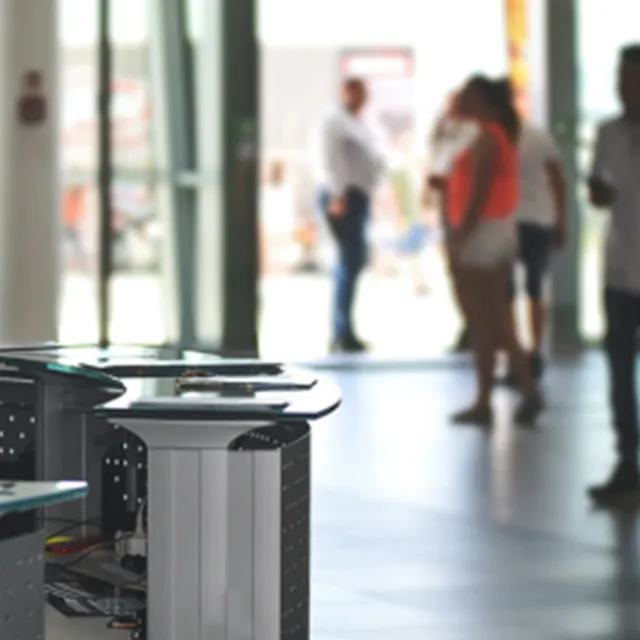
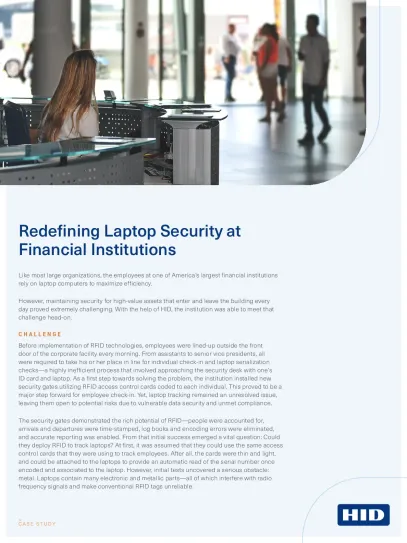
Financial institutions manage large numbers of laptops that move in and out of corporate buildings every day. At one major U.S. financial institution, employees previously had to queue at the entrance and present both their ID card and laptop for individual serial-number checks. The process was time-consuming and left laptop tracking as a separate manual step even after RFID access control had automated employee identification.
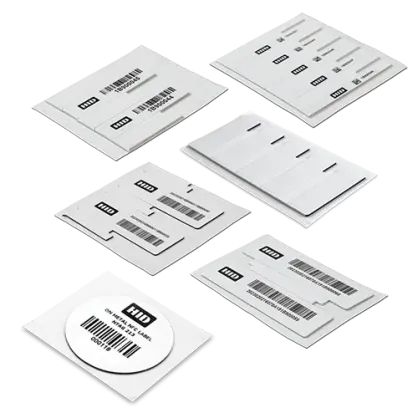
HID's solution extends RFID-based identification from employees to the laptops themselves. Each laptop is equipped with an HID IQ OM Label using passive RAIN RFID UHF technology, while RFID readers at the security desks automatically identify tagged laptops as employees enter or leave the building.
On-Metal RAIN RFID for Laptops
Laptop tracking presents a particular RF challenge because notebooks contain metallic and electronic components that can interfere with conventional RFID tags. During evaluation, the financial institution therefore tested different on-metal UHF RFID tags before selecting the HID IQ OM Label.
The selected passive label was sufficiently small and thin for the institution's requirements while remaining within the project's budget. According to HID's case study, testing at the institution achieved 100 percent read performance, including tests in which tagged laptops were placed inside briefcases or bags.
This performance figure relates specifically to the documented implementation and test conditions and should not be interpreted as a universal read-rate guarantee for every RFID deployment.
Linking the Laptop to the Employee
The financial institution developed an internal database and software application that associates each laptop with its user.
When a tagged laptop approaches the RFID reader, its serial number activates the corresponding database record. The application displays the associated employee's photo, allowing security personnel to verify the relationship between the person and the laptop and register both with the push of a button.
During implementation, tagged laptops could be identified and security-checked in less than five seconds, according to HID.
Combining Asset Tracking With Access Control
A further security layer is created by cross-referencing laptop movements with the existing RFID-based employee access control system.
The system compares the timing of the laptop's RFID detection with the employee's building entry or exit event. If the two events do not correspond, the application can raise a red flag for further investigation.
This creates a connection between two previously separate data streams:
Instead of replacing the financial institution's existing access-control infrastructure, RAIN RFID adds automated item-level visibility for the laptops moving through the facility.
From Manual Checks to Automated Asset Tracking
The implemented system replaces individual visual serial-number checks with automated RFID identification. HID summarizes the result as a fully operational solution for automated laptop identification and tracking, designed to increase efficiency and strengthen on-site security.
The case demonstrates how passive RAIN RFID can be used in a financial institution when the objective is not continuous real-time localization, but reliable identification of high-value ICT assets at defined control points and correlation with the identity of the employee carrying them.