
- Wi-Fi HaLow supports data rates up to 43 Mbps, vastly surpassing LoRaWAN capacities.
- The technology enables long-range connectivity of up to one kilometer in sub-1 GHz bands with low power consumption.
- Morse Micro has developed multiple generations of Wi-Fi HaLow chips, currently in volume production for global markets.
- Regulatory restrictions, especially in Europe, currently limit the widespread deployment of Wi-Fi HaLow.
- Wi-Fi HaLow offers a cost-effective alternative to cellular connectivity by eliminating recurring SIM and service fees.
Andy McFarlane recounts the story of Morse Micro, Australia’s first semiconductor company with its own Wi-Fi HaLow chip technology. He explains the technology’s key technical differentiators, core applications and market opportunities, as well as the regulatory barriers to its wider adoption in Europe.
Two former Broadcom engineers, a new IoT standard and a momentous decision in an Australian pub: Michael De Nil and Andrew Terry asked their wives whether they could manage for a while without a regular income. They then left their secure jobs and founded Morse Micro.
Their goal was as ambitious as it was risky: to establish IEEE 802.11ah, now known as Wi-Fi HaLow, as the foundation for a new generation of IoT connectivity and to build an independent semiconductor operation in Australia.
What began with two founders in an office developed, after several funding rounds, proofs of concept and years of intensive development work, into a semiconductor company with its own chip technology. The first chip generation has since been followed by a second, which is already in volume production and is intended to enable more powerful IoT applications with greater range, higher data throughput and standardized IP connectivity.
This is the story of Australia’s first semiconductor manufacturer with its own Wi-Fi HaLow chip technology.
Wi-Fi HaLow Pushes the Boundaries of IoT
The founders wanted to fundamentally change the market and enable a new form of long-range connectivity. LPWAN technologies have done an excellent job over the past ten to 15 years, but they transmit only very small data packets. This limits the functionality of the applications based on them.
With Wi-Fi HaLow, we can achieve data throughput of up to 43 megabits per second. In our assessment, that is approximately 1,000 times what is possible with LoRaWAN solutions. This opens up an entirely new field for more powerful IoT applications and a new generation of digital business solutions.
“Wi-Fi HaLow takes Wi-Fi somewhere new,” says Andy McFarlane. The technology adds a new dimension to the Wi-Fi ecosystem by combining high bandwidth with long range and low power consumption. “We firmly believe that this technology, with its high bandwidth, long range and low power consumption, will fundamentally change the market,” McFarlane explains. “That was also the founders’ key motivation. They wanted to develop something truly groundbreaking and fundamentally change how IoT connectivity is delivered over longer distances.”
Morse Micro at a Glance
Morse Micro employs around 220 people worldwide. Approximately 180 to 190 of them work in engineering and focus on developing Wi-Fi HaLow technology.
The company also has a sales and marketing team serving selected industries and regions, primarily in the United States, Japan, Taiwan, China, India, UK and Australia.
To expand its European business, Morse Micro has appointed a Business Development Director for Europe for the first time. He is based in the United Kingdom.
Europe has not previously been a priority market for Morse Micro because of the applicable duty-cycle restrictions. However, by establishing dedicated sales resources, the company intends to place greater emphasis on the region in the future.


What Is Wi-Fi HaLow?
Wi-Fi HaLow is a variant of Wi-Fi developed for IoT applications. The technology is based on IEEE 802.11ah and uses licence-exempt frequency bands below 1 GHz. These lower frequencies make it possible to cover longer distances and penetrate obstacles such as walls more effectively than conventional Wi-Fi at 2.4 or 5 GHz.
The standard was developed for energy-efficient devices, sensors and connected equipment that require greater range while still using IP-based communication within the Wi-Fi ecosystem. IEEE 802.11ah is designed for transmission ranges of up to one kilometre. The distance that can actually be achieved depends on the environment, the antenna, transmission power and regulatory requirements.
Development of IEEE 802.11ah officially began in 2010. The IEEE Standards Board approved the standard on December 7, 2016. IEEE 802.11ah-2016 was published in full on May 5, 2017.
In brief, Wi-Fi HaLow extends Wi-Fi with greater range, improved building penetration and operation in the sub-1 GHz band specifically designed for IoT applications.
Morse Micro's Key Segments: Video Surveillance and Energy Management
Video surveillance cameras often face a fundamental problem today. Wired solutions and cameras with cellular connectivity are comparatively expensive. Wireless cameras, by contrast, generally use 2.4 GHz Wi-Fi and therefore need to be located close to an access point.
In practice, this often means that a camera is installed where a wireless signal is still available, rather than where it is actually needed for security reasons. Garages, driveways and property boundaries are often difficult to reach with 2.4 GHz because of the longer distances and obstacles made of concrete and metal.
Wi-Fi HaLow enables high-quality video to be transmitted over significantly longer distances. Wireless cameras can therefore be installed at the edge of a property, for example, where they can detect an intrusion earlier. This fundamentally changes what security cameras can achieve.
“Homes, users and properties do not necessarily need even more speed. They need reliable coverage in the grey areas,” says McFarlane.
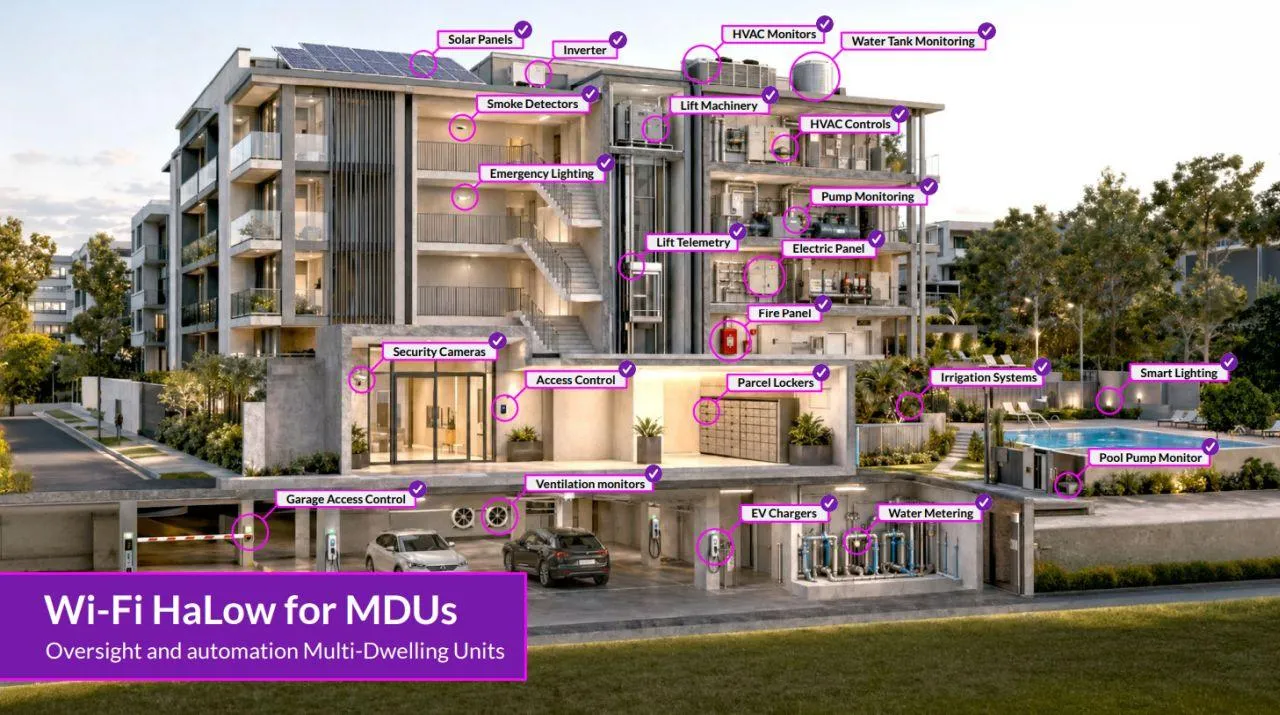
The second key market is energy management, particularly smart electricity metering. The first generation of smart meters primarily performs a billing function, whereby the meter records how much electricity has been consumed a few times per day.
The electricity sector, however, is undergoing a fundamental transformation. Alongside centralized power plants, solar installations, battery storage systems, inverters and electric vehicle charging stations are increasingly shaping a decentralized energy system. Electricity is no longer distributed exclusively in one direction but is exchanged between numerous generators, storage systems and consumers.
The industry therefore speaks of a transition from AMI 1 to AMI 2.0, the second generation of Advanced Metering Infrastructure. New electricity meters must transmit data much more frequently and record, almost in real time, the quantities of energy flowing in both directions.
According to McFarlane, smart meters in Australia will be expected to transmit bidirectional data packets every three seconds from 2028. This will significantly increase the required data volume. The goal is near-real-time Grid Edge Intelligence.
In Morse Micro’s assessment, existing smart-meter communication technologies cannot reliably handle this volume of data. A wireless technology is therefore required that combines long range with higher bandwidth. McFarlane sees Wi-Fi HaLow as being in a particularly strong position here.
There is also the need to connect solar installations, battery storage systems, inverters and charging stations to the home network. These devices are often located in difficult-to-reach places, such as on the roof, behind concrete walls or at the end of a driveway.
“Wi-Fi HaLow can complete the Wi-Fi family and provide reliable Wi-Fi connectivity outside the home as well,” says McFarlane. Devices can be connected using standardized IP connectivity, familiar Wi-Fi security mechanisms and existing home networks.
The Morse Micro team also sees further opportunities in precision agriculture and the Industrial IoT. Higher data throughput and standardized IP connectivity provide the foundation for more demanding applications and for the increasing processing of data and AI functions directly at the network edge.
What advantages does Wi-Fi HaLow offer over conventional Wi-Fi, LPWAN technologies such as LoRaWAN and NB-IoT, and cellular connectivity?
Andy McFarlane: Wi-Fi HaLow occupies its own space between these technologies. Compared with conventional Wi-Fi at 2.4 or 5 GHz, the decisive advantage is range. The signals can penetrate walls more effectively and cover greater distances.
Depending on the environment, we can provide native IP connectivity over several hundred metres, sometimes more than one kilometre and, in certain cases, even farther. Conventional 2.4 GHz Wi-Fi does not come close to achieving these distances. Wi-Fi HaLow does not replace conventional Wi-Fi, but complements it with long-range connectivity.
LPWAN technologies such as LoRaWAN do an excellent job of transmitting small data packets over several kilometres. Their range can be greater than that of Wi-Fi HaLow. We can, however, provide approximately 1,000 times the data throughput.
In addition, Wi-Fi HaLow offers standardized IP connectivity, WPA3 security and interoperability with conventional Wi-Fi. This enables integrators and solution providers to develop significantly more powerful applications and transmit much larger volumes of data.
The third technology in the comparison is cellular connectivity. Cellular technology is widespread and powerful, but it involves higher costs. In addition to more complex setup, the SIM card generates recurring connectivity costs throughout the lifetime of a device. Cellular solutions can also have comparatively high power consumption.
“Wi-Fi HaLow reaches farther than conventional Wi-Fi, enables more than LPWAN and is more cost-effective than cellular connectivity,” McFarlane summarizes.
The technological sweet spot, for example, lies in data rates of 10, 20 or 25 megabits per second over hundreds of metres, combined with one-time acquisition costs instead of recurring cellular charges.
Wi-Fi HaLow is attracting growing attention worldwide, but regulatory conditions do not yet allow it to be used equally in every region. Are European frequency and duty-cycle rules slowing market development? And do you expect Wi-Fi HaLow to become more widely used in Europe in the future?
Andy McFarlane: The fact is that the current duty-cycle requirements and regulatory restrictions in Europe will slow market development.
Our first chip generation was enabled exclusively for the United States and Australia. We initially wanted to validate the technology at scale in these markets. The second generation, introduced last year, is designed as a global chip variant. In principle, it can be used in all markets where the required spectrum for Wi-Fi HaLow is available.
This is precisely where the challenge lies: the necessary spectrum has not yet been allocated in every country or made available under comparable conditions.
Japan is a current example of positive development. Trials were conducted there together with Taiwan for an extended deployment at 850 MHz. The results were assessed very positively. A decision was subsequently made to provide more spectrum for Wi-Fi HaLow and thereby enable next-generation solutions.
Among European regulators, we do not currently see the same level of interest in providing additional spectrum or easing the existing duty-cycle restrictions. We would love to see this change.
However, I cannot assess whether or when the responsible European institutions will make corresponding changes. This could happen next year, in several years or possibly even later.
Spectrum availability differs considerably around the world. Does this affect not only Wi-Fi HaLow in the sub-1 GHz band, but also other Wi-Fi frequencies? And how do you expect Wi-Fi architecture to develop?
Andy McFarlane: An interesting comparison can be found at the other end of the frequency spectrum. In the United States, many broadband routers already support 6 GHz, 5 GHz and 2.4 GHz. In large parts of the rest of the world, however, primarily 5 GHz and 2.4 GHz are available.
The regulatory availability of 6 GHz spectrum also varies considerably worldwide. It has been released for Wi-Fi in the United States, allowing users there to benefit from the particularly high data rates available in this frequency range. In many other countries, this is not yet possible or is possible only to a limited extent.
We see a comparable situation with the sub-1 GHz frequencies relevant to Wi-Fi HaLow. Here too, the regulatory conditions differ from market to market.
I am convinced that Wi-Fi will continue to develop in both directions: towards ever higher data rates in the 6 GHz band and towards greater range in the sub-1 GHz band.
Within a few years, many broadband routers could support 6 GHz, 5 GHz, 2.4 GHz and sub-1 GHz frequencies. This would create a complete Wi-Fi architecture that delivers very high speeds where they are needed while also enabling reliable connectivity over significantly longer distances.
So far, only a comparatively small number of semiconductor manufacturers have developed and launched Wi-Fi HaLow chipsets. Why are there still so few suppliers?
Andy McFarlane: It is not for me to comment on other companies' choices, but from my perspective, the current chip suppliers show that the Wi-Fi HaLow market is still at an early and highly innovative stage of its development.
LPWAN providers using technologies such as Wi-SUN or LoRaWAN have done an excellent job over the past ten to 15 years. These solutions continue to create value. However, for the significantly higher data throughput of Wi-Fi HaLow to realize its full potential, a technological paradigm shift is required.
That shift is now taking place. Edge AI is becoming increasingly important, and more sophisticated data processing is expected to take place directly on remote devices and at the network edge. This is increasing demand for wireless technologies that combine greater range with significantly higher data throughput.
Over the past several years, Morse Micro has gained extensive experience in developing, launching and optimizing its own Wi-Fi HaLow chips. This technological experience gives us a very strong starting position today.
Are major semiconductor manufacturers such as Broadcom, NXP and Texas Instruments still underestimating the market potential of Wi-Fi HaLow, or is the market simply at an early stage of adoption?
Andy McFarlane: The fact is that the market is still at an early stage of adoption and development. It is difficult for me to assess, on behalf of Broadcom, NXP or Texas Instruments, which strategic decisions these companies are making. However, I expect them to enter the Wi-Fi HaLow market once they see the right time to invest. Only the companies themselves can say when that will be.
Over the past several years, Morse Micro has built comprehensive technological capabilities, practical experience and its own ecosystem. This gives us confidence that we can scale very rapidly in the years ahead.