

Digital Product Passport Gains Momentum as Key Standards Advance

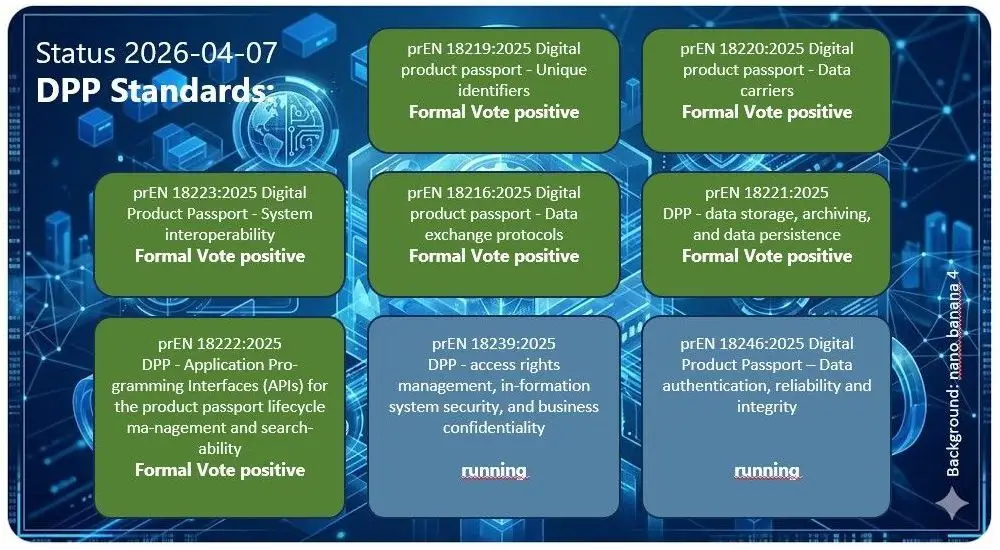
The Digital Product Passport is moving from concept to implementation. According to Otto Handle, Convenor of the interoperability framework working group within European standardization, six core standards have now successfully passed the formal vote of national standardization bodies.
This marks a decisive step toward a harmonized framework that will define how product data is structured, exchanged, and used across industries in Europe.
Six Core Standards Approved
The approved standards cover the essential building blocks of the Digital Product Passport. These include data exchange protocols, unique identifiers, data carriers, data storage and persistence, APIs for lifecycle management, and overall system interoperability.
Together, they form the technical backbone required to enable seamless data flows across systems, companies, and borders. For the first time, a consistent and interoperable approach to product data is becoming reality at a European level.
Final Elements in Development
Two additional standards are currently in progress, addressing critical aspects such as access rights management, information security, and business confidentiality, as well as data authentication, reliability, and integrity.
These components are essential to ensure trust, compliance, and secure data sharing across complex value chains. Their completion will further strengthen the robustness of the Digital Product Passport ecosystem.
Implementation Framework Taking Shape
Beyond technical standards, the regulatory framework is also advancing. Implementation acts and category rules for the first product sectors, based on the initial working plan published in April 2025, are being intensively developed.
This parallel progress between standardization and regulation indicates that the introduction of the Digital Product Passport is on track and aligned with planned timelines.
A Strategic Tool for Europe
The Digital Product Passport is more than a compliance requirement. It is a strategic instrument designed to support key objectives of the European Union.
It enables greater transparency in sustainability, helps reduce dependencies on critical raw materials, and strengthens fairness within the internal market. By creating a shared data foundation, it allows companies, regulators, and consumers to access reliable product information across the entire lifecycle.
From Standards to Practice: Join the Livestream
To understand how these developments translate into real-world implementation, Otto Handle will join the upcoming Think WIoT livestream on April 29, 2026 at 13:00 CEST.
The session will focus on how companies can move from regulatory obligation to competitive advantage, addressing data models, IT architecture, compliance, and practical implementation paths. Together with industry experts from HID, Narravero, and Fraunhofer Institute for Software and Systems Engineering ISST, the livestream will provide concrete insights, use cases, and strategies for becoming DPP-ready.
👉 Secure your free spot: https://wiot-group.com/think/en/livestreams/think-wiot-livestream-digital-product-passport-dpp/
Now Is the Time to Act
With the framework rapidly taking shape, companies are entering a critical phase. Preparing product portfolios for the Digital Product Passport requires alignment across multiple domains, including ecodesign, documentation, supply chain transparency, and certification processes.
Those who act early will be better positioned to navigate regulatory requirements and unlock new opportunities linked to data-driven product ecosystems.
The direction is clear. The Digital Product Passport is coming, and the time to prepare is now.