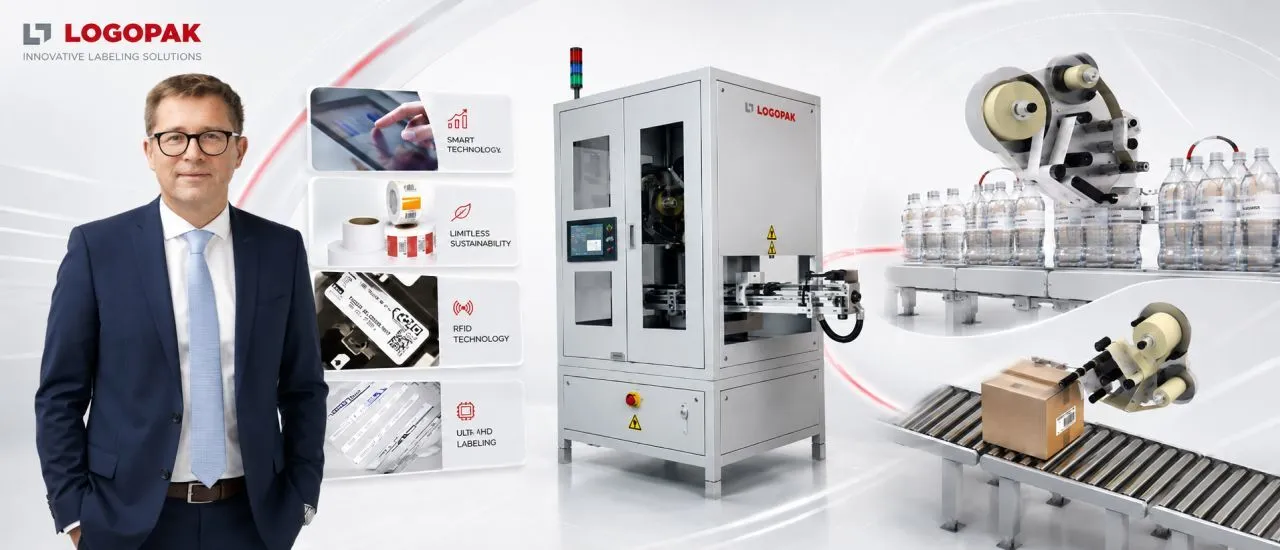

- Logopak specializes in reliable, high-availability industrial labeling systems designed for large-volume production and logistics.
- The company maintains deep vertical integration with full in-house development and manufacturing in Germany, enhancing flexibility and control.
- RFID-enabled labeling solutions are integrated within digital process chains, enhancing transparency and data-driven logistics.
- Logopak emphasizes software integration, consulting expertise, and sustainable innovations such as linerless labeling to optimize operational efficiency.
In automated production and logistics processes, labeling has long been more than just a side issue. It determines whether goods can be clearly identified, whether pallets move safely through the supply chain, whether data is accurately entered into ERP, MES, or warehouse management systems, and whether processes remain stable even when handling large volumes.
For Logopak, this very interface between physical objects, digital data records, and industrial automation has been the central focus of its work for decades.
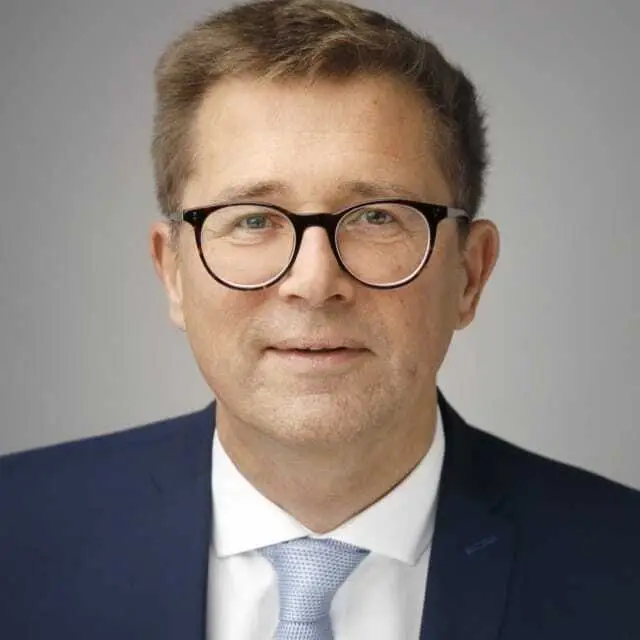
In a conversation with Steffan Gold, Managing Director of Logopak, it becomes clear that Logopak does not see itself as a supplier of simple labeling devices. The company specializes in industrial print-and-apply systems, RFID labeling, software integration, and reliable marking solutions.
The systems are primarily used where large volumes are handled, processes must run reliably, and availability is critical. Steffan Gold sums it up clearly in the interview. Logopak is typically found “where large volumes are involved,” because reliability and system availability play a central role there.
This approach is also reflected in customer feedback. When asked what customers most frequently report, Gold says: “They just work.” This refers to systems that do not require constant attention in everyday industrial operations but instead operate reliably.
This is a crucial factor, especially in production and logistics environments. Every unplanned shutdown causes effort, costs, and, in the worst case, delays along the entire process chain.
“Made in Germany” as a measure of technical depth
A key reason for this lies in the depth of vertical integration. Logopak develops and manufactures its systems in Hartenholm, Schleswig-Holstein. For Gold, “Made in Germany” therefore stands not only for quality, but also for depth of development, control, and responsiveness.
While many suppliers configure and assemble standard modules, Logopak maintains a high degree of in-house vertical integration, including mechanical manufacturing. In the interview, Gold emphasizes that this structure was a major advantage, especially during challenging supply chain situations. Components could be flexibly adapted, and orders continued to be delivered.
For customers, this means shorter lead times, greater technical control, and a higher capacity to implement even special requirements. This strength becomes particularly relevant when labeling systems are deeply integrated into existing production lines.
After all, it’s not just about printing a label. It must be applied reliably at the right time, with the right data, on the right object, in the right place, and under real-world environmental conditions.
Related Hardware
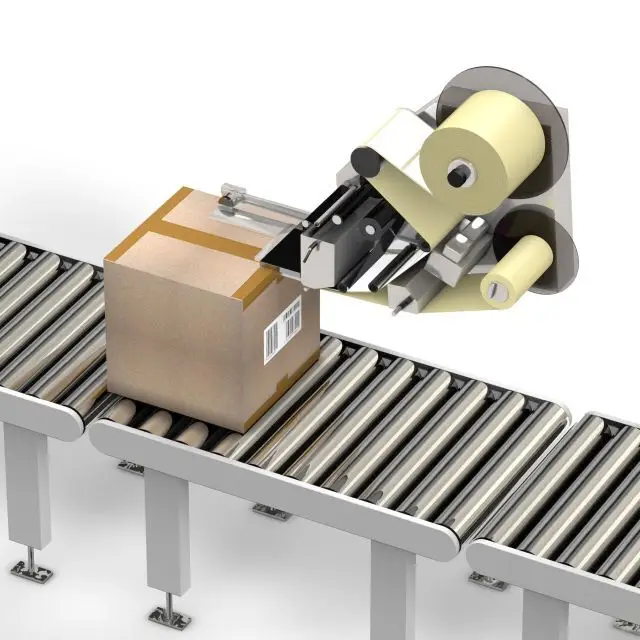
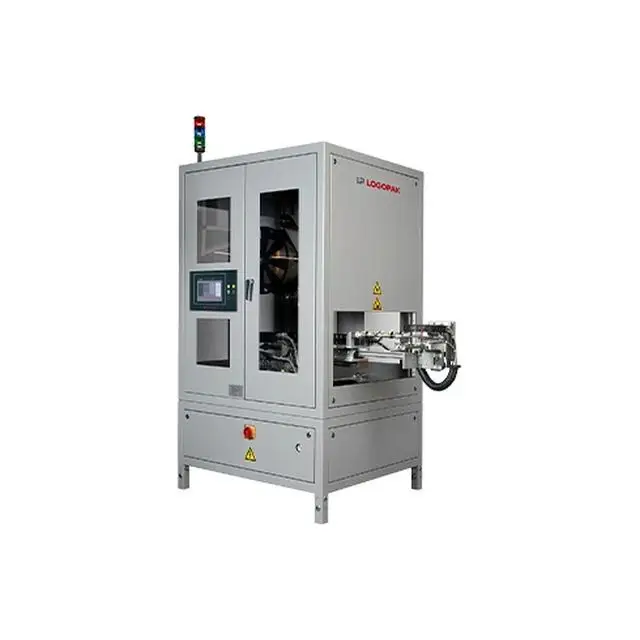
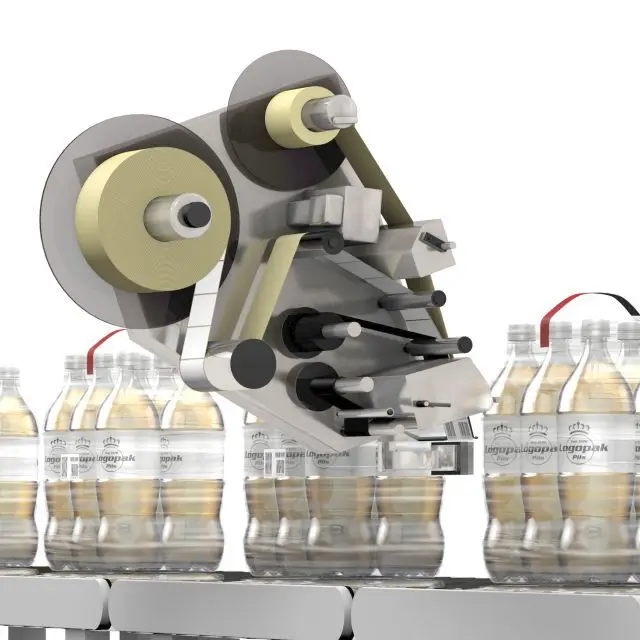

From small label formats to A3 labeling
Logopak is often associated with large pallet labelers, end-of-line systems, or gantry solutions. This makes sense, as many applications arise where high volumes, large packaging units, and automated conveyor technology converge.
At the same time, the interview shows that Logopak isn’t just a master of large systems. The systems can also complement production lines with compact print-and-apply modules.
Gold points out that Logopak can handle very small labels as well as large formats. The largest printable label is A3, or 29.7 × 42.0 centimeters, and is used, for example, on large paper rolls. What matters here is not just the printing, but the reliable handling and application on different surfaces, objects, and geometries.
This range makes Logopak attractive to companies that are not just looking for a single device, but for a labeling solution that can be adapted to real-world process conditions.
In the food industry, stainless steel options may be relevant. In logistics, the focus is on speed, repeatability, and integration into conveyor systems. In industrial applications, robust mechanics, interfaces, and long-term availability play a central role.
RFID becomes part of integrated process chains
RFID is particularly exciting. Logopak was an early player in the development of RFID-capable print-and-apply systems. The interview references a world premiere from 1999. Even back then, the focus was on automatically printing, encoding, and applying RFID labels.
However, many early projects came at a time when the supply chain was not yet fully ready. The costs were often borne by the manufacturer, but the economic benefits tended to materialize later in the chain. Today, Gold sees a different situation. RFID is viewed in a more integrated way, and the benefits are increasingly spread across multiple process stages.
Demand is growing. Gold observes a rising demand for RFID solutions, particularly in logistics. At the same time, the information available along the process chain is gaining value. Product localization, shorter search times, process optimization, and additional data such as temperature or humidity are becoming more important.
As a result, RFID is no longer viewed merely as an identification technology, but as a building block for transparent, data-driven processes.
Cooperation instead of standalone solutions
This development is also changing the role of partners. Gold explains that RFID must be thought of more in terms of ecosystems. A single provider can no longer meet all requirements on its own.
Logopak therefore collaborates with integrators, tag manufacturers, and other partners to enable system solutions. In the interview, Gold mentions, among other things, collaboration with logistics partners and the development of further ecosystems within the corporate group. Interested cooperation partners are welcome.
RFID projects rarely function in isolation. They require the right tags, suitable read points, printing and application technology, process knowledge, software integration, and a clear data strategy.
It is precisely at this interface that Logopak can contribute its expertise—not only as a machine manufacturer but as a partner for industrial labeling and data connectivity.
Software, interfaces, and consulting expertise
In addition to the mechanical aspects, software is playing an increasingly important role. Logopak developed its own software solutions early on and offers deep integration with customer systems such as SAP or MES.
For Gold, this data integration is a key reason why customers value Logopak. Labeling today is closely linked to data streams. Item numbers, batches, serial numbers, shipping data, inspection status, or RFID data must be reliably retrieved from systems, processed, and fed back.

Added to this is consulting. Gold openly describes Logopak as a provider that does not sell based on the lowest price, but rather on longevity, stability, expertise, and service. Every customer order is assigned a project manager who often has 10, 15, or 20 years of experience and accompanies the project from the initial specifications through to final acceptance. This ensures that requirements are clearly defined in advance and that subsequent implementation is secured.
This approach aligns with Gold’s recent statements. The concrete customer benefit lies in safer, more efficient, and more sustainable processes. Fewer downtimes, lower operating costs, and future-proofing through digital connectivity are key selling points. Added to this are sustainable technologies such as linerless labels and the elimination of compressed air.
Linerless labels do not require a backing paper. This results in less waste, allows more labels to fit on a roll, and reduces the need for roll changes during operation. Especially with high labeling volumes, this can save material, time, and disposal costs, thereby creating both ecological and economic benefits.
Innovation with industrial experience
Logopak is not resting on its laurels from its early role in RFID and print-and-apply applications. In the interview, Gold highlights current developments such as practical linerless solutions and low-code approaches that allow customers to more easily configure data and process workflows themselves.
This combination defines Logopak’s identity. Robust technology, service, and experience remain the foundation, while new requirements related to digitalization, RFID, software integration, and sustainability are translated into reliable industrial solutions.
For companies with automated production and logistics processes, this is a strong promise. In practice, it’s not just about whether a system is technically impressive. What matters is whether it operates reliably, whether it can be integrated, whether support is available, and whether it remains stable even years down the line.
This is precisely where Logopak’s strength lies. The company combines industrial robustness, RFID expertise, high vertical integration, software competence, and personalized project support. Or, as customers apparently put it most simply, according to Steffan Gold: “They just work.”