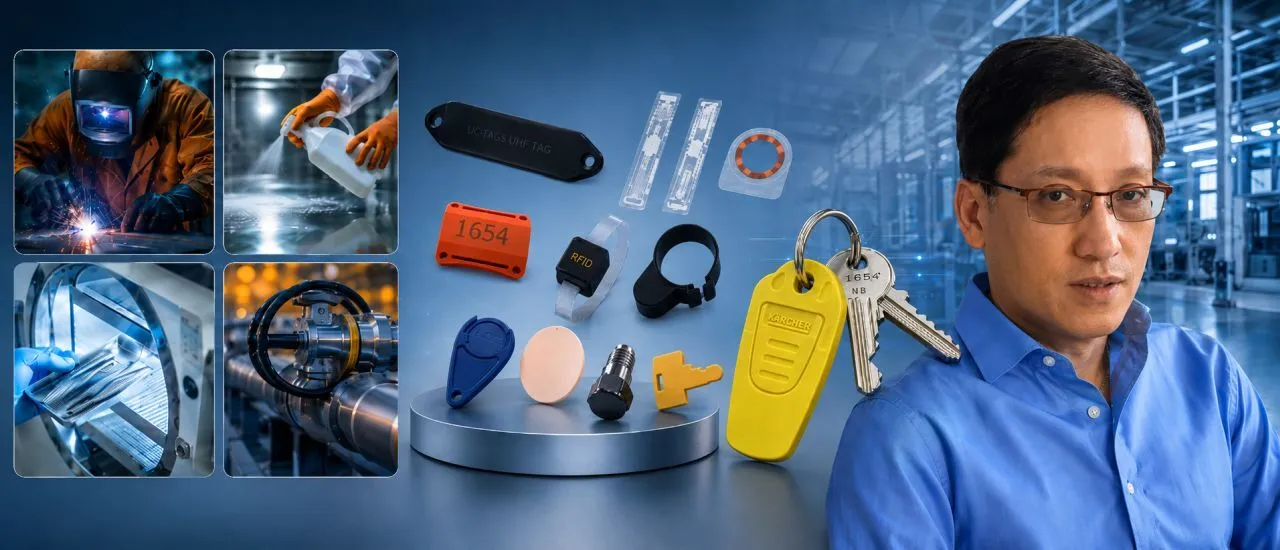

- Standard RFID tags often fail in metal, heat, and chemical-heavy environments due to physical and material limitations.
- B-Id customizes RFID hardware by analyzing environmental conditions, materials, read ranges, and stress factors to ensure reliable performance.
- Specialized tags include on-metal designs, high-temperature resistance up to 250°C, and durable coatings for chemical exposure.
- Multi-frequency RFID solutions (LF, HF, UHF) and integration approaches are important for meeting diverse industrial identification needs.
RFID links physical objects to digital processes. In industry, companies use it to tag tools, containers, components, vehicles, medical instruments, textiles, cables, machine parts, and products. The technology makes objects uniquely identifiable, traceable, and digitally usable.
However, demanding applications pose special challenges for RFID. Metal reflects or distorts radio signals. Heat stresses plastics, adhesives, and fastening technology. Chemicals attack housings and protective coatings. Mechanical stress, moisture, cleaning, sterilization, or vibration can also affect the tag.
In such environments, a standard tag is often insufficient. Success depends not only on the chip. The key lies in the interplay of the antenna, material, housing, mounting, encapsulation, frequency range, read range, and integration.
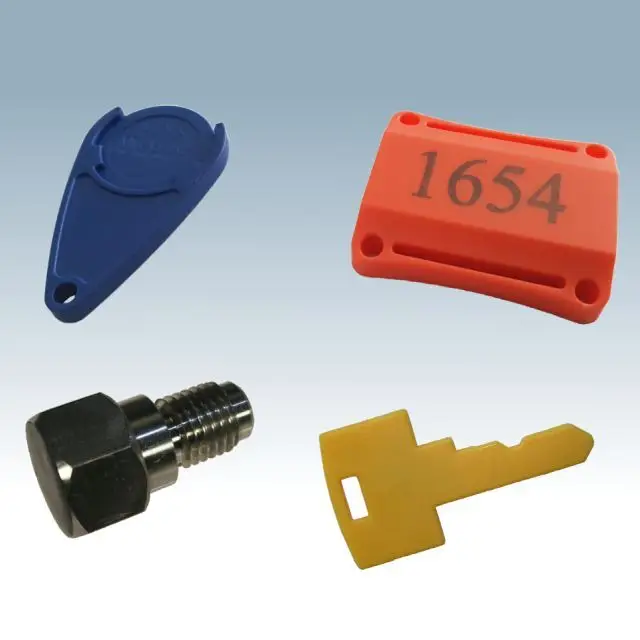
B-Id develops and manufactures industrial RFID tags and specialized transponders for such applications. The company operates as an OEM and ODM partner, produces solutions for LF, HF, UHF, and frequency combinations, and maintains an international network. The portfolio includes tokens, on-metal tags, rugged hard tags, high-temperature UHF tags, inlays, smart cards, key fobs, and custom RFID components.
Yiwen Jin, Managing Director of B-Id, sums up the fundamental question: “Answering these questions is crucial.” He is referring to the environment, the object, the read range, and the stress involved in the process.
Tag, Transponder, Inlay, or Label?
In practice, RFID tags, transponders, inlays, and labels are often used interchangeably. Technically, however, the terms differ. A transponder is the functional unit consisting of a chip and an antenna that responds to a radio signal. A tag is the ready-to-use form of this transponder, for example as a hard tag, token, on-metal tag, or embedded component. An inlay usually consists of a chip and antenna on a carrier material. An RFID label integrates an inlay into a self-adhesive label.
In many industrial applications, therefore, the focus is not on traditional labels. What is needed are robust tags that are suited to the material, environment, and process.
When the application determines the transponder design
Standard tags and RFID labels work well when the environment remains controllable. In harsh industrial processes, different rules apply.
A tag on metal requires a different antenna design than a tag on plastic. A transponder for sterilization processes requires different materials than a tag for a reusable container. An RFID tag in chemical plants must withstand different stresses than a tag in a retail environment.
That is why a good RFID project does not begin with the selection of an available product, but with an analysis of the application. Which surface needs to be tagged? How will the tag be attached? What temperature peaks occur? Which chemicals or cleaning processes affect the material? Which frequency delivers the appropriate performance?
The transponder design is based on these answers.
B-Id develops RFID tags for OEM and ODM projects
B-Id develops RFID hardware for industrial applications and manufactures custom tags in series production. As an OEM and ODM partner, the company combines product development, material expertise, antenna design, and manufacturing.
B-Id works with a wide variety of materials to develop RFID products with specific properties, unique capabilities, and application-oriented designs. The tags must not only impress on paper but also function reliably in the process.
Custom RFID solutions must be technically suitable but also remain suitable for mass production. B-Id therefore develops RFID products in such a way that they can be transferred to mass production using economically viable manufacturing processes.
For industrial users, this combination is crucial: they do not receive a compromise from the standard catalog, but rather an RFID solution tailored to the material, environment, read point, service life, and production volume.

On-metal, high-temperature, and chemical environments: RFID under real-world conditions
Many demanding RFID applications fail not because of the concept, but because of the wrong hardware. A tag that works well in the lab can fail in the production process when metal, heat, chemicals, or mechanical stress come into play.
For on-metal applications, the antenna must be tailored to the metallic environment. Special antenna geometries, spacer materials, housing designs, and substrate materials ensure that tools, machines, vehicle parts, containers, or reusable metal containers can be reliably identified.
In high-temperature applications, the entire assembly must withstand thermal stress. B-Id offers high-temperature UHF tags and inlays with a temperature resistance of up to 250 degrees Celsius. Such solutions are suitable for painting processes, heat treatments, manufacturing steps involving high-temperature stress, as well as cleaning and sterilization.
In the presence of chemical stress, the choice of materials determines the service life. Enclosures, encapsulants, adhesives, protective coatings, and antenna integration must withstand aggressive media, moisture, and numerous process cycles. Yiwen Jin clearly describes the requirements for industrial transponders: They must withstand stress “without losing their functionality.”
LF, HF, UHF, and Frequency Combinations
B-Id develops RFID tags for LF, HF, and UHF as well as for frequency combinations. This diversity is important because each frequency has different strengths.
LF is suitable for robust near-field applications, short read distances, and specific material conditions. HF and NFC offer advantages in controlled proximity, smart cards, authentication, access, or mobile interaction. UHF enables longer read ranges, fast detection, and industrial object identification across multiple tags.
Therefore, the key factor is not which RFID technology is generally the best, but which frequency is best suited to the task.
Frequency combinations expand the possibilities. An object can be automatically captured in an industrial UHF process and additionally be available via HF or NFC for service, maintenance, authentication, or mobile interaction.
State of the Art: Specialization Instead of Standardization
RFID development in recent years has taken two directions: The mass market is scaling up, while specialized industrial applications require specialized hardware.
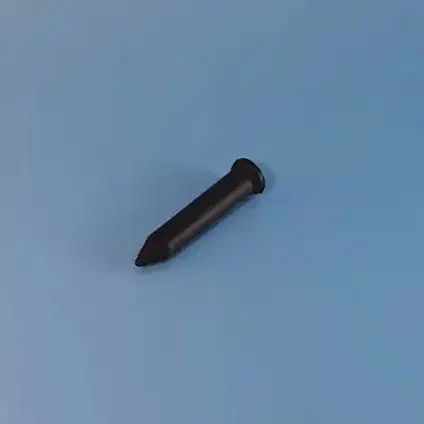
An important trend is the miniaturization of robust tags. Small form factors enable integration into tools, medical instruments, components, or tight installation spaces, but must remain reliably readable despite limited antenna surface area.
A second trend is improved performance on challenging materials. On-metal tags, specialized housing materials, ceramic solutions, and optimized antenna designs are expanding the range of RFID applications.
A third trend is integration into products and materials. RFID is no longer simply retrofitted. Transponders are embedded, encapsulated, overmolded, or integrated directly into components. This increases protection, service life, and process reliability.
RFID with additional process information is also gaining relevance. In addition to identification, passive and semi-passive RFID sensors can detect or display conditions such as temperature events, humidity, stress, or corrosion. As a result, the tag is evolving from a digital name tag into a carrier of relevant process data.
Reliability Determines Utility
In industry, it doesn’t matter if RFID works once. What matters is whether RFID works consistently, reliably, and under real-world conditions.
A tag that works reliably on plastic but fails on metal jeopardizes the process. A transponder that cannot withstand heat causes incorrect readings and rework. A tag that detaches during cleaning, vibration, or exposure to chemicals creates uncertainty instead of transparency.
Reliability is therefore not an added benefit, but the core of industrial RFID hardware.
B-Id describes its own approach using the terms expertise, experience, reliability, and trust. This combination is particularly relevant for specialized RFID transponders.
Expertise determines antenna design and material selection. Experience helps identify critical operating conditions early on. Reliability is demonstrated through consistent readability, long service life, and reproducible production quality. Trust is built when a custom tag remains resilient across many process cycles.
International Networking for European and Global Projects
B-Id has evolved into a developer, manufacturer, and supplier of RFID hardware with a focus on the European market. At the same time, the company operates internationally: Germany and China serve as key locations, partnerships provide a broad foundation, and a branch office in the U.S. serves the North American market.
This structure is an advantage for OEM and ODM projects. Customers receive consulting and project support close to the market, while B-Id can leverage international manufacturing and supply structures for series production.
Specialized RFID transponders for real-world industrial conditions
Anyone who wants to use RFID on metal, in high-temperature environments, in chemically contaminated settings, or in custom industrial processes needs more than a standard tag. They need a partner who can integrate material, antenna, frequency, design, mounting, and mass production.
B-Id combines expertise, experience, reliability, and trust with international market and manufacturing expertise. With a focus on Europe, locations and partner networks in Asia, and market access to North America, B-Id supports companies in developing specialized RFID transponders from the technical concept to a production-ready solution.
For industrial applications where standard solutions are insufficient, this results in a decisive advantage: specialized RFID transponders that reliably identify objects—even under heat, chemical exposure, metal contact, and mechanical stress.