
- RFID assigns unique digital identities to garments, enabling automated tracking without manual counting.
- Pooled laundry systems reduce inventory needs, shrinkage by over 50%, and improve laundry efficiency by approximately 30%.
- Automated issuance options include RFID lockers, centralized hanging systems, and room solutions to suit different facility needs.
- Real-time tracking of returns and garment lifecycle supports hygiene compliance and prevents premature garment replacement.
How deister electronic supports hygiene standards, ensures the availability of workwear, and reduces costs in food production through digital textile management.
In food production, hygienically sound work and protective clothing is a central component of product safety. It must be clean, undamaged, the right size, and available on time. In many facilities, however, textile management is still organized manually. Where an item is located, how long it has been there, or how often it has been washed often remains unknown.
This creates a dilemma: HACCP requirements demand controlled hygiene processes. At the same time, shrinkage, inventory turnover, and administrative overhead must be minimized. RFID solutions from deister electronic address both of these requirements. Each garment is assigned a digital identity and can be automatically tracked from delivery to return.
HACCP Requires Reliable Textile Processes
HACCP stands for “Hazard Analysis and Critical Control Points” and forms the basis of hygiene management in food processing. Companies must identify hazards, define critical control points, and implement measures to minimize risk.
Workwear is part of this system. It must not itself become a source of contamination and must be changed, cleaned, and made available in accordance with the production environment. Damaged clothing can lose its protective function.
Therefore, it is not enough to simply keep clean clothing on hand. It must be available at the start of every shift. At the same time, it should be possible to track which garments have been issued, returned, cleaned, or discarded.
However, paper lists, personal lockers, and visual inspections do not provide complete inventory transparency. With multiple shifts, misallocations, wait times, and supply gaps can occur.
Shortages, Surpluses, and Shrinkage
If a clean lab coat or a pair of suitable pants is missing at the start of a shift, an employee may not be able to enter the production area. An unreliable supply of workwear thus has a direct impact on production.
At the same time, many companies keep more clothing on hand than is needed. This is often due to a person-based laundry supply system. Multiple sets are reserved for each employee, even during vacation or sick leave.
If textiles are sorted manually, items end up in the wrong compartment, remain unused, or are taken by other people. Without digital inventory data, it is difficult to determine which sizes are missing and how many garments are actually needed.
Shrinkage also causes significant costs. Workwear is not returned, is stored in lockers, or is accidentally taken off the premises. The article cites shrinkage rates of around 20 percent as not uncommon.


RFID gives every garment a digital identity
deister electronic is a manufacturer of RFID components and RFID-based automation solutions. For digital textile management, the company combines wash-resistant UHF RFID transponders, reader technology, issuance and return systems, and software.
Each garment is equipped with an RFID transponder bearing a unique identification number. Unlike with a barcode, the garment does not need to be held individually in front of a reader. Multiple items can be detected simultaneously.
Upon receipt of goods, entire laundry containers can be identified in a single step. Manual counting is no longer necessary; all movements are automatically documented. The system detects when a garment has been delivered, stored, issued, or returned. Managers receive an up-to-date overview of quantities, sizes, and returns.
Pooled linens reduce the volume in circulation
RFID lays the foundation for the transition from individual-assigned laundry to pooled laundry. Employees retrieve a hygienically processed garment in their size from a shared inventory.
The facility no longer needs to reserve multiple complete sets of clothing for each person. The inventory is based on actual demand by size, shift, and production area. Each item taken is assigned to a specific person, and quotas can also be set.
In practice, RFID-based textile management can yield significant savings:
Shrinkage can be reduced by 50 percent or more,
laundry efficiency can increase by about 30 percent,
and the required inventory turnover can be reduced by about 30 percent.
The exact potential for each individual facility depends on existing processes, inventory levels, and the chosen system solution.
RFID-Based Clothing Room Solution at University Hospital Graz
Implementing RFID technology in hospital laundry logistics significantly enhances efficiency, transparency, and employee satisfaction while reducing operational costs and garment loss.
Three Solutions for Automated Issuance
deister electronic offers three system concepts for the automated issuance of work and protective clothing.
1. RFID Issuance Lockers
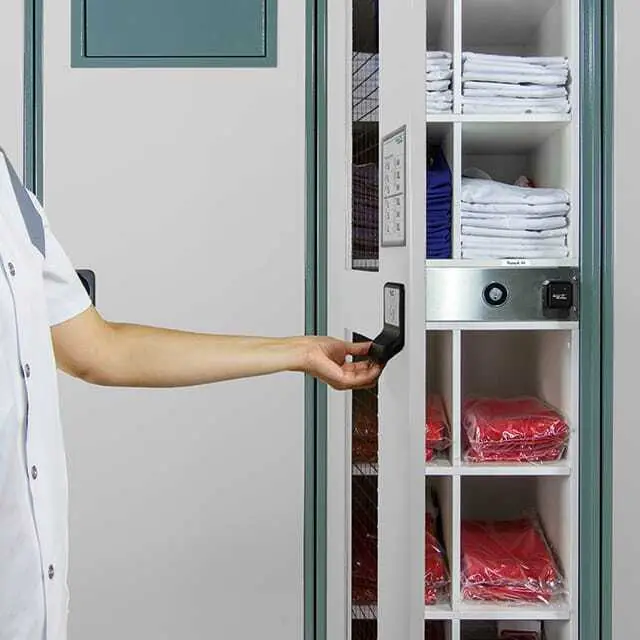
The cabinets can be installed wherever clothing is needed. Employees identify themselves and retrieve authorized items. The system then checks inventory levels and logs the items—along with the date and time—to the user’s account.
Individual quotas prevent excessive withdrawals. Work shoes, cut-resistant gloves, and other items equipped with UHF transponders can also be managed.
2. Centralized Hanging Issuance
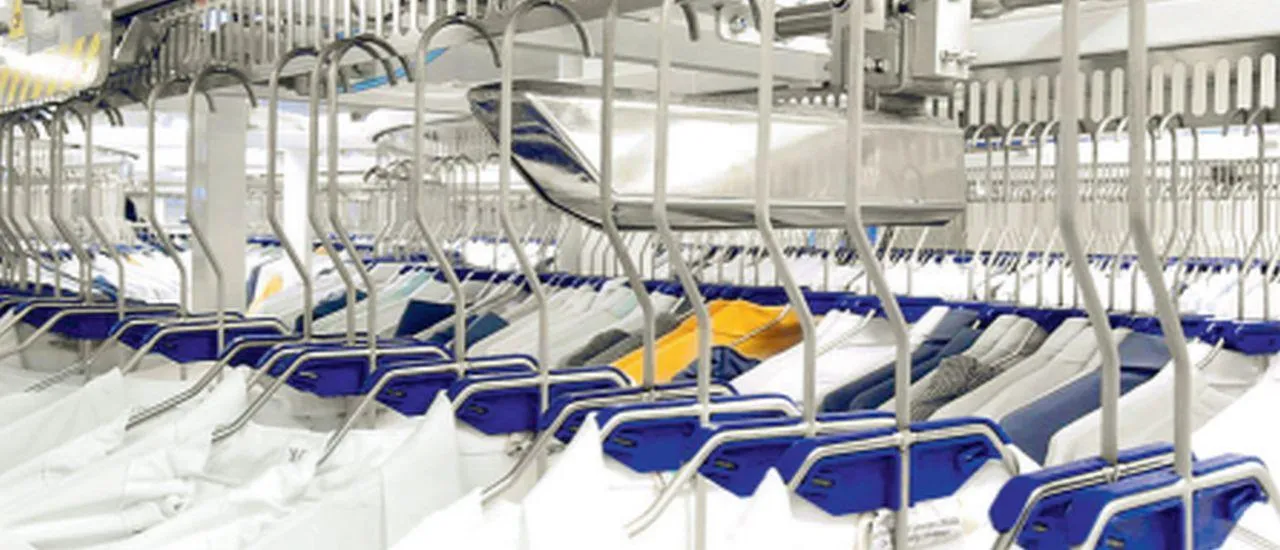
Here, garments are stored on hangers in an automated conveyor system. After identification, the employee selects the required item at the terminal. The system transports the item to the pickup station.
This controlled process prevents other garments from being touched, which is advantageous in hygiene-sensitive areas. However, this approach requires more space and involves more complex hanger logistics.
3. RFID Room Solution
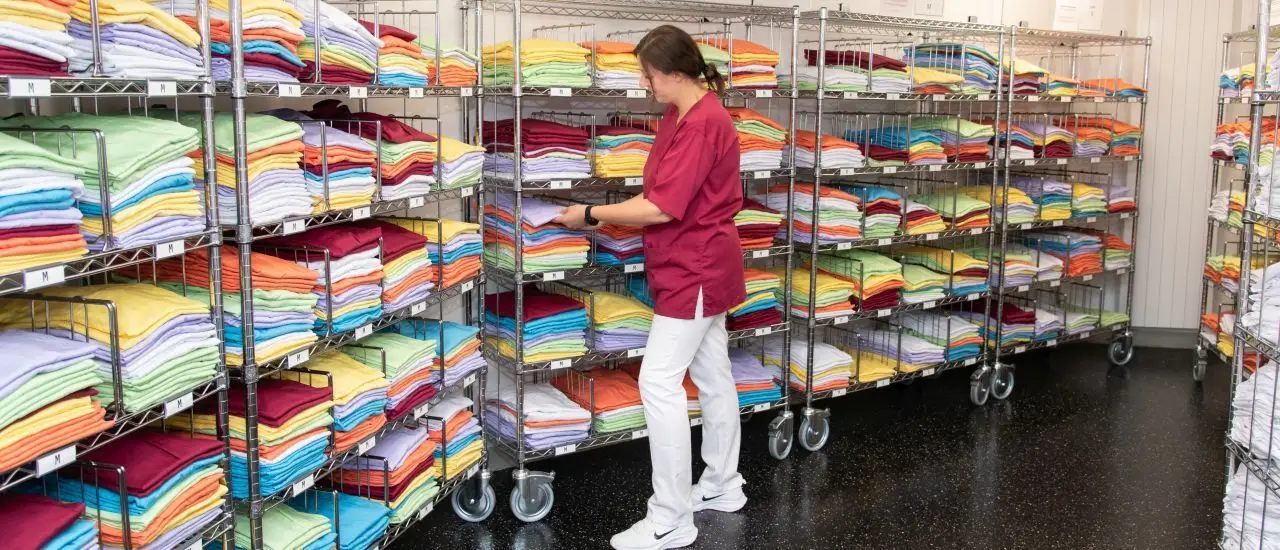
The room solution functions like an automated, walk-in wardrobe. After identification, the employee enters the dispensing room and selects the required items themselves.
Upon exiting, all items are automatically detected and assigned to the user’s account. Individual scanning is not necessary. The clothing can be folded or ready on hangers. This enables quick distribution at the start of a shift.
Automatically Track Returns and Lifecycle
Used clothing is returned via RFID-enabled return lockers or collection points. Returns are automatically recorded and assigned to the user.
This makes it possible to track who took and returned which garments. Missing items are identified sooner, returns can be better planned, and inventory is managed based on real-time movement data.
In addition, the lifecycle of each garment can be documented. If every wash cycle is recorded, it becomes clear how often a garment has been laundered and when an inspection, repair, or decommissioning is necessary.
This is important for hygiene, as worn-out materials or open seams can compromise the garment’s protective function. At the same time, it prevents perfectly good clothing from being replaced prematurely.
Combining Hygiene and Cost-Effectiveness
Implementing a digital textile management system requires investment in transponders, reading technology, issuance and return systems, and software. The economic benefits stem from reduced inventory levels, lower shrinkage, more efficient laundry logistics, and less administrative effort.
With deister electronic’s RFID-based textile management system, issuance, return, inventory, and lifecycle are automatically documented. Workwear thus becomes a transparently controllable component of hygiene management.
For food producers, this means safer processes, more predictable inventory levels, and a reliable supply for employees. Clean clothing is no longer simply provided—it is digitally managed and integrated into the production process as needed.
Manage the Entire Laundry Cycle with textag®
With deister electronic’s textag® textile management system, issuance, returns, and inventory are automatically tracked via RFID. Flexible room and locker systems enable centralized or decentralized supply, reduce travel time, and provide round-the-clock transparency across the entire laundry cycle.
This allows for targeted optimization of inventory, reduction of shrinkage, and sustainable cost savings. Companies can test textag® solutions live in the demo room in Barsinghausen near Hanover.
Schedule a free consultation and personalized demo today.