
ESP32-S31: A New SoC for Converged Wireless IoT Architectures

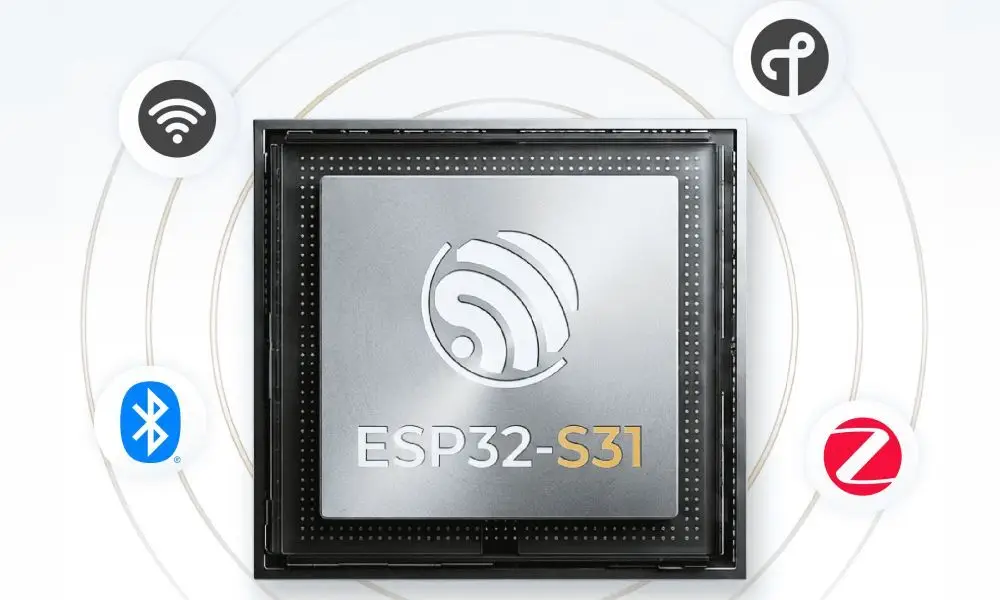
Espressif Systems, known for its widely adopted ESP32 and ESP8266 platforms in Wi-Fi and Bluetooth-based IoT devices, has introduced the ESP32-S31. The new dual-core RISC-V SoC integrates Wi-Fi 6, Bluetooth 5.4, IEEE 802.15.4, and Ethernet in a single chip.
With this release, Espressif addresses a growing requirement in IoT system design: devices are no longer built for a single protocol or network layer, but must operate across multiple wireless standards while handling increasing levels of local processing, interaction, and security.
Convergence of Wireless Networks
The ESP32-S31 reflects a structural shift in IoT connectivity. In many deployments today, devices are expected to communicate across Wi-Fi infrastructures, participate in Thread or Zigbee mesh networks, exchange data via Bluetooth, and integrate into IP-based environments. Traditionally, this required multiple components or gateway layers.
By combining these technologies in one SoC, the ESP32-S31 enables more flexible and streamlined system architectures. It supports Matter over both Wi-Fi and Thread, allowing devices to operate within interoperable ecosystems while reducing integration complexity.
A New Role in Wireless Topologies
The architectural relevance of the ESP32-S31 lies in its ability to transform devices into multi-role nodes. Instead of acting purely as endpoints, devices can take on functions within the network itself. A single hardware platform can bridge mesh networks to IP-based systems, support local control logic, and connect to cloud services when required.
This reduces the dependency on dedicated gateways and supports more distributed and resilient network designs. The inclusion of Ethernet further strengthens this approach by enabling hybrid topologies, where a wired backbone supports wireless edge communication.
Edge Processing and Performance
To support these roles, the ESP32-S31 integrates a dual-core 32-bit RISC-V microcontroller running at up to 320 MHz. One core features a 128-bit SIMD data path, enabling efficient parallel processing. Combined with 512 KB SRAM and support for high-speed DDR PSRAM, the platform is designed for data-intensive workloads.
This processing capability allows more functionality to move to the edge. Tasks such as local decision-making, signal processing, or AI inference can be executed directly on the device, reducing latency and network load while increasing system autonomy.
Interface and Multimedia Integration
Beyond connectivity and compute, the ESP32-S31 is equipped for applications that require direct user interaction. Support for camera interfaces, parallel LCD displays, and capacitive touch enables the development of devices with integrated visual and tactile interfaces. Hardware acceleration for image processing and graphics further improves efficiency.
This combination positions the chip for a new generation of IoT devices that merge connectivity with human-machine interaction, including smart appliances, control panels, and multimedia systems.
Security for Heterogeneous Networks
In multi-protocol environments, security becomes a critical factor. The ESP32-S31 integrates hardware-based protection mechanisms such as secure boot, memory encryption, and cryptographic acceleration. A RAM-based PUF enables secure key generation, while a Trusted Execution Environment allows the isolation of software components.
These features are essential in systems where devices operate across different network domains and must maintain trust and data integrity.
Software Ecosystem and Outlook
The SoC will be supported by Espressif’s development frameworks, including ESP-IDF, ESP-Matter, and ESP-GMF. It can also function as a connectivity co-processor and is positioned for use in voice-enabled and AI-assisted applications.
With the ESP32-S31, Espressif is responding to the increasing complexity of IoT systems. The combination of multi-protocol connectivity, edge processing, and integrated interfaces reflects a broader industry trend toward devices that are no longer simple endpoints, but active participants in distributed, intelligent networks.
Read more at https://www.espressif.com/en/news/ESP32_S31_Release