
U.S. Study: LoRa IoT Automates Irrigation in Field Test

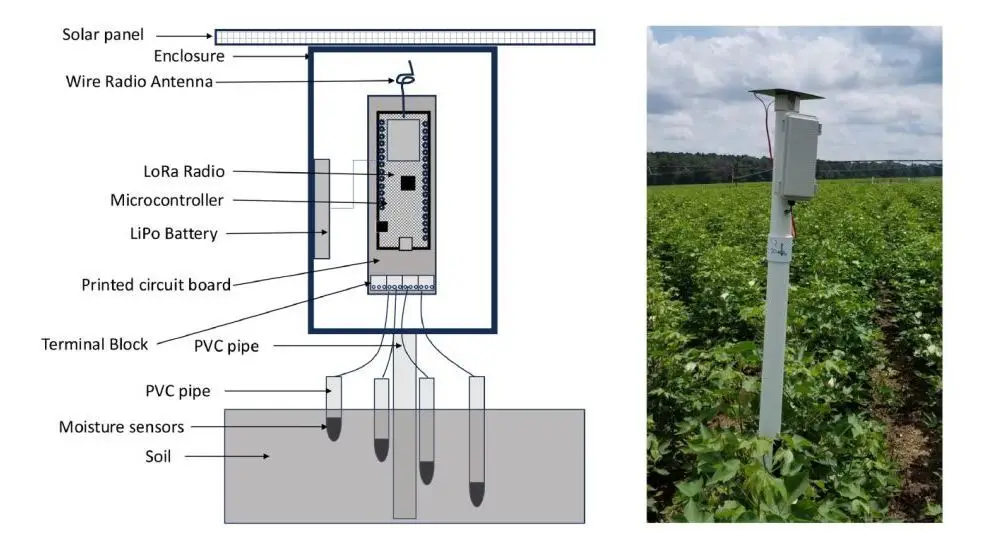
The study by José O. Payero, Udayakumar Sekaran, and Dana Bodiford Turner (Clemson University), published on ScienceDirect (Elsevier), demonstrates how a low-cost, open-source IoT system for semi-automated irrigation can be implemented using a lateral-move system.
The solution was tested under real-world field conditions over three cotton growing seasons. It controls irrigation zones based on real-time data regarding soil water potential.
IoT for More Precise Irrigation
Irrigation systems on many farms still operate according to fixed schedules or manual decisions. This can lead to over- or under-irrigation, especially under varying soil and field conditions.
The study addresses this problem with a wireless sensor network that measures soil water potential in real time and automatically controls individual irrigation zones of a lateral-move system. The goal is precise, zone-based water distribution during an irrigation cycle.
A lateral-move system is a linear irrigation system that moves sideways across the field and distributes water evenly via multiple sprinklers.
System architecture with LoRa, sensors, and relay control
The system was tested on a 1.5-hectare cotton field at Clemson University’s Edisto Research and Education Center in South Carolina and is based on open-source electronic components and an IoT platform.
WATERMARK-200SS sensors were installed in each irrigation zone to measure soil water potential at three depths. Sensor data was recorded every 20 minutes and transmitted via LoRa to a central receiver.
A position sensor with an encoder also determined the position of the Lateral-Move system in the field. Based on this, the system could decide which zones actually needed to be irrigated as it moved through the field.
16 irrigation zones in the field trial
The field was divided into 16 independently monitored zones. Control was achieved via relays and solenoid valves on the sprinkler lines.
In 2021 and 2022, four variants were compared: a dryland control trial without irrigation, as well as three irrigation thresholds at −30, −40, and −50 kPa soil water potential.
The kPa values describe soil water potential: the more negative the value, the drier the soil and the later irrigation occurs.
The threshold of −30 kPa resulted in more frequent irrigation events and more stable soil water conditions. At −50 kPa, greater fluctuations occurred because longer dry periods were allowed.
Field test over three growing seasons
The system was tested in cotton cultivation from 2020 to 2022. The focus was on technical aspects such as wireless communication, data collection, positioning, and zone-specific valve control.
Practical challenges arose during the first year of operation, including wildlife, damaged sensor cables, thunderstorms, and limited solar power supply. These issues were mitigated through protective measures and design adjustments.
Despite these conditions, 13 out of 16 sensor nodes functioned reliably in the first year. System stability was further improved in subsequent years.
No Significant Differences in Yield
Due to high and well-distributed rainfall, irrigation events were rare. Accordingly, no significant differences in cotton yield were observed between the variants.
The study thus primarily demonstrates the technical feasibility and reliability of the system. Conclusions regarding agronomic benefits under dry conditions require further investigation.
LoRa communication in the system: Architecture without LoRaWAN
The wireless sensor network is based on LoRa for local data transmission in the field. Sensor nodes send their measured values directly to a central control unit.
This is not a LoRaWAN network. Communication takes place directly between sensors and the receiver in a simple star topology.
The cloud connection is established separately via a cellular module. This module transmits the data to an IoT platform for real-time visualization.
For system integrators, this approach represents a typical agricultural IoT architecture: LoRa for local communication, cellular for external data integration. This keeps the system independent of additional network infrastructure.
Partial automation with a path to full automation
The system automates water distribution within the zones. The start and end of the irrigation process are still controlled manually.
This constitutes partial automation. Full automation would require additional components, including pressure sensors, flow switches, and safety mechanisms for pump operation.
You can find the full study here: https://www.sciencedirect.com/science/article/pii/S2772375526002261