
Machine Learning Improves Identification of Closely Spaced Chipless RFID Tags

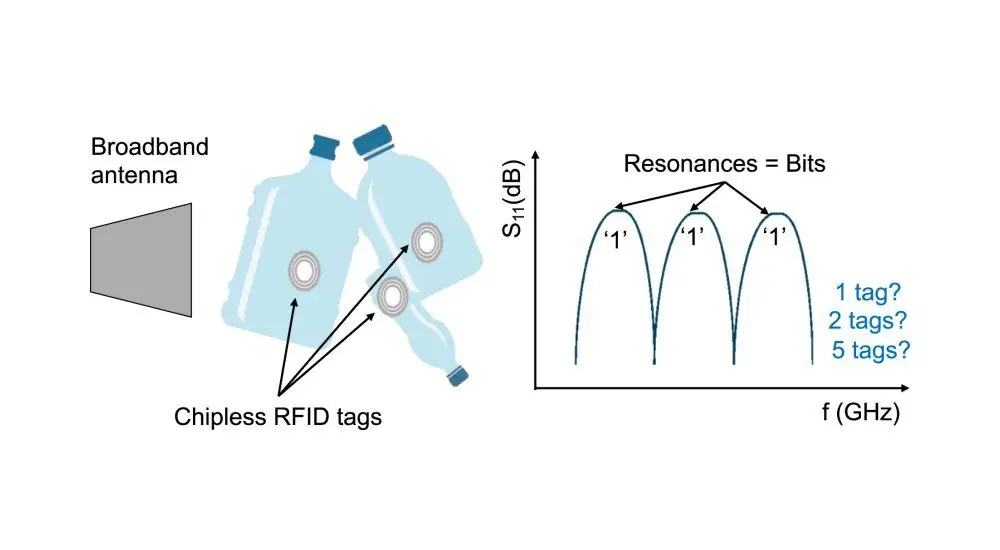
A new IEEE study shows how machine learning can help identify and localize closely spaced chipless RFID tags that are difficult to resolve with conventional signal processing. Using raster-scanned backscatter measurements and a supervised classifier, the method reconstructs probability maps that indicate both tag type and position, even under strong mutual coupling.
A Persistent Challenge in Chipless RFID
Chipless RFID is attractive for ultra-low-cost tagging scenarios where conventional passive UHF RFID may be too expensive. The technology is particularly relevant for high-volume, low-margin applications such as material identification and sorting. However, one major limitation remains: when multiple chipless tags are present in the reader field, their spectral responses superimpose, making reliable identification and localization difficult.
Unlike chipped RFID, chipless systems do not use anticollision protocols such as slotted ALOHA. Instead, the reader receives a cumulative response from all tags in view. This becomes especially problematic when tags are placed close together, because mutual coupling distorts both spectral and spatial signatures.
Machine Learning Applied to Spatial-Spectral Tag Separation
The study proposes a machine learning-based framework to resolve this problem. The approach uses a 2-D raster scan with a directive reader antenna to collect backscattered magnitude and phase responses across a defined area. At each scan point, the measured signal is processed by a trained multinomial logistic regression classifier.
The classifier estimates the probability that a given spatial point belongs to one of several chipless tag classes. These outputs are then converted into color-coded probability maps that show where each tag is likely located and which tag type is present. Postprocessing based on contour filtering, thresholding, and clustering is used to extract tag identity and estimate tag positions.
Experimental Setup With Three Tag Types
The evaluation was carried out using three single circular ring resonator tag types with distinct resonant frequencies in the 2 to 6 GHz range. Up to two tags were placed within a 14 cm × 14 cm measurement area and scanned using a Vivaldi antenna connected to a vector network analyzer.
The system collected 94 raster scan instances, covering both isolated and closely spaced tag configurations. Measurements were taken for both magnitude and phase, enabling comparison between the two signal domains.
A key target of the work was to resolve tags at spacings below 0.6λ, a range where previous methods struggled due to coupling effects. This threshold is relevant because it approaches the practical resolution limit for passive microwave structures.
High Accuracy With Phase-Based Measurements
The reported results show that the method performs particularly well when using phase data. Tag identification reached 100 percent accuracy with phase measurements and 97.82 percent with magnitude data.
Localization performance also improved significantly with phase. The average Euclidean localization error was 6.4 mm for phase-based processing, compared with 1.19 cm for magnitude-based processing. According to the authors, this demonstrates sub-centimeter precision even when tags are placed closer than the previously unresolved 0.6λ spacing.
For developers of chipless RFID systems, the result is relevant because it indicates that machine learning can compensate for coupling-induced distortions that are difficult to handle with conventional analytical methods alone.
Relevance for Scalable Chipless RFID Applications
The proposed method addresses a core barrier to broader chipless RFID deployment: simultaneous reading of multiple nearby tags. This is particularly important in applications such as recycling, sorting, and low-cost asset identification, where throughput and dense tag populations matter.
By combining raster-scanned backscatter data with supervised learning, the study introduces a new route toward spatially resolved multitag reading in chipless RFID. For system integrators and technology developers, the work suggests that AI-based interpretation could help move chipless RFID beyond single-tag or widely separated-tag scenarios.
Current Limits and Next Steps
The authors note that the approach is currently demonstrated under controlled laboratory conditions. Generalization to real-world deployments remains challenging due to environmental sensitivity, lack of standardized measurement protocols, and limited availability of large chipless RFID datasets.
Future work will focus on larger and more diverse tag populations, more realistic environments, synthetic training data generation, and more advanced machine learning models such as U-Net-based architectures. The researchers also point to phased-array systems as a possible path toward real-time operation and larger-area scanning.
Outlook
The study shows that machine learning can improve both identification and localization of closely spaced chipless RFID tags under conditions where conventional methods fail. While the method still depends on controlled scanning and trained models, it provides a practical proof of concept for addressing one of the most persistent technical limitations in chipless RFID.
Read the full article here: https://ieeexplore.ieee.org/document/11368724
About the Authors
The paper was authored by researchers from Auto-ID Labs at the Massachusetts Institute of Technology (MIT), Cambridge, USA, a group known for its work on identification technologies, sensing systems, and RFID-related research.
F. Villa-Gonzalez, H. Li, R. Bhattacharyya, Sobhi Alfayoumi, and S. E. Sarma are all affiliated with Auto-ID Labs MIT. Their work in this study focuses on the use of machine learning to improve the identification and localization of closely spaced chipless RFID tags, addressing a long-standing challenge in chipless RFID system design.