

IEEE 802.15.4 IR-UWB Positioned for Scalable Adoption Across Industries

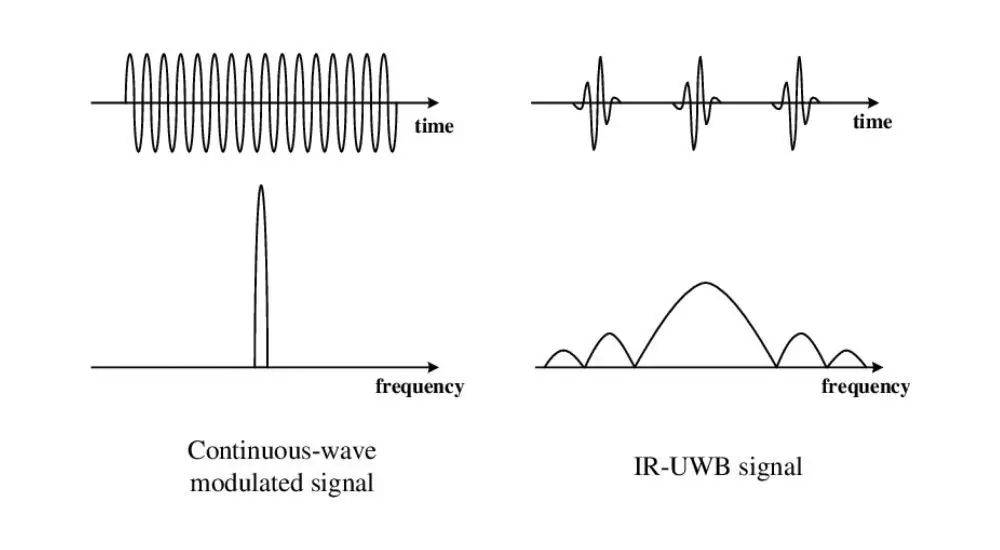
A recent IEEE publication outlines the growing role of impulse radio ultra-wideband (IR-UWB) under IEEE 802.15.4 as a key technology for precise ranging, sensing, and low-power communication. The paper highlights increasing adoption across automotive, consumer, and industrial sectors, supported by ongoing standardization and ecosystem development.
Expanding Adoption Across Industries
IR-UWB has transitioned from niche industrial deployments into broader commercial and consumer markets. Early use cases focused on asset tracking and real-time location systems. Today, adoption is accelerating in applications such as digital vehicle access, mobile devices, and smart environments.
Industry consortia including the Car Connectivity Consortium, FiRa Consortium, Omlox, and the Connectivity Standards Alliance are actively building specifications based on IEEE 802.15.4 UWB capabilities. This alignment between standardization and market requirements is driving interoperability and deployment at scale.
What Is IR-UWB?
Impulse Radio Ultra-Wideband (IR-UWB) is a wireless technology that transmits data using very short pulses rather than continuous signals. These pulses, typically in the nanosecond range, create a wideband signal with bandwidths often exceeding 500 MHz.
This wide bandwidth enables highly accurate time-of-arrival measurements, allowing systems to determine distances between devices with centimeter-level precision. This makes IR-UWB particularly suitable for localization and proximity-based applications.
Unlike narrowband systems, IR-UWB performs well in environments with reflections and interference. The short pulses allow the receiver to distinguish between multiple signal paths, improving robustness in indoor and complex environments.
Another defining characteristic is the very low transmit power. IR-UWB operates at extremely low power spectral densities, enabling coexistence with other wireless technologies in the same frequency bands while minimizing interference.
In addition to communication, IR-UWB can be used for sensing applications, as the reflected signals provide information about the environment, including motion and presence.
Technical Advantages for Ranging and Communication
The paper emphasizes that IR-UWB’s large bandwidth enables steep signal edges, which improve the precision of timing measurements. This directly translates into accurate ranging performance, even in multipath conditions where traditional radio systems struggle.
At the same time, the technology supports a wide range of data rates, from low data rate operation for energy-efficient applications to higher throughput modes for communication use cases.
Receiver design plays a central role in system performance. Depending on the implementation, systems can use non-coherent detection for simplicity or coherent detection for higher accuracy and improved signal interpretation.
Evolution of the IEEE 802.15.4 Standard
The development of IR-UWB is closely tied to the evolution of the IEEE 802.15.4 standard. Key milestones include:
Introduction of UWB physical layers in 802.15.4a
Extensions for RFID and RTLS in 802.15.4f
Secure and accurate ranging enhancements in 802.15.4z
Ongoing improvements in the 802.15.4ab amendment project
Recent updates focus on improving ranging accuracy, enabling sensing capabilities, increasing data rates, and optimizing energy efficiency. These enhancements are designed to meet the requirements of emerging applications in automotive, IoT, and consumer devices.
Emerging Use Cases: Access, Positioning, and Sensing
The paper identifies several application areas driving IR-UWB adoption:
Digital vehicle access using secure proximity verification
Indoor navigation with high spatial resolution
Hands-free access control for buildings and enterprise environments
Asset tracking and logistics in industrial settings
In addition, sensing capabilities are enabling new use cases such as presence detection, motion analysis, and monitoring of vital signs. In automotive environments, IR-UWB is also being explored for child presence detection and positioning support.
Spectrum Efficiency and Coexistence
A key characteristic of IR-UWB is its ability to operate at very low transmit power levels. This results in a minimal interference footprint, allowing multiple systems to share the same spectrum.
Unlike traditional approaches that rely on avoiding interference, IR-UWB enables coexistence-based spectrum sharing, where multiple technologies can operate simultaneously. This is particularly relevant for dense IoT environments with a high number of devices.
However, coexistence also requires careful system design, as high-power signals from other technologies can impact UWB receiver performance.
Regulatory Considerations and Challenges
Despite technical maturity, regulatory fragmentation remains a challenge. Differences in spectrum allocation and operational rules across regions increase complexity for global deployments.
The paper highlights the need for:
Greater harmonization of UWB regulations
Support for fixed infrastructure and outdoor deployments
Clarification of rules for vehicular applications
Flexibility for low-power and transmit-only devices
Addressing these issues will be critical for enabling broader adoption and reducing development costs.
Outlook: Convergence of Ranging, Sensing, and Communication
IR-UWB is evolving into a multi-functional wireless technology that combines precise ranging, environmental sensing, and data communication. Ongoing standardization efforts aim to further enhance performance, reduce energy consumption, and improve interoperability.
As integration into consumer devices increases and ecosystem support expands, IR-UWB is expected to play a central role in applications requiring spatial awareness and secure proximity detection.
Read the full study here: https://ieeexplore.ieee.org/document/11277364
About the Authors
The paper was written by four long-standing wireless standards experts with deep experience in UWB, IEEE 802.15, and spectrum policy.
Clint Powell is Managing Director of PWC, LLC and Chair of the IEEE 802.15 Wireless Specialty Networks Working Group.
Benjamin A. Rolfe is CTO of the UWB Alliance and Chair of the IEEE 802.15.4ab Task Group.
Dries Neirynck is Director and Chief Engineer at Ultra Radio Ltd, specializing in UWB system design and regulation.
Jim Lansford is Principal at Farafir SRL and has more than 40 years of experience in wireless communications, standards, and signal processing.