
LILYGO T-Watch Ultra Combines LoRa, GNSS, NFC and Edge AI in Wearable Form

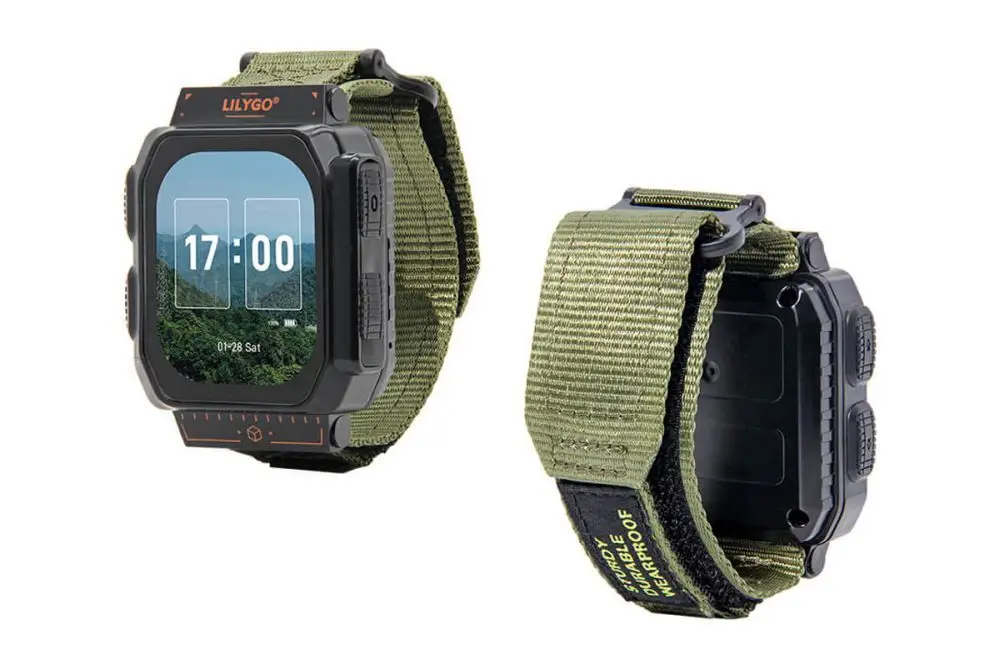
LILYGO, a Chinese manufacturer of open hardware platforms based on ESP32 microcontrollers, has introduced the T-Watch Ultra, a smartwatch development platform for IoT and edge applications. The device integrates LoRa, GNSS, NFC and onboard sensors in an IP65-rated enclosure, targeting prototyping and industrial use cases rather than consumer applications.
Wearable Platform Based on ESP32-S3
The T-Watch Ultra is built around the ESP32-S3, a dual-core microcontroller supporting Wi-Fi and Bluetooth connectivity. It can be programmed using Arduino, ESP-IDF, PlatformIO or MicroPython, enabling direct firmware customization.
A 2.01-inch AMOLED display provides a user interface for data visualization and interaction. The platform is designed as an open development system, allowing integrators to adapt hardware and software to specific IoT requirements.
LoRa, GNSS and NFC for Distributed IoT Systems
A defining feature of the device is the combination of multiple wireless technologies. The integrated SX1262 LoRa transceiver enables long-range, low-power communication, while the u-blox MIA-M10Q GNSS module provides positioning data.
In addition, the device includes NFC functionality based on the ST25R3916 reader IC. This enables short-range interactions such as device pairing, identification, or integration into NFC-based workflows.
Together, these technologies allow the device to operate across different communication layers, from local NFC interaction to long-range LoRa connectivity.
Sensor Integration and Edge AI Capabilities
The T-Watch Ultra integrates a Bosch BHI260AP smart sensor, which combines a microcontroller with an inertial measurement unit. This component is designed for motion-based AI applications, enabling local processing of sensor data such as gesture recognition or activity detection.
Instead of transmitting raw sensor data, the sensor can process information locally and output interpreted events. This reduces data transmission requirements and enables real-time responses directly on the device.
For IoT architectures, this approach supports edge processing and event-driven communication models.
Edge Processing in a Wearable Form Factor
The combination of ESP32-S3 processing, sensor integration and connectivity allows the device to perform local data processing before transmitting relevant information. This is particularly relevant for battery-powered IoT systems where communication should be minimized.
The IP65-rated enclosure enables use in environments exposed to dust or water splashes, supporting field deployments and industrial scenarios.
Relevance for Integrators and Solution Providers
For system integrators, the T-Watch Ultra provides a compact platform that combines processing, connectivity, sensors and user interface in a single device.
Typical use cases include:
wearable LoRa nodes in distributed sensor networks
GNSS-based tracking and monitoring
NFC-enabled identification or interaction points
edge AI sensing for motion or activity detection
prototyping of wearable IoT interfaces
The platform reduces integration effort by combining multiple hardware components into a single system.
Positioning Compared to Similar Platforms
Compared to earlier ESP32-based wearable development kits, such as the T-Watch S3 series, the Ultra version extends functionality with LoRa, GNSS, NFC and integrated AI-capable sensors.
Other ESP32 development boards or LoRa modules provide similar features at component level but lack integration into a wearable, IP-rated device. Dedicated smartwatches typically do not offer open programmability or LoRa connectivity.
This positions the T-Watch Ultra as a development platform for wearable IoT applications where connectivity flexibility and local processing are required.
Industrial and Research Applications
The combination of long-range communication, positioning, short-range interaction and local sensor processing enables deployment in distributed IoT systems.
Potential applications include industrial monitoring, logistics tracking, environmental sensing and wearable interfaces for operational workflows. The integration of NFC and motion-based sensing expands the range of interaction and automation scenarios.