

RFID Enables Local Breathing Measurement in Medical Proof of Concept

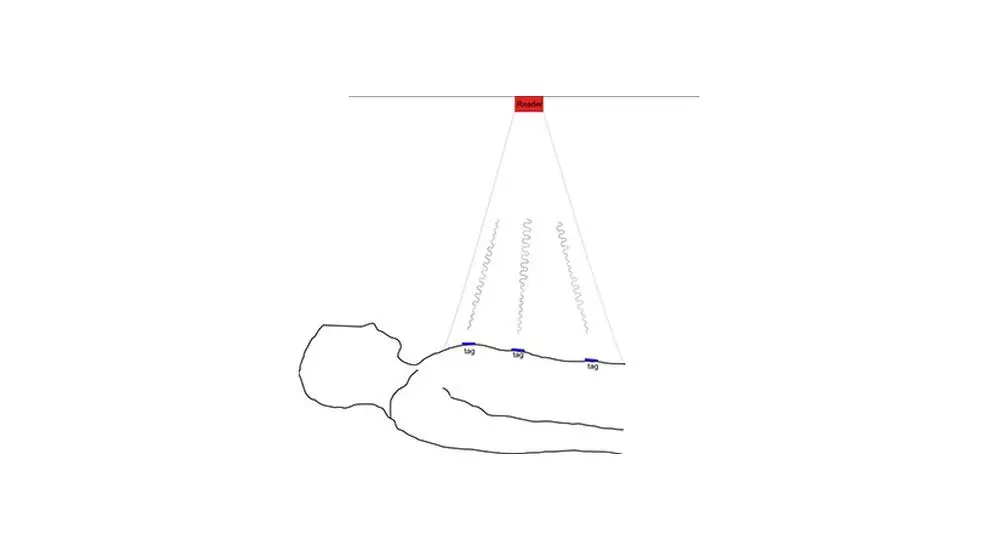
A recent IEEE study demonstrates how UHF RFID can be used to measure localized breathing movements across the chest. Using multiple passive tags and commercial readers, the system captures displacement data in real time. The results highlight both the potential and the technical limitations for clinical use.
From Logistics Technology to Medical Sensing
RFID is widely used in logistics and identification, but its sensing capabilities are increasingly being explored. In this study, published in IEEE Access, researchers investigate whether RFID can measure chest wall displacement at multiple locations simultaneously.
Unlike spirometry, which requires active patient participation, this approach enables non-invasive and passive monitoring. Existing imaging-based methods such as ultrasound or CT scans provide detailed insights but are often costly, complex, or operator-dependent. Wearable solutions offer simpler setups but lack spatial resolution.
The proposed RFID-based method aims to fill this gap by enabling localized and simultaneous measurement across different regions of the thorax.
System Architecture and Measurement Principle
The setup uses a standard UHF RFID system consisting of a reader, antenna, and multiple passive tags. In the experimental configuration, tags are placed at defined positions on the chest of a medical simulation mannequin.
Breathing causes small changes in the distance between the tags and the reader. These changes lead to phase variations in the backscattered signal. By processing the phase data, the system extracts breathing patterns and local displacement.
A key advantage of RFID is that each tag has a unique ID, allowing simultaneous tracking of multiple positions without additional sensors or wiring.
Experimental Validation with Multiple Tag Configurations
Two measurement scenarios were evaluated. In the first, two tags were placed symmetrically on the chest. In the second, four tags were distributed across upper and lower thoracic regions.
The results show strong agreement between RFID-based measurements and reference data obtained from a piezoelectric respiration belt. Correlation values above 0.70 were achieved in most cases, with frequency-domain correlation often exceeding 0.90.
The system was also able to detect asymmetric breathing by simulating deactivation of one side of the respiratory system. In these cases, displacement differences between left and right chest regions were clearly observable.
Limitations of Commercial RFID Hardware
Despite promising results, the study identifies several technical challenges. Commercial RFID systems are not designed for precision motion sensing and are sensitive to multipath interference. This leads to instability and noise in the measurements.
Tag placement and mechanical contact also affect signal quality. In addition, proximity to the human body can detune standard RFID tags, reducing performance.
Another limitation is the measurement setup itself. Increasing the distance between reader and tags improves usability but also increases susceptibility to interference. Achieving a stable configuration requires careful system design.
Requirements for Clinical Deployment
For real-world use, custom system development is required. This includes directional antennas to reduce interference, access to raw signal data for advanced processing, and optimized tag designs for on-body use.
Regulatory aspects must also be considered. RF exposure limits and electromagnetic compatibility with other medical devices are critical factors for clinical environments.
The current study is based on a mannequin model and does not account for real patient movement, posture changes, or soft tissue dynamics. These factors must be addressed in future research.
Outlook: Potential for Non-Invasive Respiratory Monitoring
The study confirms that RFID can capture temporal and frequency characteristics of breathing signals and detect local asymmetries. This opens up potential applications in diagnostics, rehabilitation, and continuous monitoring.
However, the transition from proof of concept to practical deployment depends on overcoming hardware limitations and improving measurement robustness.
About the Authors
The paper was written by an interdisciplinary team from Chalmers University of Technology, Sahlgrenska University Hospital, and the University of Gothenburg.
Jiaqi Wu works in biomedical engineering and sensing technologies for non-invasive health monitoring, with a focus on respiratory signal detection.
Anneli Thelandersson contributes clinical expertise from physiotherapy and intensive care research at Sahlgrenska University Hospital.
Gunilla Kjellby Wendt brings experience in rehabilitation, physiotherapy interventions, and the integration of digital technologies into clinical care.
Monika Fagevik Olsén contributes expertise in physiotherapy, rehabilitation, and clinical practice, with a research focus that includes abdominal surgery.