
Measured BLE Attenuation: ABS Is Transparent, Metal Can Block Completely

Author Mohammad Afaneh from Novel Bits measured real Bluetooth Low Energy (Bluetooth LE) signal attenuation at 2.4 GHz inside a calibrated RF shielded chamber to quantify how common building materials affect RSSI and connectivity. The results inform enclosure selection, link budgets, and deployment planning for product designers and integrators.
Why material attenuation matters
Bluetooth LE range in the lab often differs from field performance because building materials absorb or reflect RF energy at 2.4 GHz. Without concrete attenuation numbers, designers either over-engineer transmission power or discover connectivity failures post-deployment. Measured attenuation affects:
Enclosure material selection and the decision to use external antennas or RF windows.
Link budget calculations, where unaccounted-for attenuation can consume margin and break connectivity.
Installation planning, including repeater placement and expected coverage behind walls or panels.
The test setup
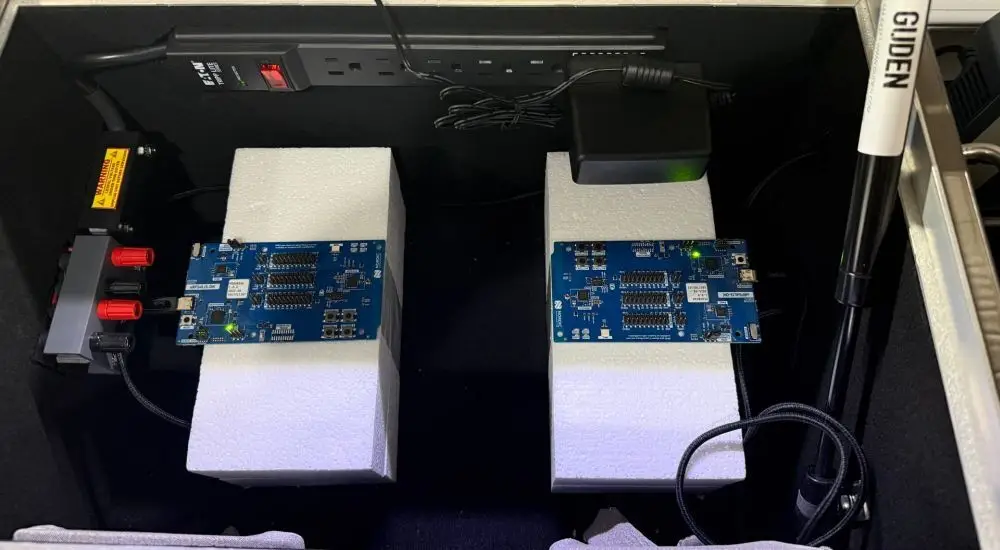
Measurements were performed in a Ramsey STE3000M RF shielded chamber (noted cost approximately $4,000) to isolate material effects from multipath and ambient interference. Key test parameters:
Transmitter: Nordic Semiconductor nRF54L15 DK at 0 dBm on LE 1M PHY.
Separation: 4 inches between transmitter and receiver antennas.
Metrics: Received Signal Strength Indicator (RSSI) and Packet Error Rate (PER).
Protocol: Established Bluetooth LE connection, then inserted material samples between devices.
Chamber: Ramsey STE3000M with absorber foam to reduce reflections.
The baseline measurement with no material in place was -26 dBm RSSI and 0% PER. Measurements compared each material insertion against that baseline.
Results: two extremes
ABS plastic: effectively transparent
ABS (Acrylonitrile Butadiene Styrene) produced no measurable attenuation in the test. With the ABS sample between devices the reading remained -26 dBm RSSI and 0% PER. That corresponds to 0 dB of attenuation in this setup.
Practical implication: for most consumer Bluetooth LE devices housed in ABS, the enclosure material itself does not reduce signal strength. If a plastic-housed device has range problems, investigate antenna design, TX settings, or the RF environment rather than the enclosure.
Aluminum foil wrap: total blockage
A device fully wrapped in aluminum foil (no cable passthrough) was unable to establish a Bluetooth LE connection. The wrap simulated a fully enclosed metal housing and produced total blockage rather than degraded performance or elevated packet loss.
Practical implication: fully metallic enclosures can prevent communication entirely. For devices that must be metal-housed, plan for external antennas, RF windows, or deliberate apertures to enable RF transmission.
The surprising middle ground
Intermediate materials and partial-metal configurations produced more complex results. Tests on ceramic tile and multiple aluminum configurations revealed that metal proximity can cause effects beyond simple attenuation, including antenna detuning. How metal is used or positioned matters as much as whether metal is present.
The author notes that the complete Episode 1 analysis (available through the Bluetooth Developer Academy) includes a full comparison table, exact RSSI and PER numbers for all materials and configurations, and a detailed antenna detuning analysis.
Why controlled measurements matter
Desktop tests in open environments conflate direct-path loss with multipath, diffraction, and ambient interference. A shielded chamber isolates the material as the only variable and yields repeatable, actionable data. The Ramsey STE3000M demonstrated more than 85 dB of shielding effectiveness at 2.4 GHz, allowing confidence that measured changes are due to the material only.
Takeaways for system integrators and solution providers
Measure or account for material attenuation in your link budgets; real numbers change design decisions.
ABS plastic enclosures add negligible loss at 2.4 GHz in this test configuration.
Fully enclosed metal housings can prevent Bluetooth LE communication; plan for antennas or RF windows.
Partial-metal configurations can detune antennas; validate antenna placement early in the design cycle.
Use controlled measurements when possible to avoid misattributing range issues to the wrong cause.