

- Passive RFID identifies pallets, while RTLS tracks forklifts and DeepHub links the two data streams.
- The system can record pickup and drop-off locations, but completed movements must be reliably detected and integrated with the WMS.
- Forklift tracking may use UWB, BLE, GPS, or LiDAR, depending on accuracy needs and site conditions.
- Pilot projects will test recognition rates, location accuracy, process integration, and the overall business case.
Tracking thousands of pallets without equipping each one with an active tracking tag: FEIG ELECTRONIC and Flowcate have combined their technologies. RFID identifies the goods, while a tracking system monitors the transport vehicles. Following the technical integration, both companies plan to test applications with pilot customers.
In a warehouse with 5,000 pallets, goods are often moved by just a few forklifts. So why equip thousands of pallets with active tracking technology when their location can be determined via the transport vehicles?
Anja Van Bocxlaer, editor-in-chief of Think WIoT, discusses the joint solution with Daniel Büth of FEIG ELECTRONIC and Stephan Zangerl of Flowcate. The conversation covers technology, costs, and initial customer projects.
Why the Partners Are Combining RFID and Location Tracking
Flowcate has developed DeepHub, a middleware solution that consolidates identification and location data from different systems. Flowcate is one of the co-founders of omlox. This open industry standard enables the cross-vendor provision of location data via common interfaces. DeepHub is certified according to omlox; FEIG has implemented the integration of compatible RFID readers into the platform.
“Of course, we’re currently seeing an increase in inquiries from the fields of tracking, localization, and asset tracking,” says Büth. For FEIG, the integration with DeepHub opens up new applications for its RFID technology. Zangerl points out that the different methods complement each other: “There simply isn’t a single ‘silver bullet’—that is, a single technology that can handle every use case.”
Passive RFID tags do not require a battery and are cost-effective for large inventories. When read, they provide a unique identifier but do not provide a continuous position. RTLS—Real-Time Locating Systems—can continuously track vehicles or other objects, but depending on the technology, this requires additional hardware. The shared architecture therefore combines cost-effective identification of the object with tracking of its means of transport.
What happens when a forklift picks up a pallet?
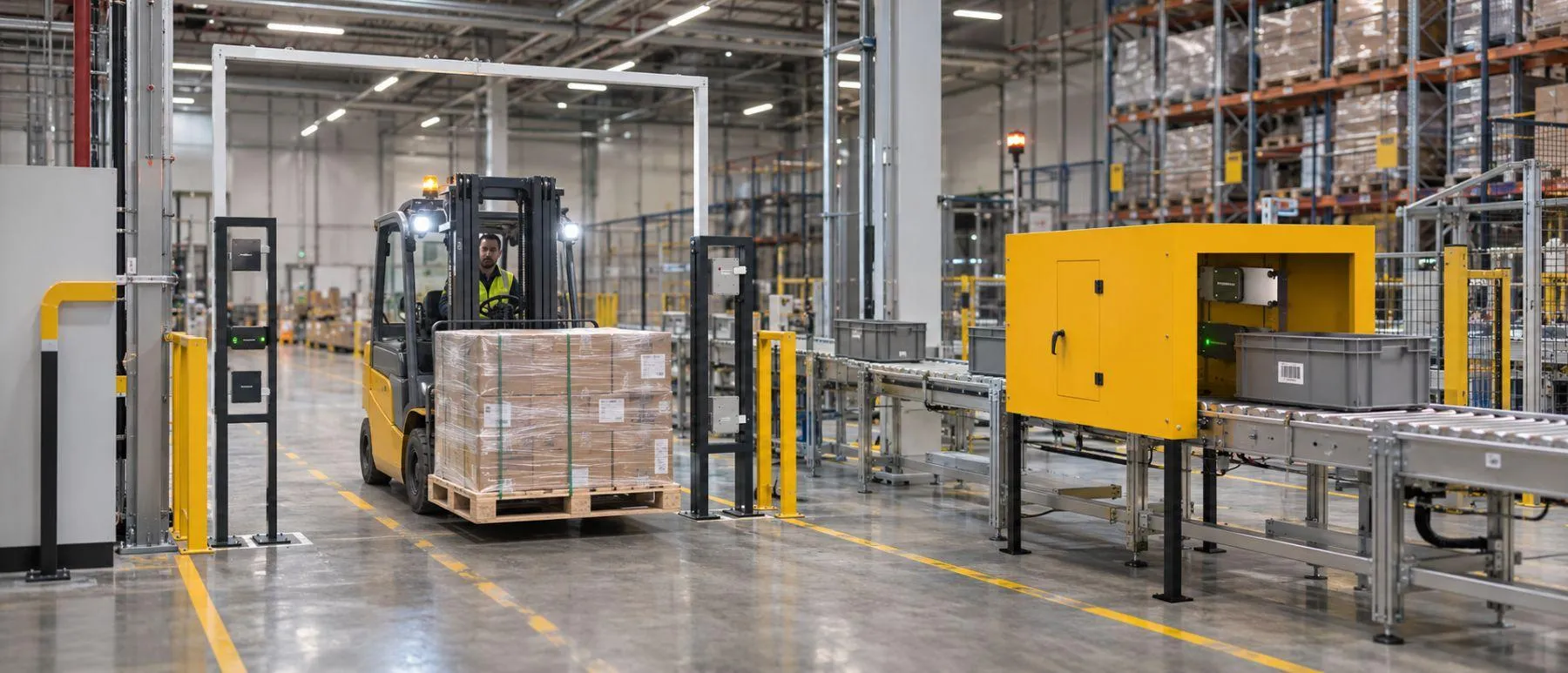
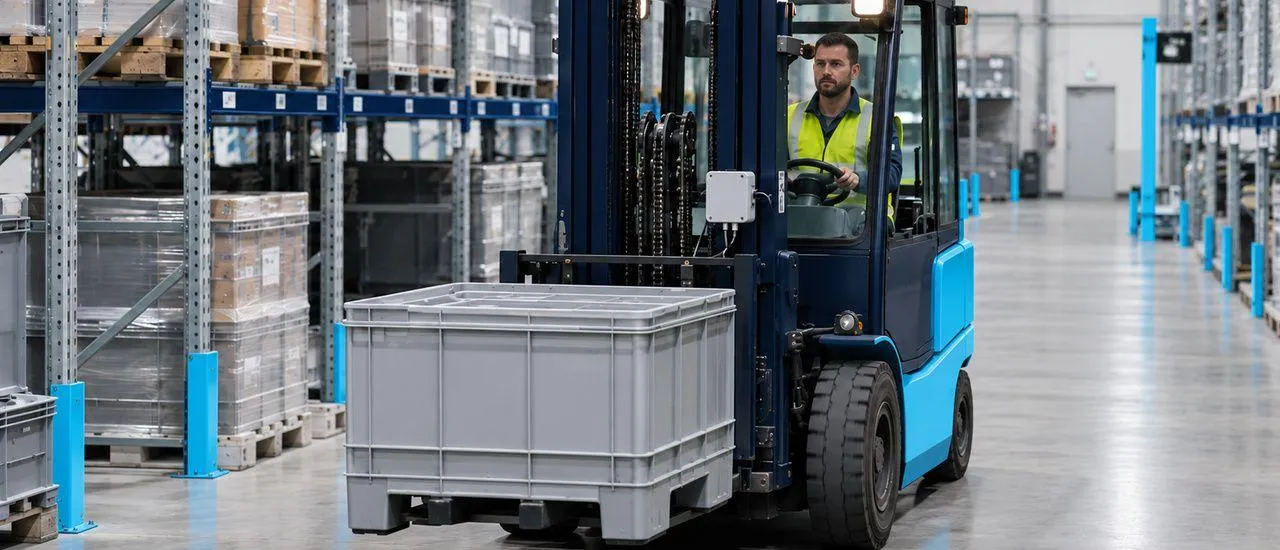
An FEIG RFID reader on the forklift’s fork detects the pallet tag, while a tracking system determines the vehicle’s position. Flowcate DeepHub links both data sets and can thus track where a pallet was picked up and at which location it was set down again. “Where was it picked up, where was it transported, and where was it set down?” Zangerl summarizes.
To ensure reliable booking in the warehouse management system (WMS), the picking up and setting down must be recognized as operations and assigned to the correct pallet. An RFID read alone does not confirm that a transport has been completed. Once these conditions are met, the system can automatically document the new storage location. This variant does not require stationary RFID gates: the reading point moves along with the forklift.
The driver continues to receive the transport order via the existing warehouse management system, such as the WMS and his forklift terminal. To reconcile the order, the picked-up pallet, and the actual storage location, the events from DeepHub must be integrated with the respective WMS and the driver’s user interface. The interviewees do not confirm that a ready-made HMI order integration is available.
UWB, BLE, GPS or LiDAR – The Customer Decides
The technology used to track the forklift remains open. UWB enables precise positioning indoors; BLE is also suitable for indoor tracking; GPS or GNSS are options for depots. The deciding factors are accuracy, environment, cost, and existing infrastructure.
Other options include LiDAR and SLAM. LiDAR maps the environment using laser beams, while SLAM determines the vehicle’s position and creates a map of the surroundings based on sensor data. Depending on the application, zone-level tracking may suffice, or precise localization down to the parking space may be required.
DeepHub can integrate compatible positioning sources into a unified architecture. This means that a facility with multiple warehouses or an outdoor storage area does not have to use the same positioning technology everywhere.
Stationary and Mobile RFID Tracking Working Together
The partners also describe solutions that incorporate stationary readers. If a pallet carries many individually tagged items, an RFID gate can read the individual items under controlled conditions and assign their identities to a common transport unit. The reader on the forklift then simply confirms which unit is being transported. This is simpler than having to read every single product while the forklift is in motion.
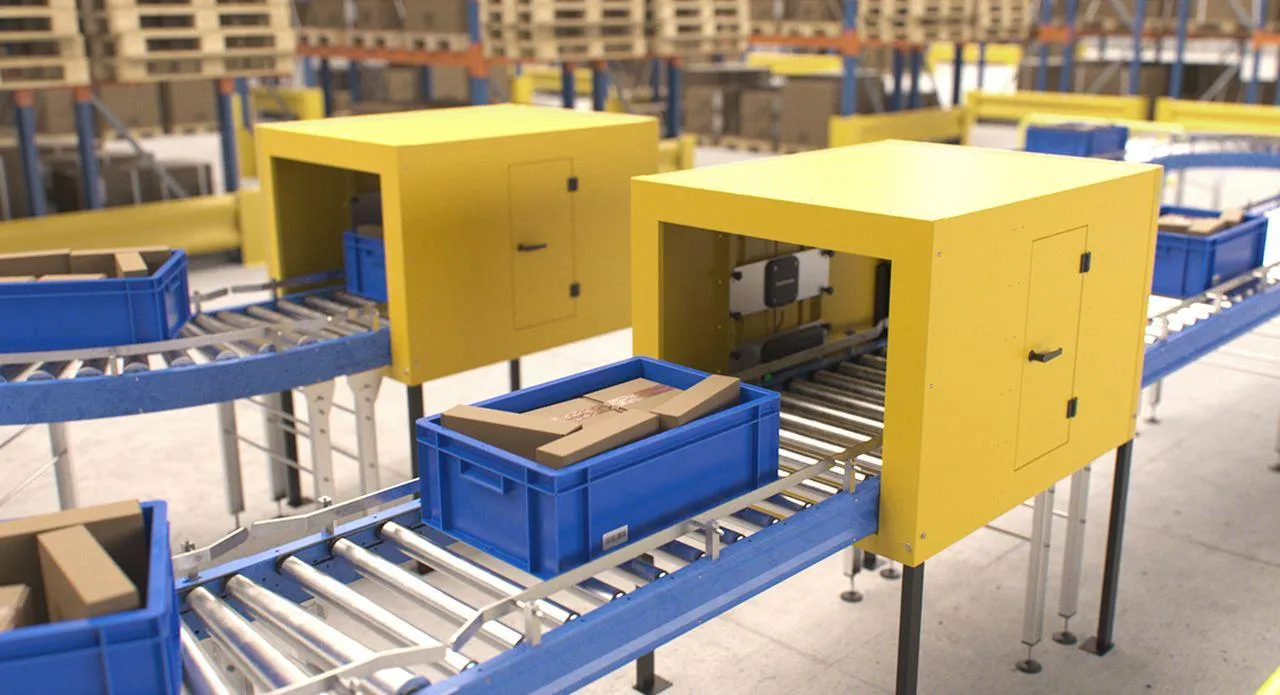
Büth also points out the multiplexer functions of FEIG readers: Multiple antennas can be operated on a single device and assigned to individual workstations or detection zones. “Since we can essentially treat each antenna as a separate reading zone or point, this naturally also offers corresponding potential for hardware cost savings.” Such an RFID reading zone indicates where an object was detected; it does not replace continuous forklift tracking.
A third variant uses the forklift for ongoing inventory. Antennas mounted on the sides detect tagged tools, containers, or equipment as the forklift passes by. Because the forklift’s position is known, the last detection area of the respective object can be narrowed down.
Zangerl cites the example of a cordless screwdriver that was detected while traveling through a specific warehouse aisle. Located handheld scanners or transport carts can also combine identity and position data.
How much does RFID cost compared to active tracking?
As an example, Zangerl estimates costs of 0.10 to 2 euros for passive RFID tags and 5 to 120 euros for active RTLS tags. If a company were to equip 5,000 pallets with active tags costing 20 euros each, that would amount to 100,000 euros for the tags alone. Passive RFID tags costing 20 cents each would total 1,000 euros for the same inventory.
This calculation does not yet constitute a complete cost comparison. FEIG readers, vehicle tracking, radio or sensor infrastructure, software, and integration must also be taken into account. Their relative costs vary depending on the number of vehicles, the areas involved, and the required accuracy. The advantage: Active tracking can be concentrated on five to ten forklifts instead of thousands of pallets.
This option makes particular sense when load carriers already have RFID tags and are predominantly moved using tracked vehicles anyway. For objects that move independently of these transport operations, the concept must be evaluated separately.
How Automated Inventory Management Reduces the Workload on Employees
Van Bocxlaer also addresses the issue of labor costs. Zangerl reports that, based on experience from customer projects, operational staff sometimes spend 10 to 30 percent of their daily working hours searching, scanning, booking, taking inventory, and coordinating. With many daily goods movements, such activities add up.
If the pallet and storage location are automatically recognized, the driver does not have to manually record the location after every transport. The WMS receives up-to-date movement information; inventory adjustments and search operations can be reduced.
During inventory, it is possible to trace when an item was last recorded. Büth sees this primarily as a way to reduce the workload on employees: forklift operators can focus on transport while documentation takes place in the background. Reliable data capture remains crucial.
How the Reader Communicates with DeepHub
A local application for data transfer to DeepHub was developed for compatible FEIG readers running on the Linux platform. A connector is available on the Flowcate website. During setup, the reader is integrated via its IP address; subsequently, pre-filtered RFID events and the assignment of the reading point can be processed.
According to Büth and Zangerl, the integration is certified and simplifies connectivity compared to developing a new interface from scratch each time. DeepHub can process identification and location events and forward them to WMS, production, or asset management applications via corresponding integrations. The process logic is integrated on a customer-specific basis.
What Pilot Customers Can Now Test
Many companies already have RFID tags, individual reading points, and warehouse management systems; some also use location tracking technology. The unified architecture becomes particularly valuable where this data has not yet been consolidated and goods movements therefore still have to be recorded manually.
The initial implementation can be limited to a few forklifts, a single material flow, or a production area. This allows companies to test the achievable recognition rate, location accuracy, and process integration before equipping additional areas.
To prepare, Flowcate offers a Use Case Quick Check: A one-hour kickoff meeting is followed by an on-site workshop lasting about four hours. During this workshop, processes, spatial conditions, and potential technologies are evaluated. Zangerl believes that, with a viable concept, a pilot launch is possible within about three months; procurement and integration efforts determine the actual timeline.
Another project is already in the planning stages: According to Zangerl, an industrial customer has approximately 200,000 RFID-tagged reusable load carriers. To track them at production workstations, a concept involving multiple spatially distributed RFID antennas and multiplexers is planned. This is intended to improve the documentation of material movements, production orders, and returnable containers. Results are not yet available.
From blood units to library shelves
Beyond industrial material flows, Büth sees further potential applications, including for HF-RFID. These include smart refrigerators for tracking the inventory of blood products and medications, as well as the automatic inventory management of libraries using stationary or mobile RFID readers.
For now, FEIG and Flowcate are focusing on the industrial and logistics sectors. Here, pilot customers will demonstrate where indirect tracking works reliably and what infrastructure is actually required for it. The technical integration is ready; the specific process will determine the economic viability.
Interested in a pilot project?
Companies that wish to combine existing RFID infrastructure with location technologies and automate their inventory management can work with FEIG ELECTRONIC and Flowcate to develop a potential pilot application.