
Dryad Adds Satellite Link to Gen-4-Pro Wildfire Sensor

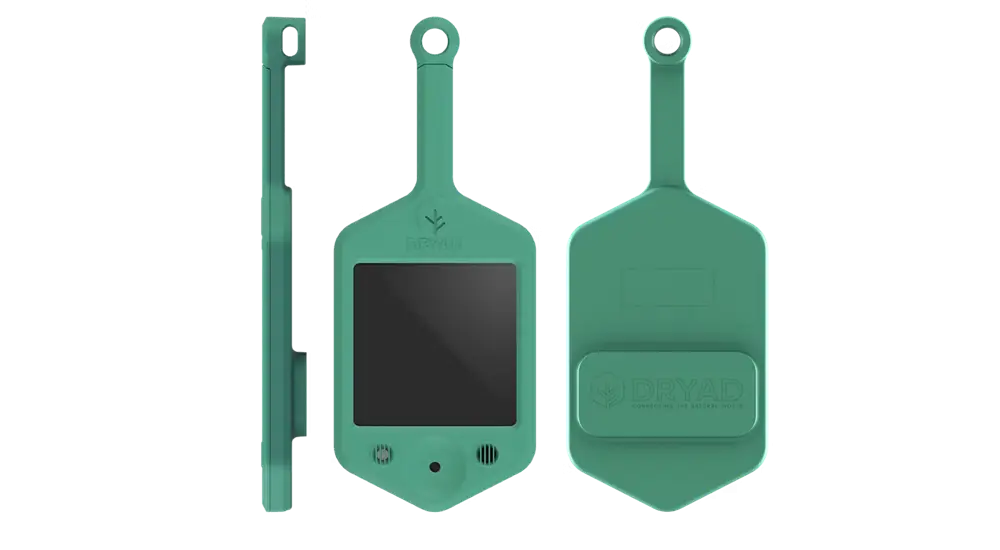
Dryad has launched the Gen-4-Pro Silvanet Wildfire Sensor, the fourth generation of its IoT-based wildfire detection device. The new sensor adds direct satellite connectivity to the existing Silvanet architecture and expands sensing capabilities with carbon monoxide (CO) and PM2.5 (fine airborne particles) measurement.
IoT Sensor for Early Wildfire Detection
The Gen-4-Pro Silvanet Wildfire Sensor is part of Dryad’s Silvanet system for ultra-early wildfire detection. The system combines solar-powered gas sensors, wireless IoT communication and cloud-based analytics.
Unlike camera-based or satellite-based observation systems, Silvanet is designed to detect wildfires within minutes of ignition. According to Dryad, detection can take place during the smoldering phase, before flames or smoke columns become visible.
This is particularly relevant for human-caused fires, for example those triggered by accidents, technical defects or negligent behavior. In such scenarios, early detection can create more time for emergency response before a fire spreads.
LoRaWAN Remains the Terrestrial Network Layer
Silvanet already uses LoRaWAN for low-power wireless data transmission across wide-area sensor networks. This makes the system suitable for distributed deployments in forests and other outdoor environments where sensors must operate with minimal energy consumption.
For system integrators, LoRaWAN remains the terrestrial connectivity layer in the Silvanet architecture. It enables sensor data to be transmitted across large areas where gateways can be installed and maintained.
The Gen-4-Pro therefore does not introduce LoRaWAN as a new feature. Instead, it continues to support LoRaWAN and adds a second communication option for deployments beyond the practical reach of terrestrial networks.
Direct Satellite Connectivity for Remote Areas
The main connectivity upgrade in the Gen-4-Pro is the integrated direct satellite connection. Dryad states that this feature is provided through its partner Kinéis.
The satellite link allows the sensor to operate without relying on terrestrial network infrastructure. This is relevant for remote forests, protected areas and locations where deploying or maintaining gateways would be difficult or uneconomical.
Dryad also highlights linear infrastructure such as power lines and railway routes as target applications. These environments often extend through remote or hard-to-access areas, where autonomous connectivity can reduce infrastructure requirements and simplify deployment planning.
Sensor Data: CO, VOC and PM2.5
The Gen-4-Pro adds new sensors for carbon monoxide and PM2.5 particles (fine airborne particles with a diameter of 2.5 micrometers or smaller). According to Dryad, these additions improve detection accuracy and sensitivity, reduce false alarms and extend the detection range by a factor of two or more.
The sensor also measures volatile organic compounds, which are part of the gas signature produced during pyrolysis. Combined with CO and particle measurements, this allows the device to detect the early chemical indicators of a developing fire.
Dryad states that integrated AI functions evaluate data from VOC (Volatile Organic Compounds), CO and particle sensors to distinguish wildfire signatures from other environmental influences. This is important for reducing false alarms in complex outdoor conditions.
Microclimate Monitoring as an Additional Data Layer
Beyond wildfire detection, the sensor monitors forest microclimate parameters. These include temperature, humidity, air pressure, CO, VOC and PM2.5.
This makes the device relevant not only for fire alerts, but also for environmental monitoring and proactive risk assessment. PM2.5 measurement can additionally support air quality monitoring and provide data for environmental protection or public health applications.
For solution providers, this broad sensor data set can support architectures that combine event detection with continuous environmental observation.
Solar Operation Without Lithium-Ion Batteries
The Gen-4-Pro uses an integrated solar panel and supercapacitors instead of lithium-ion batteries. Dryad states that the sensor can operate for 10 to 15 years without battery replacement or regular maintenance.
The new generation includes a larger solar panel and three times the energy storage capacity. This is intended to support year-round operation, including under dense forest canopies and in low-light winter conditions.
For end users, energy autonomy is a central factor in large-scale field deployments. Reduced maintenance requirements can lower operational effort, especially in remote or difficult-to-access areas.
Relevance for Wildfire Monitoring Projects
For system integrators, the Gen-4-Pro adds flexibility to Silvanet deployment architectures. LoRaWAN can be used where terrestrial gateways are practical, while direct satellite connectivity extends coverage to remote areas without local network infrastructure.
For authorities, utilities and landowners, the value lies in earlier detection, faster response and broader monitoring coverage. The product is offered by Dryad and, according to the company, is available worldwide with immediate effect.
The technical relevance of the Gen-4-Pro lies in its combined upgrade of sensing accuracy, energy autonomy and connectivity, making the new sensor generation more suitable for large-scale wildfire detection in remote, infrastructure-critical and difficult-to-access environments.