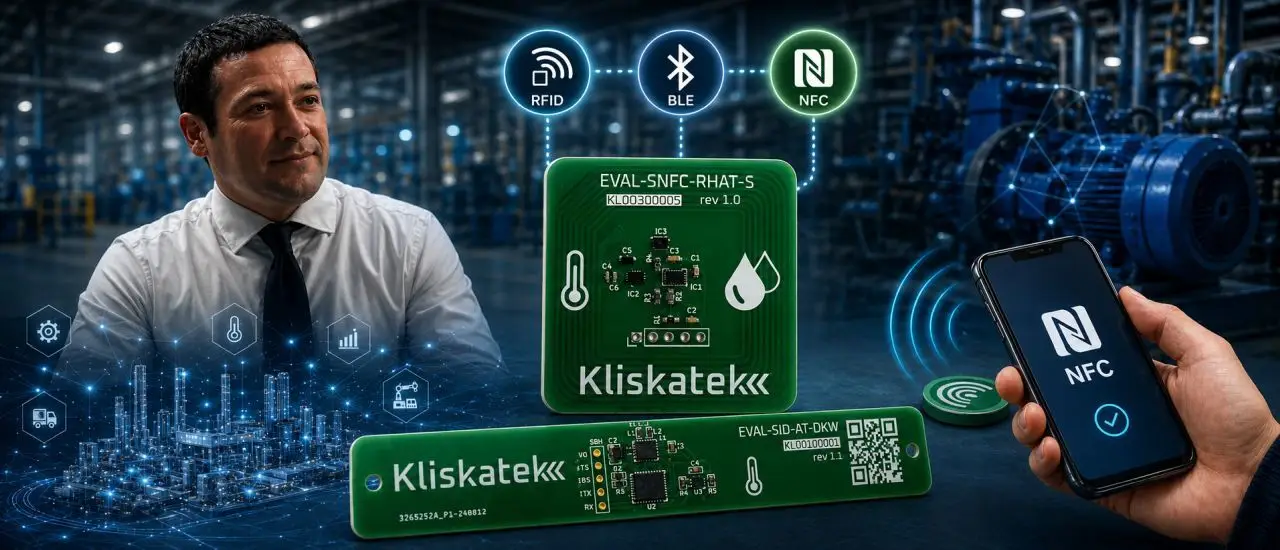

- Battery-free sensors now support multiple communication protocols such as RFID EPC C1G2, BLE, and NFC using the same energy source.
- Industrial applications benefit most from battery-free sensors where battery replacement and wiring are unfeasible or costly.
- Financial decision-makers are increasingly driving adoption due to reduced maintenance and total cost of ownership advantages.
- Limitations of battery-free sensors remain primarily tied to the physical constraints of energy transmission distance.
Battery-free RFID technology has long been considered a specialized solution for identification and simple sensor applications. But in 2026, the landscape is changing fundamentally: New approaches decouple the energy source from the communication protocol, thereby opening up entirely new application possibilities.
In this interview, Mikel Choperena from Kliskatek explains why battery-free sensor technology is becoming a multi-protocol platform, which applications are now scaling, and why CFOs, rather than engineers, are suddenly driving the discussion.
What future do you see for battery-free RFID?
Mikel Choperena: Battery-free RFID is evolving into something that goes beyond RFID itself.
If you look at what “battery-free” meant just five years ago, it was relatively clearly defined: a passive UHF RFID tag powered by a reader’s RF field, operating a sensor, and sending data back via EPC C1G2 backscatter. That still works excellently, and is technologically mature.
What has fundamentally changed, however, is the decoupling of energy and communication.
What exactly has changed technically?
Mikel Choperena: Today, RF energy harvesting is no longer tied to a single communication protocol.
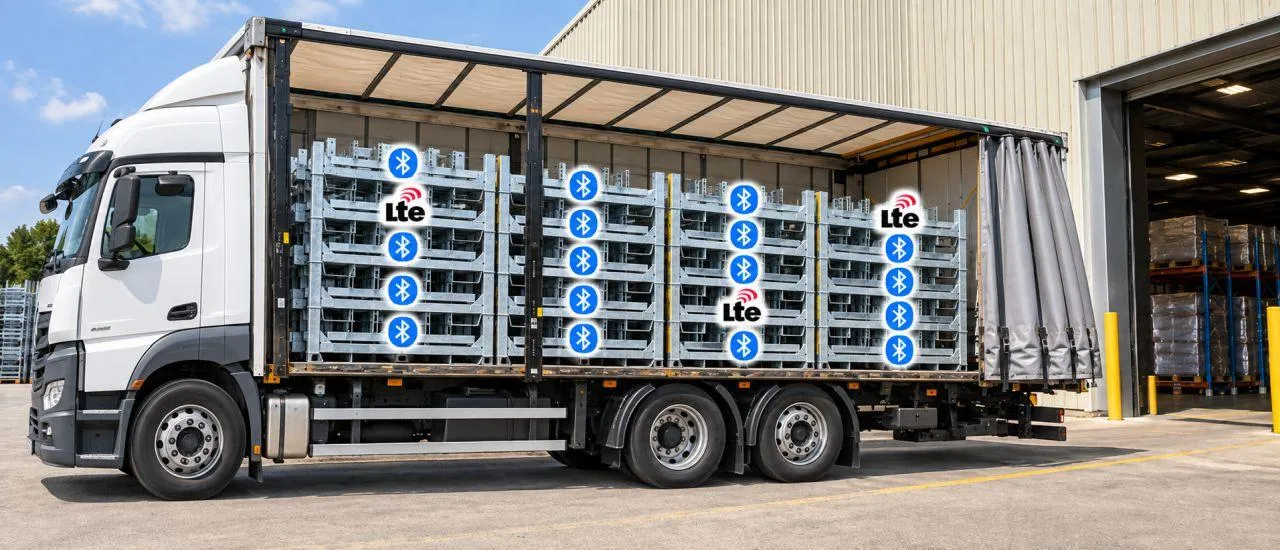
For example, we develop sensor tags that harvest energy from a UHF RF field, but can communicate via EPC C1G2 (SenseID) or via BLE advertising (SenseBLE) depending on the application. The sensor remains the same. The energy source remains the same. Only the communication channel changes. Another example is NFC. With SenseNFC, a smartphone can supply the tag with energy directly, without any infrastructure.
SenseID, SenseBLE and SenseNFC are battery-free wireless sensing technologies by Kliskatek.
You have been working on battery-free sensing for many years. How has your perspective on the technology evolved?
Mikel Choperena: This perspective is based on more than 15 years of work in battery-free sensing. We started developing such technologies at Farsens and are now continuing this work at Kliskatek with a broader, multi-protocol approach.
The core idea remains the same: sensors should deliver data where maintenance, wiring or battery replacement are not practical. What has changed is the technical flexibility. Battery-free sensing is no longer tied to one communication method, but can be implemented through RFID, BLE or NFC depending on the application.
What does this mean for the future?
Mikel Choperena: The future lies in battery-free sensor technology as a multi-protocol platform.
The sensor doesn’t care how it communicates. The only things that matter are whether it has enough power, whether it can measure, and how it can transmit the data.
The communication protocol thus becomes an implementation decision, not a technological limitation.
Where do you currently see the most important areas of application?
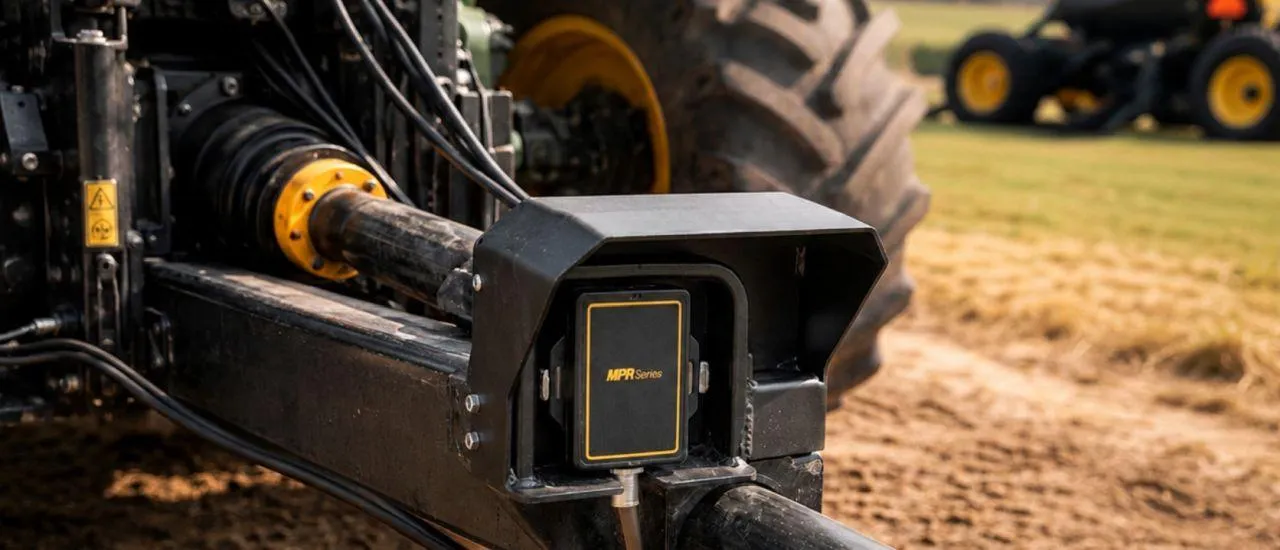
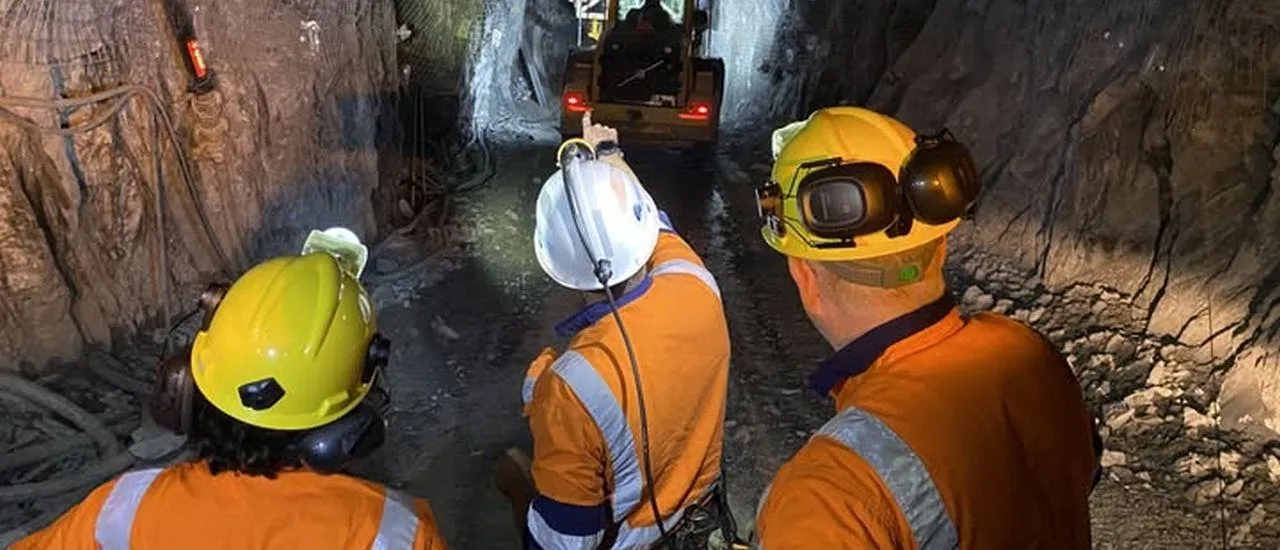
Mikel Choperena: In the short term, clearly in industrial environments, anywhere where changing batteries is problematic. Typical examples include rotating machinery where cabling is not possible, closed systems that do not allow access to the sensor, or sealed high-voltage equipment such as switchgear, where sensors may need to operate maintenance-free for decades.
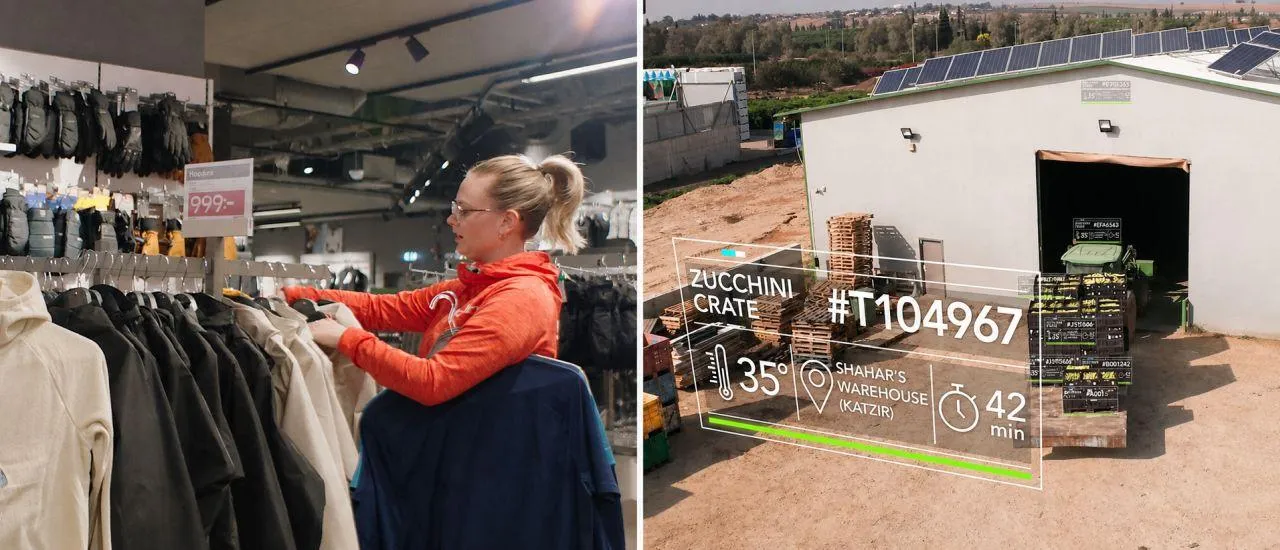
Another example is large warehouses with thousands of measurement points. Replacing batteries there quickly becomes a logistical nightmare. This is often underestimated until it is too late.
What has changed from a market perspective?
Mikel Choperena: The most exciting thing is who is leading the discussion today. In the past, it was engineers who talked about read ranges and antennas.
Today, it’s increasingly plant managers and CFOs asking questions like: “What does maintenance cost me?” or “What is the total cost of ownership?” And this is exactly where battery-free sensor technology shines. That’s because no battery replacement is needed, maintenance visits are eliminated, and the lifespan spans many years. Once the financial case is made, the technology sells itself.
What role do smartphones play?
Mikel Choperena: A huge one. Every smartphone today has NFC. That means every technician, every maintenance worker, and every inspector has a sensor reader in their pocket.
This practically reduces the barrier to entry for many applications, such as maintenance rounds or spot checks, to zero. This changes the speed at which such solutions spread.
How do you position battery-free RFID compared to active and semi-passive solutions?
Mikel Choperena: I think the industry thinks too much in terms of opposites here. In practice, it’s not about “either/or,” but about finding the right solution for the specific application. Our view is clear. It’s not “RFID versus BLE.”
A company with existing RFID infrastructure will use EPC C1G2. A company without such infrastructure can get started more cost-effectively with BLE.
Depending on the application, active, semi-passive, and battery-free sensor systems differ significantly not only technically but also economically. While active solutions offer maximum autonomy, battery-free concepts score points especially where maintenance needs to be avoided. The following overview shows the most important differences.
Technology | Brief Profile | Biggest Advantage | Key Limitation |
🔋 Active | Autonomous, long-range, continuous | Continuous data collection | Battery requires maintenance |
🔋 Semi-passive | RFID plus battery backup | Data logging and enhanced sensor performance | Battery remains a weak point |
⚡ Battery-free | Power from RF or NFC, communication via RFID or BLE | No maintenance required due to battery replacement | Energy and range limitations due to physics |
What are the limitations?
Mikel Choperena: The only real limit is the energy transmission distance.
A battery-free sensor only works where sufficient energy is available. That’s physics, and there’s nothing we can do to change that. For applications that require a long range or continuous monitoring, battery-powered systems remain necessary.
What does the future look like in concrete terms?
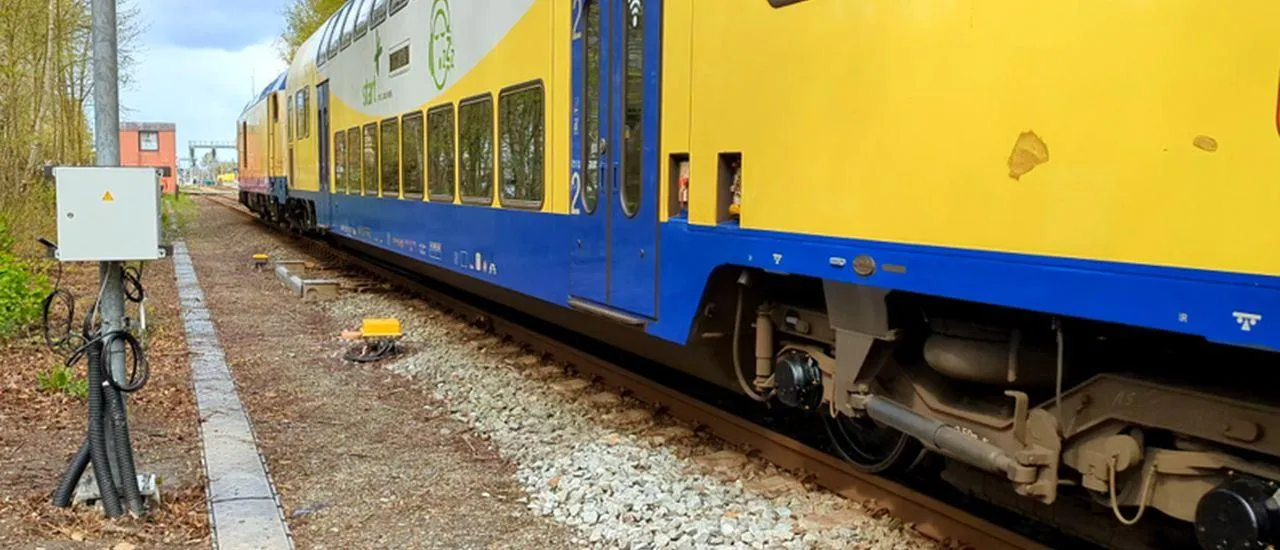
Mikel Choperena: I see clear hybrid scenarios. That means battery-free at fixed points such as portals, docks, and maintenance points, and battery-powered for mobile or remote applications. The data converges on a common platform. For the system, the sensor data is identical. Only the power source differs.
This is exactly the direction we are working on at Kliskatek: making battery-free sensing easier to deploy across different industrial environments and communication infrastructures. Further information about our technologies and applications is available at kliskatek.com.