
CES 2026: Little Momentum for RFID

Lüneburg, January 12, 2026 — CES, hosted by the Consumer Technology Association (CTA)®, is considered the leading consumer-driven trade show for new products, platforms, and technology narratives. That's precisely why it's striking that RFID remained relatively quiet at CES 2026. There was no broad wave of new RFID platforms, reader launches, or "RFID-first" showcases, instead RFID appeared mainly on the sidelines in a few application-driven demos.
"RFID was more of a side issue at CES 2026 – visible in individual use cases and in the context of energy supply for 'connected labels', but not as a standalone wave of innovation. For a consumer-driven leading trade show like CES, this is a clear signal: RFID was not at the center of the trade show narrative this time."
— Anja Van Bocxlaer, Editor-in-Chief, Think WIoT
What was there: three RFID-related CES signals
1. RFID in tires: present, but not new
One visible RFID point was the automotive/mobility context: embedded RFID tags in tires (tire tags) as a building block for identification, lifecycle management, and potentially safety/sustainability processes. However, this is not a new CES trend, but a use case that has been known for some time, including in Think WIoT reporting. Accordingly, at CES, this seemed more like "roadmap continuity" than a breakthrough moment.
2. Consumer signals came primarily via NFC
In the consumer-oriented area, RFID primarily appeared as NFC (HF RFID) for tap-to-identify/tap-to-trigger: embedded tags as an identity layer and trigger for interactions in "smart objects." This is relevant for experience design and product interaction, but remained clearly NFC-driven and thus more interaction-oriented than supply chain RFID.
3. RTLS & tracking: Multi-tech stacks "think RFID"
In location/tracking, RFID was primarily visible as part of multi-technology platforms: RFID is positioned less as a standalone location technology and more as an identity or checkpoint layer that interacts with more precise methods (e.g., for continuous tracking).
What was still important: Energy supply as an indirect RFID driver
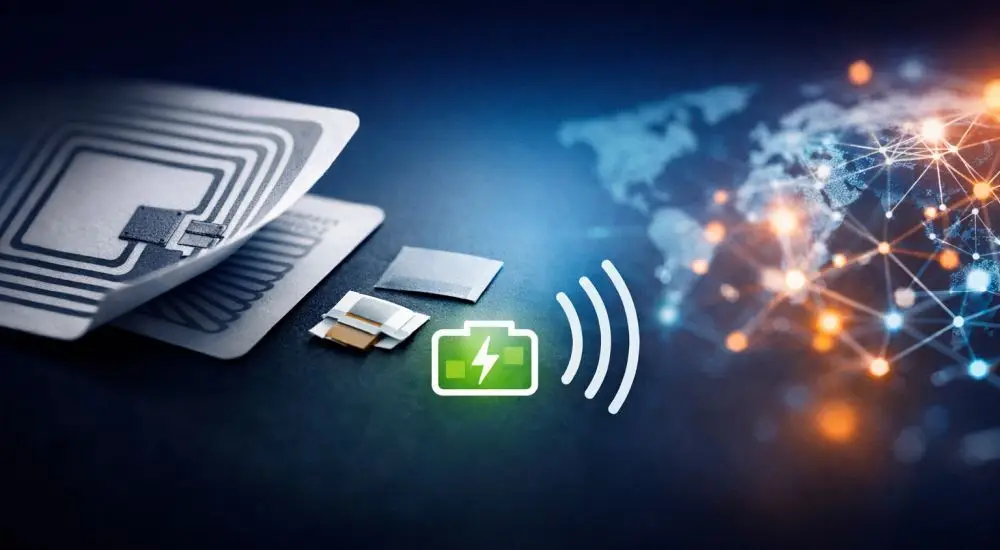
Although RFID itself was not given a "big" role, enabling technologies that could influence RFID applications in the medium term were visible at CES – especially where "passive" is not enough and active/hybrid labels become relevant.
One example is energy harvesting, as positioned by Dracula Technologies for ultra-low-power, low-maintenance "battery-free" or "battery-light" concepts: The connection to RFID arises where harvesting is integrated into smart label form factors to go beyond purely passive IDs – for example, for additional sensor technology, status updates, or extended functionality in hybrid concepts.
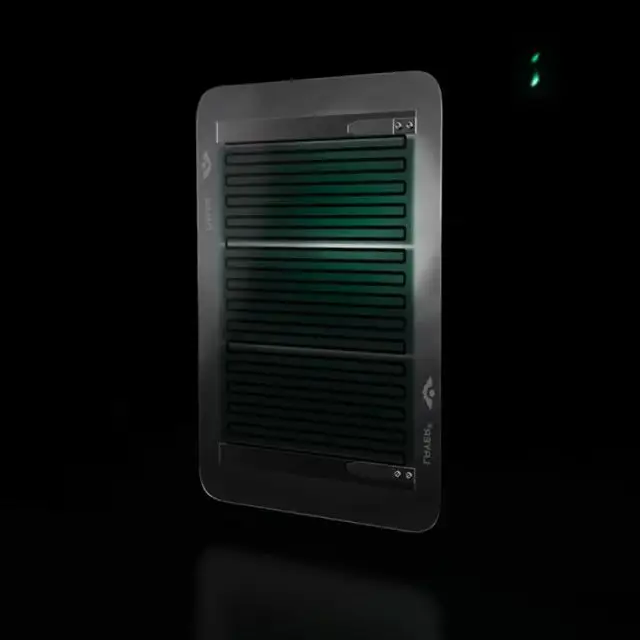
LAYER®Vault – OPV Energy with On-Board Storage

LAYER®Vault delivers autonomous power for indoor ultra-low-power IoT devices by integrating OPV harvesting and energy storage in a flexible film.
Rechargeable thin-film batteries, as addressed by BTRY, are also relevant: Ultra-flat energy storage devices can circumvent the height and integration limitations of conventional batteries, making applications that combine RFID/NFC with sensor technology or additional features (e.g., connected labels, smart cards, active tags) more realistic.
-v2-responsive.webp)

Zinergy also fits into this picture: Printed, flexible batteries are often positioned towards (semi-)active HF/UHF RFID labels and sensorized label use cases – i.e., where energy supply becomes a bottleneck and passive RFID IDs are no longer functionally sufficient.
Why the "RFID silence" at CES is striking
Think WIoT considers CES 2026 to be unusually reserved when it comes to RFID: at a consumer-driven trade show that typically scales innovation via marketable product stories, RFID remained largely implicit – as a component of solutions, not as a standalone innovation narrative.
Further background: Read our resource article on RFID – covering the basics, development trends (LF/HF/UHF to active and hybrid label concepts) and an overview of typical applications and design decisions.