RFID @WORK 2026 showcases RFID solutions in real-world testing

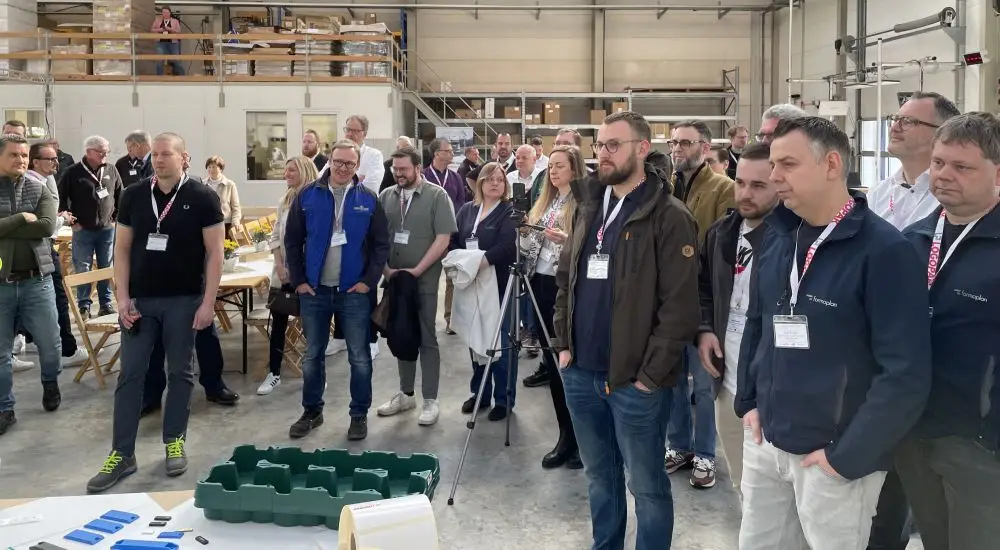
On April 22, 2026, approximately 50 trade visitors from industry, retail, and logistics attended RFID @WORK in Melle-Buer. Logopak, Wilms, and Lüttmann demonstrated RFID, sensor technology, and software in real-world logistics and production processes.
RFID Hands-On Day with Concrete Applications
The RFID @WORK practical workshop – Discover the Future of Smart Logistics! – brought together technology and process managers from logistics, production, industry, and retail at Gustav Wilms oHG in Melle-Buer.
The joint event organized by Logopak Systeme GmbH & Co. KG, Gustav Wilms oHG, and Lüttmann Werkzeugmaschinen Vertriebs GmbH focused on practical live demonstrations.
The goal was not only to explain RFID-based digitalization along the supply chain in theoretical terms, but also to make it visible within ongoing processes. The audience consisted primarily of decision-makers, process engineers, and IT specialists who came to learn about RFID integration, automation, track & trace, and intelligent labeling systems.
The event was opened by Katharina Wilms, Björn Ballázs from Logopak, and Rolf Kottmann from Lüttmann. In the technical presentation “Tags and Technology for Track & Trace,” Marcus Muschke from Logopak outlined key RFID fundamentals, technical requirements, and practical applications.
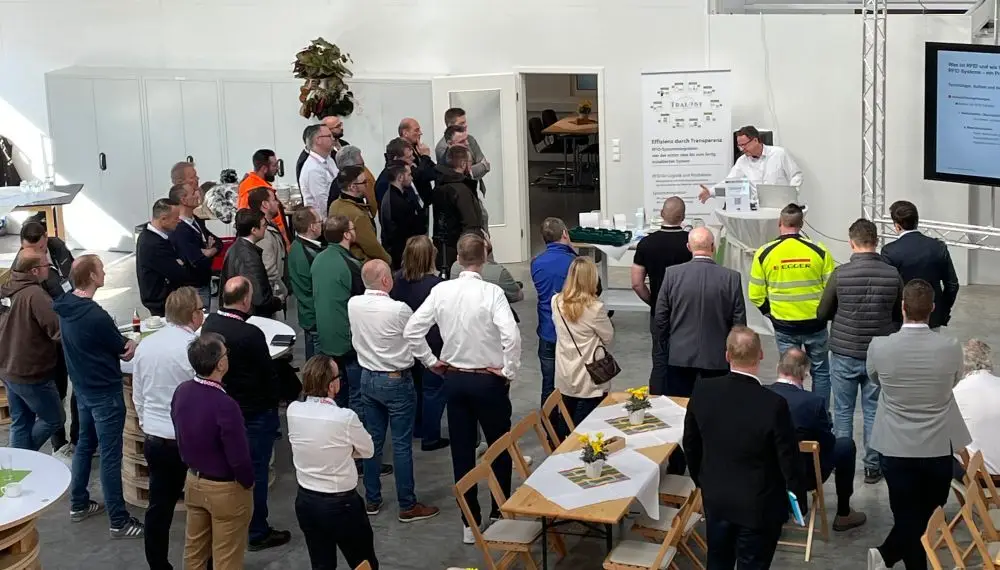
Live Demos Along Real Process Chains
At several stations, participants were able to experience RFID solutions in operation. Among other things, the following were demonstrated: an RFID-based toolgate for tool issuance, a pallet labeling station with a bad-tag-removal function, RFID sensor tags for temperature monitoring, and an e-Kanban system for the digitalization of materials management.
Additional demonstrations covered RFID readers on forklifts in conjunction with UWB-based localization, RFID tracking at truck gates, pick-and-bulk reading including loading control, and the Tralosy software solution from Wilms for visualizing and controlling RFID-based processes.
The applications clearly demonstrated how RFID connects physical material flows with digital information flows. Whether it’s a pallet, tool, container, load carrier, or sensor tag: process events can be automatically recorded, validated, and utilized for operational decisions.
RFID, Sensors, and Software in Synergy
A key focus was on the integration of intelligent identification systems into production and warehouse processes. The pallet labeling station demonstrated how identification, RFID validation, and process reliability can be combined. The bad-tag-removal function ensures that faulty RFID tags are detected and removed from the process.
Condition monitoring was also addressed. RFID sensor tags for temperature measurement demonstrated how identification and condition data can be linked. This creates additional opportunities for quality-critical supply chains to document goods movements and relevant environmental data.
The live stations also demonstrated that RFID projects do not function in isolation. The key lies in the interplay of suitable tags, reading technology, labeling, software, process understanding, and integration into existing IT and material flow systems.
Positive Conclusion from the Organizers
The organizers drew a positive conclusion. The direct exchange at the stations showed that the demand for application-oriented RFID formats remains high. Many questions from participants focused on specific integration scenarios, reading reliability, data quality, and the transferability of the showcased solutions to their own production and logistics environments.
Trade visitors also rated the practical workshop positively. Sergej Lysikov, Logistics Plant Manager at EGGER Kunststoffe GmbH & Co. KG, emphasized that RFID opens up numerous possibilities for automating the supply chain within the plant and between different locations. In particular, the combination of RFID readers on forklifts, process monitoring, and suitable software has revealed new perspectives for further process design.
Myriam Kestel, RFID Business Development Manager at Checkpoint Solutions, emphasized the wide range of RFID applications on display. The live demonstrations not only provided concrete insights but also sparked new ideas for further application scenarios.
Sarah Schwekendiek, Operations Manager at Wäscherei Schwider GmbH, described the day as particularly insightful. Since her company is currently in the process of developing its own RFID applications, the event provided many concrete ideas for further conceptual and practical development.
RFID @WORK 2026 thus presented a comprehensive picture of smart logistics: automatic identification, robust tagging, sensor technology, localization, and software work together to make material and information flows more transparent, faster, and more controllable.