BTRY Discusses Ultra-Thin Batteries for IoT on EUVC Podcast


BTRY CEO and Co-Founder Moritz H. Futscher joined the EUVC podcast to discuss how ultra-thin, flexible solid-state batteries could enable new IoT, medtech, wearable and embedded electronics applications where conventional battery formats limit product design.
Battery Form Factor Becomes a Design Factor
Battery innovation is no longer only about chemistry, capacity or larger packs. In compact wireless IoT devices, the shape, thickness, flexibility and integration capability of the energy storage element increasingly determine which products can be built.
This was the central topic of the EUVC podcast episode “Building the world's ‘thinnest’ battery out of Europe”, published on May 19, 2026. Andreas Munk Holm spoke with Michael Brehm and Mohamed Foulser from Redstone, as well as Moritz H. Futscher, CEO and Co-Founder of BTRY.
EUVC is a European venture capital and technology platform covering how companies, investors and institutions shape Europe’s tech ecosystem. Its podcast addresses venture capital, deep tech, company building and industrial competitiveness.
Ultra-Thin Solid-State Batteries
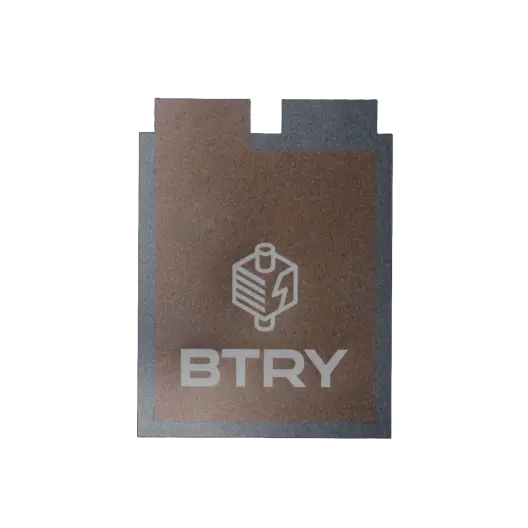
BTRY is a Swiss battery startup founded in 2023 as a spin-off from Empa and ETH Zurich. The company develops ultra-thin, foldable solid-state batteries for applications such as IoT, medtech and consumer electronics.
For wireless IoT systems, this is technically relevant. Smart labels, sensor tags, wearables, medical devices and embedded electronics require energy sources that are not only small, but also thin, mechanically integrable and able to deliver short power peaks.
According to previous Think WIoT reporting, BTRY’s thin-film solid-state batteries are manufactured layer by layer in a vacuum process using semiconductor-like production steps. The cells do not use liquid or organic electrolytes or solvents. This architecture is intended to improve safety, robustness and integration options compared with conventional lithium-ion batteries based on liquid electrolytes.

Relevance for Smart Labels and Sensors
In wireless IoT, energy storage must often support short, high-current events. BLE transmissions, display updates, sensor measurements or data logging can create brief peak loads that are difficult to cover with very small conventional cells.
BTRY’s technology addresses this requirement in thin and compact form factors. In a Think WIoT interview, the company stated that current developments target capacities of up to 10 mAh, discharge rates of up to 60C and pulse currents of up to 600 mA. Cycle stability is stated at around 1,000 cycles.
This positions the technology between conventional batteries and supercapacitors for certain use cases. It is not primarily aimed at maximum capacity, but at rechargeable, integrable energy storage for devices where thickness, current peaks, safety and mechanical integration are key design constraints.

Energy Harvesting Still Needs Storage
The EUVC discussion also addressed overlooked opportunities in embedded electronics. This is particularly relevant for energy-harvesting IoT systems.
Energy harvesting can supply small amounts of energy from light, radio waves, temperature differences or vibration. However, many systems still need a buffer to bridge periods without available ambient energy and to cover short peak loads. Thin-film batteries can act as such a buffer where a capacitor is insufficient or where longer storage duration is required.
European Hardware Scaling
The podcast also frames BTRY within a broader European industrial context. The question is not only whether Europe can develop advanced battery concepts in research environments, but whether such technologies can be scaled into globally competitive hardware companies.
For BTRY, scalable manufacturing is therefore central. According to Think WIoT reporting, the company plans to commission its first pilot line in 2026 to supply first customers, with production scaling planned for 2027.
Contact BTRY
Companies developing smart labels, sensor tags, medtech devices, wearables or embedded electronics are strongly encouraged to contact BTRY for further information on ultra-thin solid-state batteries, technical specifications, integration options and application-specific requirements.
Listen here to the EUVC podcast episode: https://www.eu.vc/podcast/building-the-world-s-thinnest-battery-out-of-europe/bd01ceee-a456-4f28-b8fe-abdb01477a19