

RFID focus at NRF 2026 aligns with Think WIoT’s push for more wireless IoT

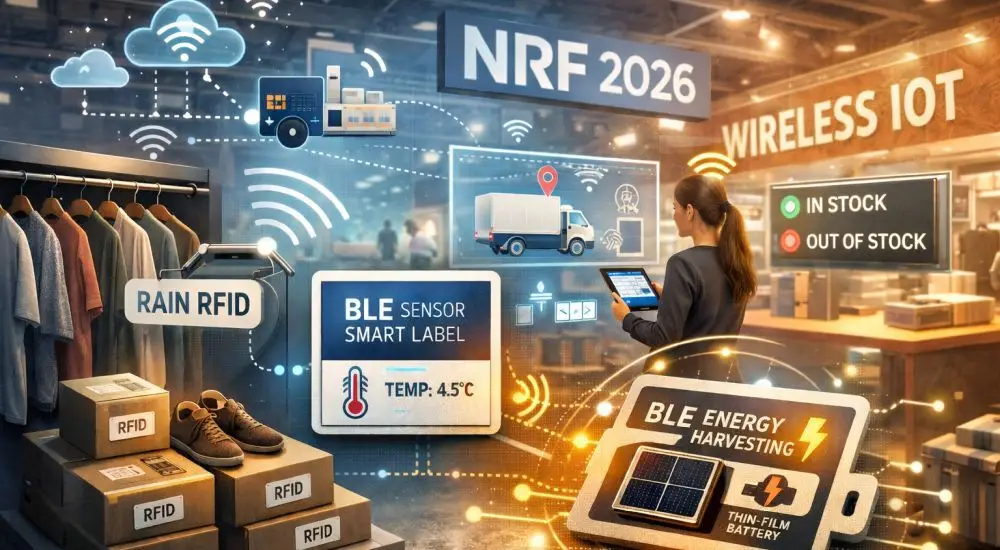
From item-level visibility to intelligent operations, wireless IoT is the next step in scalable retail transformation.
NRF 2026 in New York reinforced a clear direction in retail technology: RFID, and in particular RAIN RFID, is increasingly treated as a foundational data layer for modern retail. The focus is expanding beyond inventory accuracy alone toward real-time operational intelligence that supports store execution, supply chain performance, and connected experiences.
In line with these developments, Think WIoT emphasizes that the next phase is not RFID alone. It is more IoT with wireless at scale, connecting products, assets, stores, and supply chains to the systems that run retail.
“Retail is moving toward always-on intelligence,” said Anja Van Bocxlaer, Editor-in-Chief, Think WIoT. “RFID delivers item-level truth. The broader opportunity is the convergence of RFID and wireless IoT so operations become proactive, automated, and measurable across the enterprise.”


Examples from NRF 2026 that illustrate the direction
NRF 2026 activity across the ecosystem highlighted how RFID is progressing from a point capability to connected infrastructure. The following examples reflect what companies emphasized in NRF-related announcements and communications:
NXP Semiconductors emphasized continued investment in RAIN RFID innovation and positioned its latest tag IC generation for scalable, high-volume retail use cases, supporting broader category adoption and enterprise rollouts.
Checkpoint Systems highlighted smart-label approaches that connect item identification with operational outcomes, focusing on turning RFID data into workflows that improve availability and execution.
Hana RFID underscored the maturity and momentum of item-level tagging supply, highlighting the importance of reliable inlay and label ecosystems for large-scale deployments.
Zebra Technologies emphasized retail execution through integrated workflows and partner ecosystems, positioning RFID and data capture as most valuable when directly tied to daily store and supply chain processes.
EM Microelectronic pointed to ongoing engagement around RFID and connected-item capabilities, reflecting continued semiconductor innovation for next-generation identification and connected packaging.
CAEN RFID highlighted RFID infrastructure for retail transformation, pointing to robust reader and system building blocks needed to scale deployments.
Key themes shaping retail technology momentum
Across NRF 2026 discussions, several practical directions stood out:
RFID as a data backbone for analytics and automation, with item-level events feeding planning, replenishment, and execution systems.
Enterprise scaling, with repeatable rollouts across stores and distribution centers becoming the expectation, not the exception.
Convergence with adjacent wireless IoT, extending visibility into continuous action in day-to-day operations.
Think WIoT’s vision: more IoT with wireless
Think WIoT advocates a future where wireless IoT complements RFID to deliver continuous, actionable intelligence. RFID remains a strong foundation for item identity and item-level truth. At the same time, retail technology momentum is showing a rise in BLE-based labels and sensing labels as an alternative to RFID and, more often, as a complement to RFID, especially when additional signals are needed beyond identity alone.


BLE labels can add a wireless layer that supports use cases such as condition monitoring, temperature or environmental sensing, location context, and real-time status updates across stores and supply chains. In combination with RFID, this enables a more complete connected-item model. RFID provides fast, frictionless identification, while BLE contributes wireless telemetry that can trigger workflows automatically.
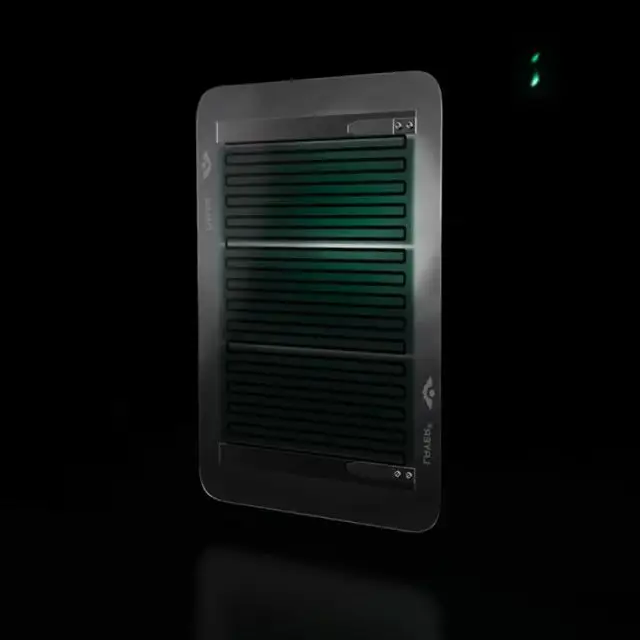

A key accelerator for BLE labels is the growing focus on energy harvesting and ultra-low-power designs. Wireless labels that harvest energy from ambient sources, such as light, motion, or radio frequency fields, can reduce or eliminate battery constraints.
In many designs, this is combined with thin-film solid-state batteries as a buffer to bridge dark phases or periods without available ambient energy, improving reliability while keeping maintenance and total cost of ownership low. This makes always-on sensing and periodic BLE advertising more practical for high-volume retail applications where replacement cycles matter.
“Our vision is clear: more IoT with wireless, open, interoperable, and scalable,” added Van Bocxlaer. “RFID delivers item-level truth. BLE labels and other wireless IoT technologies, including energy-harvesting wireless labels, help turn that truth into continuous operational signals. Retailers need an ecosystem where RFID integrates naturally with wireless IoT and software platforms so data turns into outcomes like better availability, lower waste, fewer manual touches, and faster decisions.”
-v2-responsive.webp)

About Think WIoT
Think WIoT is a media and content platform covering wireless IoT technologies and real-world deployments, including RFID, RTLS, BLE, LPWAN, WI-FI, 5G and the connected infrastructure powering digital transformation.