
EuroQCI 2026: quantum-secure communications move toward operations

Think WIoT today published its 2026 outlook on the European Quantum Communication Infrastructure (EuroQCI), an EU initiative to build a secure quantum communication infrastructure spanning the whole EU, including its overseas territories.
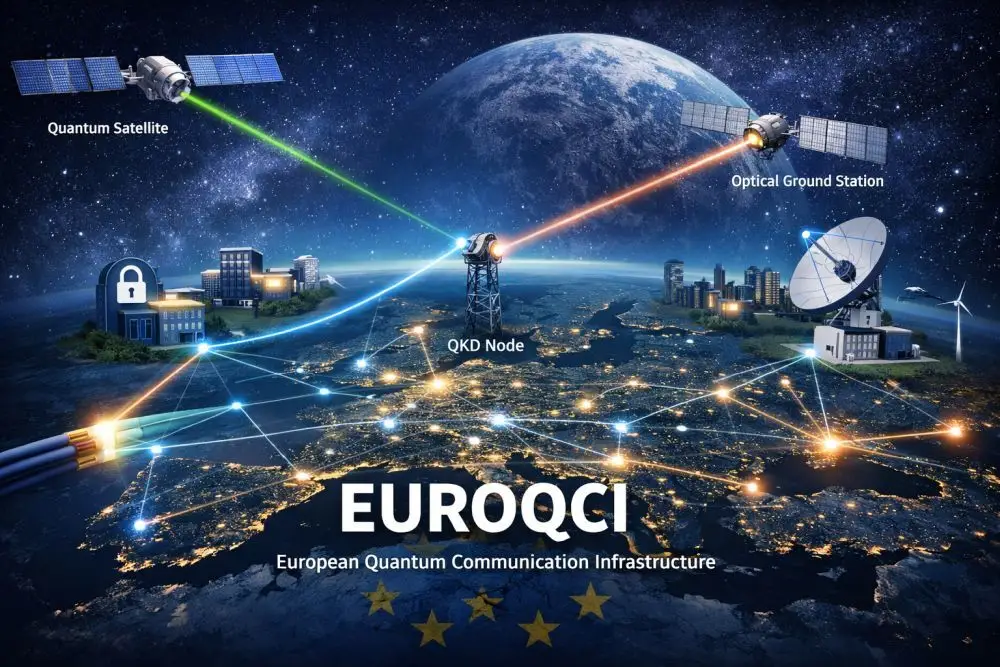
The European Commission is working with all 27 EU Member States and the European Space Agency (ESA) to design, develop, and deploy EuroQCI. EuroQCI will be composed of a terrestrial segment relying on fibre communications networks linking strategic sites at national and cross border level, and a space segment based on satellites. EuroQCI is an integral part of IRIS², the new EU space based secure communication system.
EuroQCI is expected to follow a hybrid model: a fibre based terrestrial backbone connects key sites across Europe, while a future space component extends reach and resilience. In this model, satellites distribute cryptographic key material to optical ground stations during scheduled passes.
Optical ground stations are used because satellite based quantum key distribution relies on very faint photon level optical signals and needs telescope like terminals for precise tracking and sensitive detection. Those keys are then routed through secure key management systems into terrestrial networks where they can refresh encryption for real services such as secure data links and VPNs.
The space layer is not a replacement for terrestrial networks; it is designed to complement them, especially for long distance links, cross border connectivity, and hard to reach areas.
“2026 is the year EuroQCI starts to look less like a set of pilots and more like an operational capability,” said Anja Van Bocxlaer, Managing Director and Editor in Chief of Think WIoT. “The focus is shifting to interoperability, testing, and deployment governance, what real users need before they can rely on quantum secure services.”
What quantum secure communications means
Quantum secure communications safeguards sensitive data by integrating quantum based systems into existing communication infrastructures, providing an additional security layer grounded in quantum physics. It is designed to reinforce the protection of Europe’s governmental institutions and critical infrastructures such as data centres, hospitals, and energy networks.
In practice, quantum secure communications typically combines two complementary building blocks:
1. Post quantum cryptography (PQC)
New cryptographic algorithms, especially for key exchange and digital signatures, designed to remain secure even against quantum attacks. PQC can be deployed broadly across existing systems such as web security, VPNs, device identities, and software updates, without special quantum hardware.
2. Quantum Key Distribution (QKD)
A technique for exchanging encryption keys using quantum signals. Eavesdropping attempts disturb the quantum states, enabling detection and rejection of compromised key material. QKD does not replace encryption. It supplies high assurance keys used by conventional encryption.
Towards an operational EuroQCI
EuroQCI was launched in 2019 with the EuroQCI Declaration. Work continues under the supervision of the European Commission, implemented by Member States for the terrestrial segment and by ESA for the space segment.
EuroQCI’s first implementation phase started in January 2023 with support from the Digital Europe Programme. This phase includes industrial projects to develop key technological building blocks, national projects to design and build national quantum communication networks, and PETRUS as a coordination and support action to link projects and identify standardisation needs.
Alongside this, Connecting Europe Facility funding supports cross border links between national networks and interconnections with the space component. Since January 2024, the NOSTRADAMUS project has been setting up a testing and evaluation infrastructure to assess and validate QKD based technologies with a view to certification.
Operational activities are planned to start from 2026 onwards at the Commission’s Joint Research Centre in Ispra, Italy.
Space segment
For the space segment, the Commission is working with ESA on specifications for a first generation constellation of EuroQCI satellites. This will build on the prototype satellite Eagle-1, developed by ESA and an industrial consortium, due to be launched in late 2025 or early 2026. Future activities will be planned and funded under IRIS².
2026 ecosystem events relevant to EuroQCI
The following conferences and stakeholder meetings are expected to convene the EuroQCI ecosystem in 2026 and provide opportunities to track progress, interoperability, and deployment readiness:
26 February 2026 Vienna, Austria QCI CAT Stakeholder Event
25 to 26 March 2026 Paris, France Quantum Networks Summit 2026
20 to 24 September 2026 Málaga, Spain ECOC 2026
About Think WIoT
Think WIoT is Europe’s leading independent B2B platform and community for connectivity and the Internet of Things, connecting decision makers across industry, telecom, policy, and research. Through high impact content, market intelligence, and curated events, Think WIoT helps organizations navigate and shape next generation networks, from IoT and edge to satellite, private 5G, and secure communications.
For background on EuroQCI and its terrestrial and space segments, see: European Quantum Communication Infrastructure - EuroQCI