
Mesh networks for drone swarms without cellular connectivity

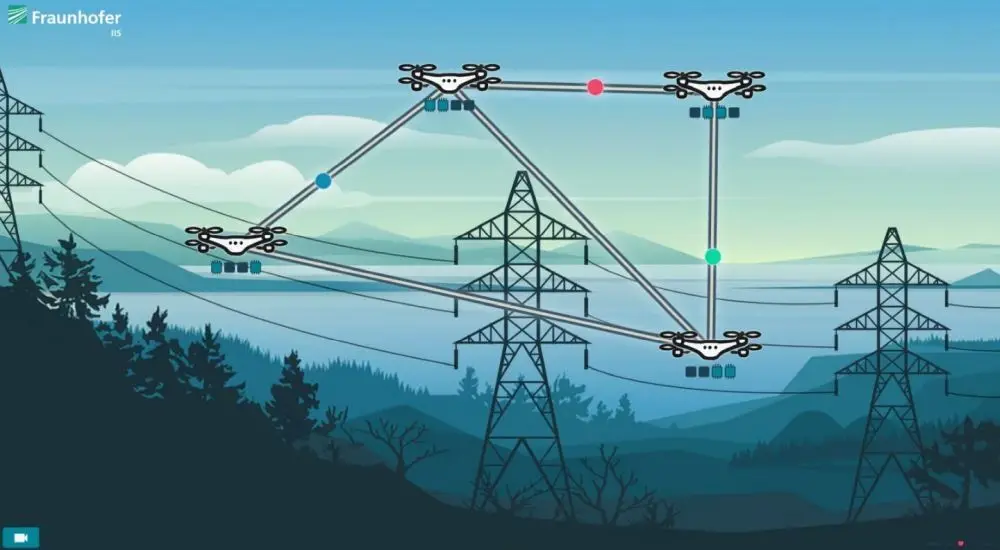
Researchers at the Fraunhofer Institute for Integrated Circuits IIS in Erlangen are developing a mobile ad hoc mesh network for civilian drone swarms. The technology is designed to connect multiple drones in a decentralized manner and enable communication even in areas where cellular coverage is lacking or unavailable.
Drone swarms need robust communication
Drone swarms can document construction progress on large building sites, monitor offshore wind farms, or assist in the search for survivors following natural disasters. For such swarms to operate in a coordinated manner, the individual drones must reliably exchange information.
Until now, civilian drone swarms have often been controlled centrally via a cellular connection. Communication proceeds in a star-shaped configuration via a central hub, usually a cell tower. If this fails or there is no network coverage, the swarm can no longer operate cooperatively.
Decentralized Mesh Instead of a Central Node
The Fraunhofer Institute for Integrated Circuits IIS in Erlangen is therefore working on a mobile ad-hoc mesh network. In this network, multiple drones are connected to each other in a decentralized manner and can communicate, for example, via Bluetooth LE.
Each drone acts as a node. Data does not have to be transmitted directly to every other drone but can be relayed via multiple intermediate nodes. This ensures that information exchange remains possible even without an external communication connection.
This approach is relevant for industrial and civilian applications because many locations do not offer stable cellular coverage. These include remote regions, disaster areas, large construction sites, or offshore facilities.
Ultra-Low-Power for Small Civilian Drones
Decentralized, highly dynamic networks have so far been used primarily in the military sector. According to Fraunhofer IIS, these systems are often large, expensive, and designed for heavy drones. Suitable mesh networks have been lacking in the ultra-low-power sector.
The Fraunhofer IIS approach, on the other hand, is intended to be energy-efficient and cost-effective. Since the connection can run via Bluetooth LE, for example, the technology is suitable for small and lightweight drones in civilian use.
This opens up an important opportunity for system integrators and solution providers. A local, energy-efficient communication architecture can enable swarm applications without relying on cellular infrastructure.
Heartbeats build network awareness
Technically, the system operates on a table-based model. The drones regularly transmit so-called heartbeats, also known as advertisements. These signals indicate to other nodes in the network: A device is present.
When two nodes register each other, they update their local tables. In these tables, they store information about which other devices have been detected on the network. As this process repeats every few seconds, an overview of the entire network gradually emerges.
A data packet can then be passed from node to node until it reaches its destination. The necessary information is built up iteratively. For users, the communication should eventually feel like a direct one-to-one connection.
Relevance for autonomous operations
In practice, multiple drones could automatically launch from a case, form a formation, and combine their respective technical capabilities. This would allow, for example, the range of a swarm to be increased or a three-dimensional map to be created.
This is particularly relevant for applications where drones must operate independently of external infrastructure. These include missions in crisis zones, environmental monitoring, infrastructure inspection, or hard-to-reach industrial environments.
The basis for this development stems from projects within the GAIA initiative. There, the Fraunhofer team is working on satellite-based animal transmitters for vultures in Namibia, which can also communicate with each other in a decentralized manner.
Prototype planned for next year
The researchers have already demonstrated how the technology works in a simulation. Laboratory tests are currently underway with Bluetooth devices that process data across multiple nodes.
A prototype is expected to be presented next year. Dr. Manuel Schrauth and his team will present initial results at this year’s International Aerospace Exhibition (ILA) from June 10 to 14 in Berlin.
Further information is available on the Fraunhofer IIS website: https://www.iis.fraunhofer.de/en/pr/2026/press-release-mesh-networks-drone-swarms.html