How Digital Load Carriers Strengthen Supply Chain Resilience

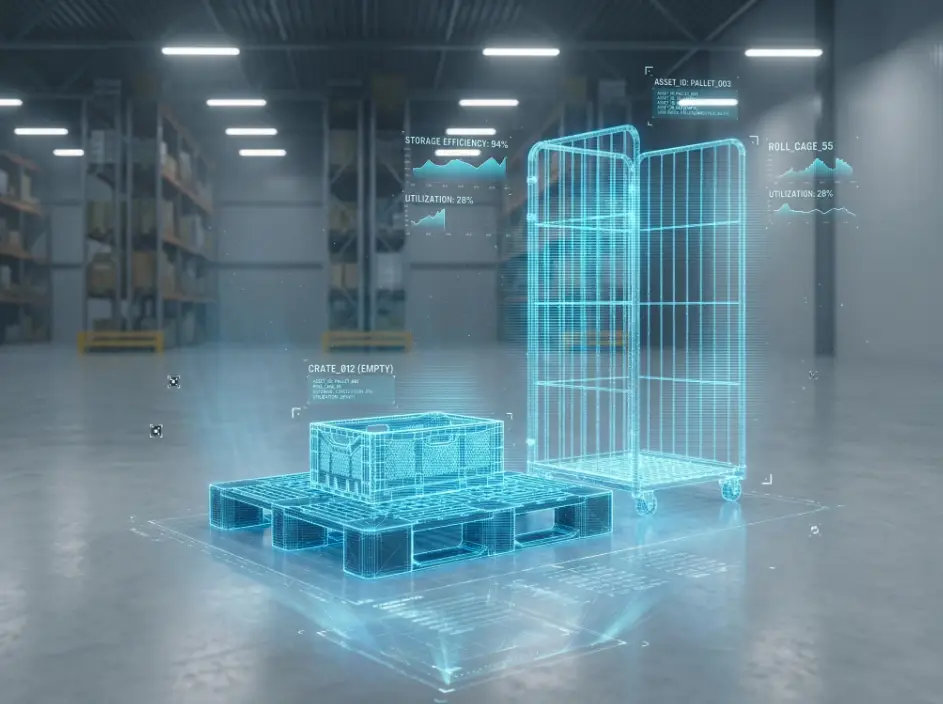
When goods move between organisations, critical information is often lost. Digital load carriers can close this visibility gap by giving pallets, crates, roll cages and containers a digital identity. Carl McInerney from Connected Load Carrier explains how shared asset data can reduce friction, improve coordination and strengthen supply chain resilience.
At the recent IntraLogisteX fair, I had the opportunity to speak about a structural weakness that still affects many modern supply chains: the moment goods move from one organisation to another, the information connected to those goods often disappears.
In my speaker session, I explored why traditional collaboration does not always scale in practice, and why the physical assets we often overlook — pallets, crates, roll cages and containers — may hold the key to more efficient, transparent and resilient supply chains.
The reset at the handover
Supply chains are operating under growing pressure. Margins are tight, demand is volatile and new regulations, including the Packaging and Packaging Waste Regulation, are forcing companies to rethink how goods and reusable assets move through their networks.
Yet despite shared KPIs, collaborative contracts and long-term partnerships, efficiency often reaches a limit at the warehouse door.
Every time a pallet, crate or roll cage moves from producer to haulier, from distribution centre to store, or from one partner to another, the physical asset continues its journey — but the context around it is often lost.
Who had the asset?
Where was it last seen?
How long did it dwell at a location?
Was it returned, delayed, damaged or missing?
When this information resets at every handover, businesses are forced into manual reconciliation. People chase missing assets, correct errors, rebuild context and resolve disputes. The result is not only operational friction, but also unnecessary cost.
In practice, this lack of continuity creates three major challenges:
Excessive safety stock
Companies hold more inventory than they need because uncertainty remains high.Manual reconciliation
Teams spend valuable time checking asset movements, correcting data and investigating discrepancies.Strained partner relationships
Disputes arise when companies cannot agree who had which asset, where it was, or when it changed hands.
One version of the truth
Earlier in my career, I saw how powerful shared visibility can be.
I helped organise a model in which a physical planner was embedded directly inside a major retailer’s office to manage seasonal demand peaks more effectively. The planner still worked with two separate systems on two separate laptops, but the key difference was that both sides were operating from one shared version of the truth.
By seeing inventory levels and promotion schedules in real time, the planner could adjust supply before demand spikes became a problem. The result was smoother demand planning, better coordination and a measurable reduction in operational pressure. In fact, the process improvement was so significant that a planned new distribution centre was no longer required.
The lesson was clear: shared visibility reduces friction.
But today, supply chains need to scale that principle beyond two companies. We cannot place a human planner inside every building, depot or partner organisation. The next step has to be digital.
The load carrier as the physical constant
ERP, WMS and TMS systems are essential, but they do not always connect seamlessly across company boundaries. Each organisation has its own systems, data structures and processes.
So what actually moves through every part of the supply chain?
The load carrier.
Pallets, crates, roll cages and containers are often the only physical constants that touch every organisation in the chain. They move from site to site, partner to partner and process to process.
That makes them far more than transport equipment. They can become digital assets.
By giving load carriers a digital identity and connecting them to a digital twin, companies can allow key information to travel with the asset. Location, dwell time, movement history, handover events and status data can be captured and shared across stakeholders.
When assets speak a common language, the economics of supply chain operations begin to change. Buffers shrink because uncertainty shrinks. Disputes decrease because facts are available. Manual checks become less necessary because events are documented automatically.
From asset tracking to operational certainty
Digital load carriers are not only about knowing where an asset is. Their real value lies in creating a shared operational truth between organisations.
This is where supply chain resilience becomes practical.
A resilient supply chain is not only one that reacts to disruption. It is one that has enough visibility to prevent avoidable friction before it grows into a larger problem.
When companies know where assets are, how long they dwell, when they move and where exceptions occur, they can make better decisions. They can reduce unnecessary stock, improve asset rotation, identify bottlenecks and create stronger accountability between partners.
The load carrier becomes a source of trusted operational data.
A practical path to transformation
For companies dealing with coordination errors, missing assets or inefficient handovers, transformation does not need to start with the entire supply chain. It can begin with one clearly defined asset group or process.
A practical roadmap could look like this:
Identify the friction
Start by asking where control is being lost. Are assets disappearing at handover points? Are disputes common between partners? Are high-value containers sitting idle for too long?Select a high-value asset group
Choose a specific asset category, such as premium containers, reusable crates or high-turnover roll cages. This keeps the project focused and measurable.Secure asset identity
Use digital technologies to establish a reliable identity for each asset at key handover points. The goal is not simply to count assets, but to create a trusted record of movement and status.Measure and scale
Once the data shows faster rotation, fewer disputes or reduced losses, scaling becomes a business decision supported by evidence.
This approach allows companies to move from fragmented visibility to measurable operational improvement.
The bottom line
Connected Load Carrier integrates fragmented data streams from multiple stakeholders to create a shared operational truth.
Collaboration only becomes a competitive advantage when it produces certainty. When facts are no longer debated, handovers can trigger action instead of arguments.
Digital load carriers make this possible by turning pallets, crates, roll cages and containers into connected assets that carry both goods and data through the supply chain.
Want to make your load carriers digitally visible?
Connected Load Carrier helps companies create shared operational truth across supply chains by connecting asset identity, movement data and stakeholder systems.
Get in contact with Carl McInerney or learn more about Connected Load Carrier.