BeWhere Integrates BLE Asset Tracking with Cisco Spaces and Hubble Network

Cisco Spaces, Hubble Network and cellular gateways extend BLE asset tracking across buildings, yards and transport networks.
How can companies track thousands of assets without equipping each one with a cellular modem? BeWhere Holdings, a Canadian IoT specialist in asset tracking and monitoring, is expanding its Bluetooth Low Energy (BLE) ecosystem by connecting beacons to existing wireless infrastructure.
On October 5, 2026, BeWhere announced integrations with Cisco Spaces and Hubble Network, alongside three new BLE sensors. The concept combines indoor positioning, external detection networks and cellular gateways to improve asset visibility across industrial and logistics environments.
Cisco Spaces: Wi-Fi Infrastructure for BLE Tracking
Cisco Spaces is Cisco's cloud platform for indoor positioning, asset tracking and location-based services. Supported Cisco Wi-Fi access points can also receive signals from compatible BLE tags.
The new integration enables BeWhere beacons to be detected through Cisco Spaces infrastructure. When a compatible Cisco access point receives a beacon signal, its location observation becomes available through Cisco Spaces and can be incorporated into BeWhere's tracking applications.
Companies already using compatible Cisco infrastructure can therefore locate tagged tools, equipment and containers without installing a separate BLE gateway network. Positioning accuracy depends on access-point density, configuration and available software functionality.
Hubble Network: BLE Detection Beyond Company Sites
While Cisco Spaces relies on enterprise infrastructure, Hubble Network operates a distributed network of more than 100 million participating scanning gateways, including smartphones.
When a compatible BeWhere beacon comes within range, a participating scanner forwards a timestamped observation with its own location. This extends tracking opportunities beyond company premises without requiring cellular connectivity on each tag.
However, updates depend on nearby participating receivers. Continuous tracking is not guaranteed. Hubble also develops satellite-based Bluetooth connectivity, but BeWhere's announced integration covers its terrestrial network.
Global Tracking Meets Local Positioning
BeWhere's cellular/GPS trackers provide another tracking option. Installed on vehicles or equipment, they report their own position while collecting signals from nearby BLE-tagged assets. The BeWhere Connect app also turns supported smartphones into mobile gateways.
This resembles the swarm solution presented by Martin Dobler of IoT Invent: one LTE-connected tracker detects multiple lower-cost BLE tags and forwards their data through a shared connection.
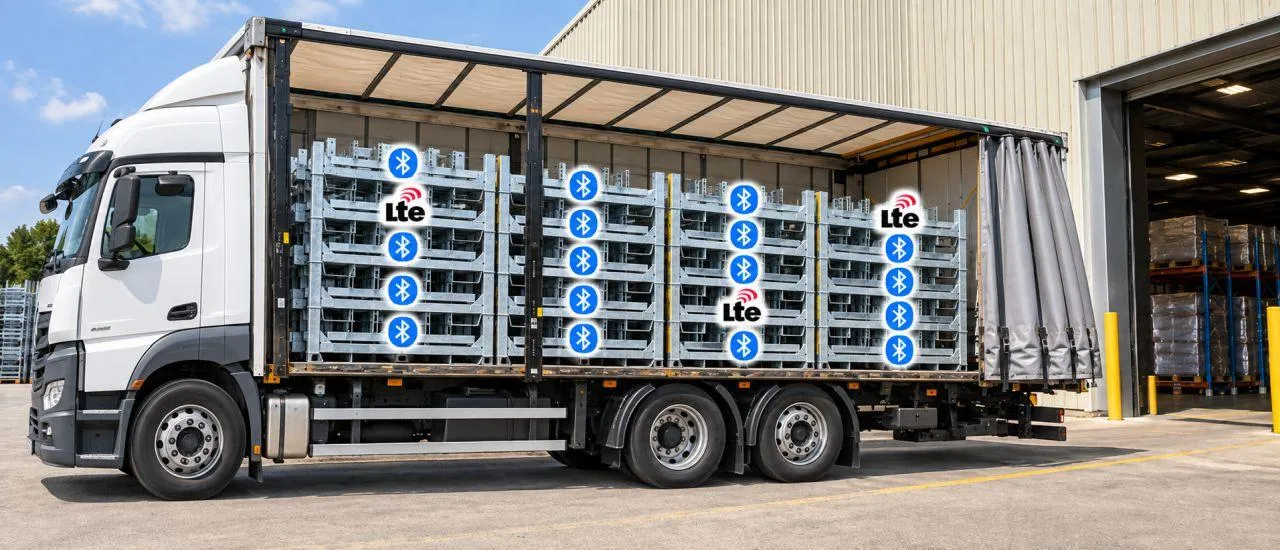

Supply Chain Visibility: How IoT Invent Makes Assets and Containers Visible
Integrating IoT-enabled tracking technologies with sensor data and cloud analytics provides comprehensive supply chain visibility that drives efficient asset management and operational decision-making.
IoT Invent's Global Tracking Meets Local Positioning approach similarly combines cellular connectivity with local Bluetooth tracking.
For example, a tracker on a truck could report its location alongside detections of twenty BLE-tagged containers. This avoids individual cellular subscriptions for every container, although location updates remain dependent on BLE reception.
Full Transparency with RTLS and AI: Smart Asset Tracking Across Borders
Combining RTLS with AI and global-local connectivity enables smart asset tracking that enhances transparency and efficiency in industrial logistics processes.
Three BLE Sensors Add Condition Monitoring
BeWhere has introduced three additional BLE devices.
The temperature tag monitors sensitive goods in food, pharmaceutical and healthcare logistics. A Hubble-compatible version supports detection through Hubble's network.
The door sensor records opening and closing events on trailers and containers, while the range sensor measures proximity for presence detection, loading and inventory applications.
BeWhere's APIs allow location and sensor information to be incorporated into fleet management, enterprise and operational systems.
Tracking Coverage and Cost: Finding the Right Balance
BeWhere's approach combines three sources of BLE detection: Cisco infrastructure inside equipped facilities, Hubble's participating scanners beyond company sites and dedicated cellular gateways on vehicles or equipment.
The company says its new BLE beacons cost significantly less than traditional asset trackers, although exact prices, licensing costs and service fees remain undisclosed.
The potential economic advantage comes from connecting large numbers of affordable BLE tags through shared infrastructure instead of equipping every asset with an independent cellular connection.
For logistics operators, this offers a practical way to monitor reusable containers, tools and equipment across different locations. The important trade-off is between cost and visibility: BLE tags can make large-scale asset tracking more economical, but their location is only updated when a compatible receiver detects them.