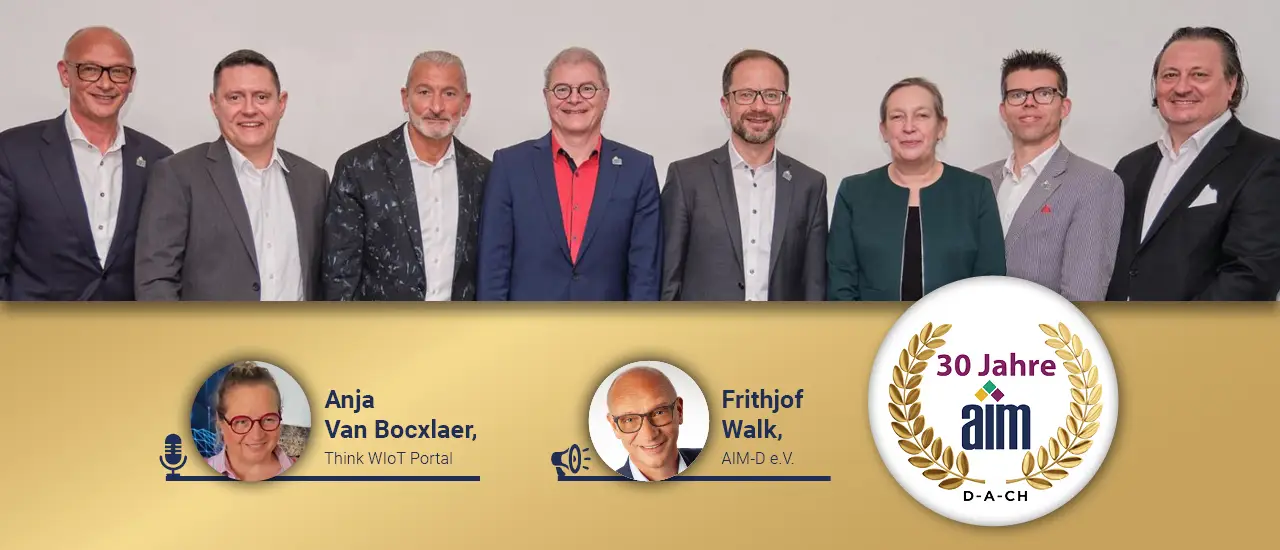

- AIM Germany was established in 1994 as an independent chapter to advance auto-ID standards.
- The association has significantly contributed to barcode and RFID technology standardization on a global scale.
- AIM Germany emphasizes balancing innovation with adherence to foundational standards within a global framework.
- A key future challenge is motivating members and young professionals to actively participate and drive innovation.
In 2024, the industry association AIM Germany will celebrate its 30th anniversary. AIM stands for a global network of auto-ID experts focused on creating standards and norms for optical readable media (ORM), barcodes, QR codes, RFID technologies, NFC, RTLS, and sensors.
This focus is based on the digital transformation of value chains, including automated and autonomous processes in production and logistics, IoT and IIoT, cyber-physical systems, and digital twins. AutoID technologies act as central "enabling technologies" in this context.
Interview with Frithjof Walk
1. Mr. Walk, when and how was AIM Germany founded, and what has the association achieved in the last 30 years?
Frithjof Walk: Let 'sstart at the very beginning. AIM-D was founded on May 30, 1994, as AIM Europe. Due to the large number of members from Germany, it was decided in the same year to establish AIM Germany as an independent chapter. At this point, I would like to mention the initiators from the very beginning: The founding members were Vera Bißdorf and Gerhard Wippern from AIM Europe, Reinhard Jurisch from Microsensys, Dr. Olaf Kluge from F&O Electronic, Kurt Mörsch from Meto, Peter Schmidt from ADT, and Andreas Schulz from Balluff. The association was founded in Hirschhorn. Erwin Kretz was elected as the first managing secretary general. He headed the association until 2007.
In October 1995, the University of Dortmund became the first academic alliance partner to join AIM Germany. One year after its founding, the association already had 46 members. In 1996, ident Verlag was launched as the official mouthpiece of AIM.
For more than 25 years, the intensive cooperation between AIM Germany, DIN, and ISO/IEC has had a significant influence on the development of almost all barcode standards. The aim of this cooperation is the standardization of barcode symbologies, RFID technologies, data structures, and barrier-free interoperability. Germany played a key role in this.
Today, the headquarters are located in Lampertheim.

AIM Germany has made significant contributions, particularly to projects such as Direct Part Marking (DPM), rectangular Data Matrix Code versions, and the development of the "Pointer to Process" and the Data Identifier for URLs in standardized data formats.
An important milestone was reached in the 1990s with the standardization of 2D codes such as Data Matrix, QR, and PDF417. In summary, AIM Germany can look back on three decades of standardization and standardization innovation.
During these decades, numerous white papers have been produced in collaboration with members. Another well-known initiative is the Tracking & Tracing Theater, which AIM DACH has been running at Logimat for 15 years.

2. In your opinion, what is the most important thing for the future development of AIM?
Walk: Especially in the phase when young people are learning and gaining experience, we also need to teach them how to keep everything in balance. On the one hand, we hopefully have dynamic young people who are full of drive, ready to cross boundaries and explore new things. On the other hand, however, we must not lose sight of the big picture: Where do we come from and where do we want to go?
Despite all our innovative strength and drive to move forward, we should not forget the foundations on which we are building and the context in which we operate. Fortunately, we are embedded in a global structure, which is a great opportunity. Sometimes I am even glad to have someone to whom I can say, "You know what? I can't decide that on my own, I have to coordinate it with the global level."
3. How would you describe the association?
Walk: Continuity, commitment, and accountability. Almost all of the board members have demonstrated long-standing loyalty to their tasks. Tracking and tracing at Logimat, for example, has been carried out for 15 years. There is a strong sense of togetherness, as well as participation in the biannual general meetings. So there is a long history of loyalty and commitment.
4. What is the biggest challenge for the future of the AIM association?
Walk: Stop complaining and get on with it! "Just do it" is a good motto. We must and will continue to motivate members to actively participate in the association's work in the working groups or committees.
I believe that is the biggest challenge for us: encouraging members to get involved, take responsibility, and dare to experiment. Less criticism and more courage – that's what we need at all levels.
5. How do you see the growth and development of auto-ID technologies in Germany?
Walk: When innovations are not further developed but "sold," a country takes risks. Innovations migrate. I would like to warn against this. The examples are well known: solar cells, robotics, RFID, light bulbs, Walkmans, and telephones. When innovations migrate, growth takes place elsewhere.
My criticism of Germany is therefore what is known as "German Angst." We want to maintain the status quo instead of building something new, perhaps even risky. For me, German Angst is a stumbling block for the economy.
I believe we need young people who really want to make a difference, not just those who complain on TikTok that others are better off.