
Smart card or smartphone? A comparison of access technologies in companies
The future of corporate access systems is a hybrid integration of RFID smart cards and smartphone credentials to balance security, convenience, and infrastructure compatibility.
- Published: March 13, 2026
- By: Anja Van Bocxlaer
- Read: 7 min
- RFID smart cards remain highly robust and compatible with existing corporate infrastructures.
- Smartphone credentials offer digital provisioning and increased flexibility, especially for temporary or visitor access.
- Hybrid models combining smart cards and smartphones are becoming the standard in corporate access systems.
- New standards like Aliro 1.0 facilitate interoperability and integration of digital keys across devices and readers.
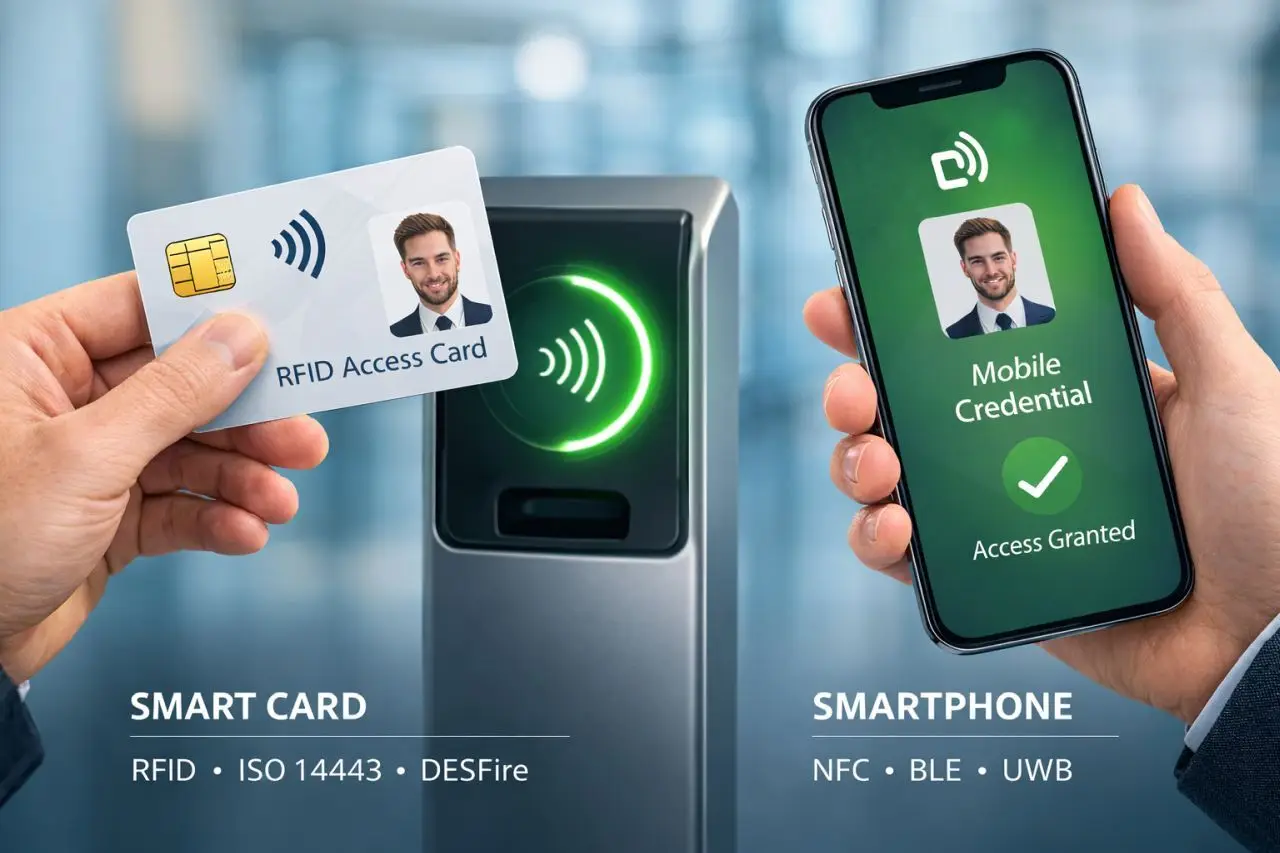
Access cards at office doors are still part of everyday life for many companies. At the same time, smartphones are increasingly becoming digital keys for buildings, systems, and services.
Between RFID smart cards and mobile credentials, a new reality is emerging: Companies must not only decide which identification medium to use, but also how different technologies can work together effectively.
In fact, many organizations are already using a hybrid model. Physical cards and mobile credentials exist in parallel and fulfill different roles within the same access infrastructure. According to HID's State of Security and Identity Report 2026, around three-quarters of companies have already introduced mobile credentials or are planning to use them, while at the same time the majority continue to use physical cards.
RFID employee cards: Robust and established
RFID employee cards have been one of the most important technologies for access control for decades. The cards contain a microchip and an antenna that communicate contactlessly with a reader. When the card is held up to a reader, it transmits a unique identity or cryptographic authentication data, which is verified by the access system.
The biggest advantage of this technology is its robustness. RFID cards do not require their own power supply, work independently of operating systems, and can be used reliably for many years.
In many companies, employee cards also perform far more tasks than just building access. They are used, for example, for time recording, IT login, printer authentication, or canteen payments. As a result, they often function as a universal identification medium within the corporate infrastructure.
Mobile credentials: the smartphone as an access key
At the same time, smartphones are increasingly becoming digital identity platforms. Mobile credentials are access data that are stored directly on the device and transmitted wirelessly to access readers.
Communication usually takes place via Near Field Communication (NFC) or Bluetooth Low Energy (BLE). While NFC enables classic "tap-to-access" scenarios, BLE also allows access over longer distances or hands-free access systems.
A key advantage of mobile credentials is digital management. Authorizations can be provided, adjusted, or revoked using software. This significantly simplifies organizational processes, especially for temporary access for visitors or external service providers.
Technological basics of contactless access systems
Today, contactless access systems are primarily based on RFID, NFC, and Bluetooth Low Energy (BLE). Depending on whether a classic smart card or a smartphone is used as the identification medium, different communication and security concepts are employed.
RFID (Radio Frequency Identification) has been the basis of many card and badge systems for many years. In the field of access control, contactless smart cards operating in the high-frequency range at 13.56 MHz are often used. Many of these cards comply with the international standard ISO/IEC 14443, which is also used for contactless payment cards.
Security platforms such as MIFARE DESFire enable encrypted communication and the secure storage of keys and application data.
Smartphones, on the other hand, do not simply use "RFID," but primarily NFC (Near Field Communication) when used as a digital identification medium at a reader. NFC also operates in the 13.56 MHz range and can interact with systems based on ISO/IEC 14443.
This means that in many cases, a smartphone can be used in a similar way to a contactless card, for example in classic tap-to-access scenarios. In addition, smartphones offer their own security features such as secure elements, biometric authentication, and secure execution environments that go beyond pure radio communication.
This spectrum is often supplemented by Bluetooth Low Energy (BLE). BLE enables communication over longer distances and is used in particular in mobile access systems, for example for user-initiated or hands-free access scenarios. In advanced systems, BLE can also be combined with Ultra-Wideband (UWB) to precisely determine the distance between the smartphone and the reader.
Smart card vs. smartphone: Technical comparison
Both technologies fulfill the same basic function—the secure authentication of individuals. However, they differ in several technical and organizational characteristics.
Criterion | RFID smart card | Smartphone Credential |
|---|---|---|
Power | No battery required | Depends on battery level |
Ownership | Issued by the company | usually private device |
Security | Dedicated security chip | Depends on device and operating system |
Management | Physical issuance and blocking | Digital provisioning |
Infrastructure | Often already available | Partially new infrastructure required |
User convenience | Additional identification medium | Use of existing devices |
Which access technology is suitable for which application?
Which technology is more suitable depends heavily on the respective application scenario.
Criterion | RFID smart card | Smartphone Credential |
|---|---|---|
Building access | Very well suited | Well suited |
Security-critical areas | Very well suited | Suitable, depending on guidelines |
Visitor access | Possible, but less flexible | Very well suited |
Robustness | Very high | Depends on the device |
Battery dependency | None | Yes |
Administrative control | Very high | Depends on device management |
User convenience | High | Very high |
Existing infrastructure | Mostly compatible | partial adaptation necessary |
In practice, RFID cards remain particularly strong where stability, clear administrative control, and compatibility with existing infrastructure are crucial.
Security and integration
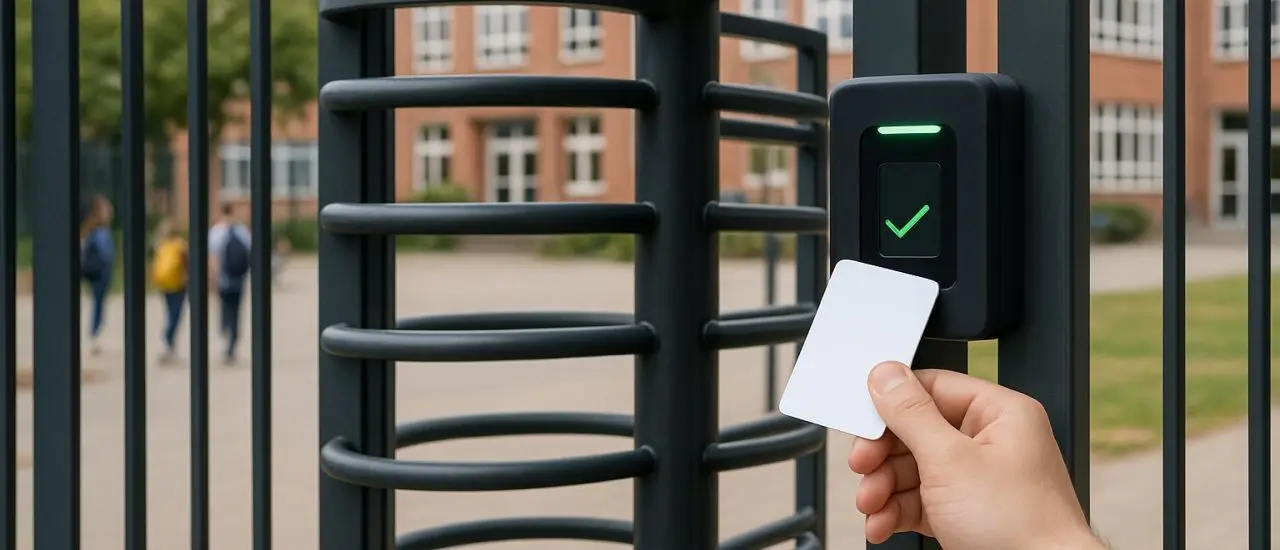
Contactless chip cards are among the most important technologies for identification and access control worldwide. Many existing access systems are designed for RFID-based identification media. As a result, smart cards are often deeply integrated into processes and technical infrastructures.
Modern cards support encrypted communication methods and secure chip architectures. Another advantage of physical identification media is administrative control: cards are issued by the company and can be blocked or replaced at any time.
Smartphones, on the other hand, pose additional challenges in terms of device security, mobile device management, and data protection, as they are often private or mixed-use devices.
New standards for digital keys
The development of mobile access systems is increasingly being shaped by new standards.
With Aliro 1.0, the Connectivity Standards Alliance has published a new standard for digital keys. Aliro combines NFC, Bluetooth Low Energy, and optional Ultra-Wideband and is designed to improve interoperability between smartphones, readers, and access systems. An important component is integration into the wallet ecosystems of Apple, Google, and Samsung.
At the same time, companies are pushing ahead with specific platforms. One example is Magenta Security Mobile.ID, a solution from Deutsche Telekom in collaboration with Samsung. It turns smartphones into digital keys for access, identification, encryption, and digital signatures. Sensitive identity data is stored in the smartphone's secure element and used via NFC or Bluetooth.
New applications on the corporate campus
The increasing digitalization of work environments is creating new applications for identity media. In addition to classic access functions, cards and mobile credentials are increasingly being used for additional services.
These include, for example, authentication at charging points for electric vehicles, booking workstations or meeting rooms, using sharing services on campus, or accessing internal services. In such scenarios, the identification medium no longer functions merely as a door opener, but as an interface between physical infrastructure and digital platforms within the company.
Conclusion: The future of access systems is hybrid
In practice, the question "smart card or smartphone?" can rarely be answered unequivocally.
Smartphones are gaining in importance because they enable digital provisioning, high user comfort, and new platform models. At the same time, RFID-based smart cards remain attractive due to their robustness, ease of management, and broad infrastructure compatibility.
The future of modern access systems therefore lies less in replacing one technology with another and more in integrating different identity media within a common access infrastructure.