

RFID in Autoclaves and Sterilization: Identification and Sensing
Successful autoclave-resistant asset identification and sensing depend on hybrid technological systems engineered to withstand the multifaceted physical stresses of sterilization environments.
- Published: March 15, 2026
- By: Anja Van Bocxlaer
- Read: 8 min
- Sterilization environments challenge IoT devices through combined heat, humidity, pressure, and chemical exposures.
- Passive RFID leads in autoclave asset identification due to its simplicity and battery-free design.
- Optical marking provides durable, permanent identification directly on metal instruments despite limited automation.
- Hybrid systems integrating RFID, optical marking, BLE, and sensor loggers better address the varying demands of sterilization workflows.
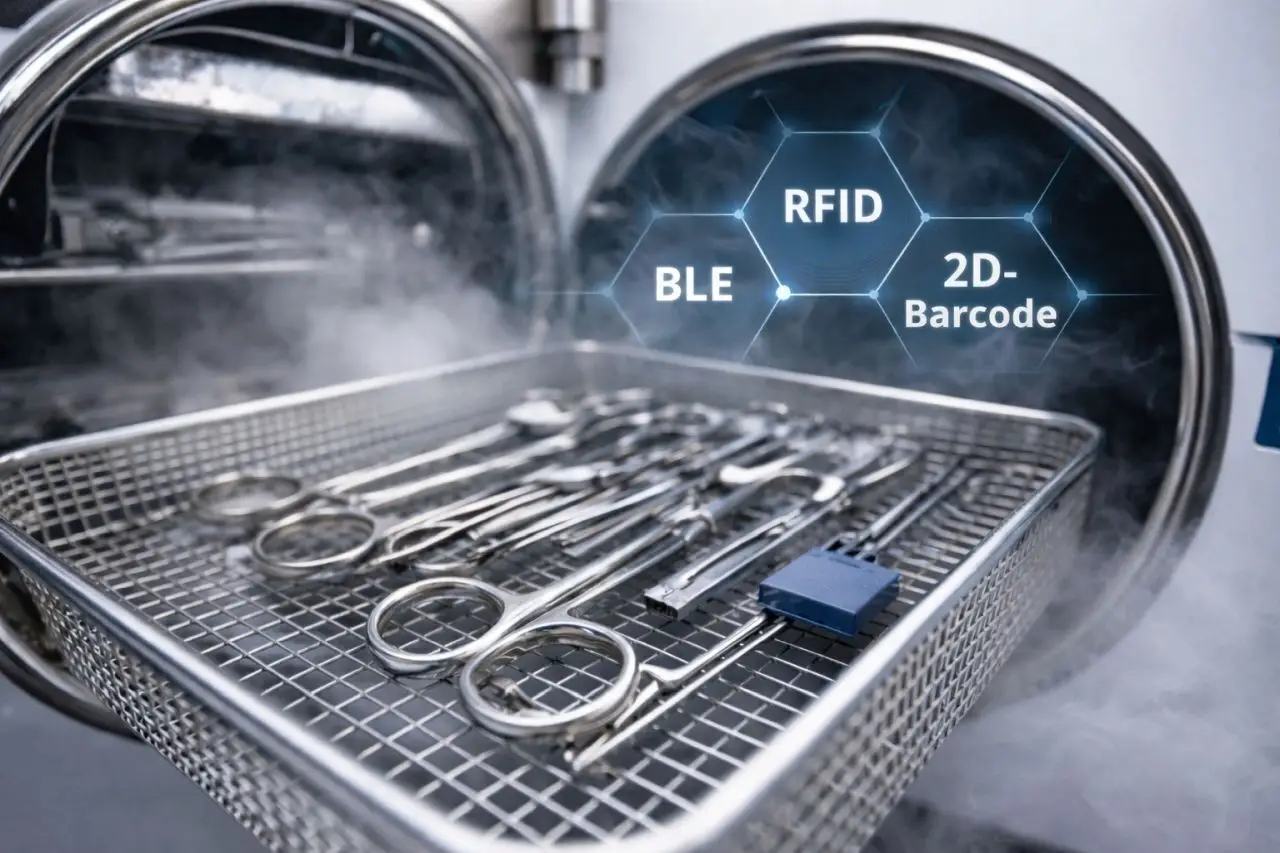
Autoclave and sterilization environments require hybrid IoT architectures
Pressurized steam, high humidity, repeated thermal cycles, chemicals, and metal surfaces make autoclaves one of the toughest environments for digital identification. Yet this is exactly where traceability is becoming more important. Hospitals want to track instruments across cleaning, sterilization, storage, and use. Laboratories and pharmaceutical facilities need documented process reliability.
Industrial companies face similar challenges when reusable tools, components, carriers, or production assets must remain identifiable after cleaning, sterilization, or other high-temperature washdown processes.
This makes autoclave-resistant asset identification relevant far beyond the operating room. Whether the asset is a surgical instrument, a sterilization tray, a laboratory container, or an industrial component exposed to harsh thermal and chemical cycles, the core requirement is the same: reliable identification and, increasingly, reliable sensing under extreme conditions.
The answer is not a single wireless standard. It is a systems approach. Passive RFID, optical marking, sensor loggers, BLE, and future solid-state battery concepts all have a role, but not at the same level of the architecture. The real progress in this field comes from matching the right technology to the right sterilization or harsh-environment task.
Sterilization in autoclaves is more than a temperature challenge
Autoclave environments are often reduced to temperature alone, but that misses the real engineering picture. A sterilization cycle exposes devices not only to 121 °C to 134 °C steam, but also to pressure, moisture ingress, cleaning chemicals, and repeated mechanical and thermal stress. That combination pushes standard electronics beyond their comfort zone.
This matters because the weak point is often not the radio chip itself. In many cases, the real failure risks sit elsewhere: packaging, sealing, memory retention, interconnects, adhesives, and batteries. A device may contain a semiconductor that survives brief exposure to high temperatures, but if moisture enters the package or the energy source degrades, the whole concept fails.
That is why autoclave-ready IoT cannot be understood as a chip selection problem. It is a hardware integration problem.
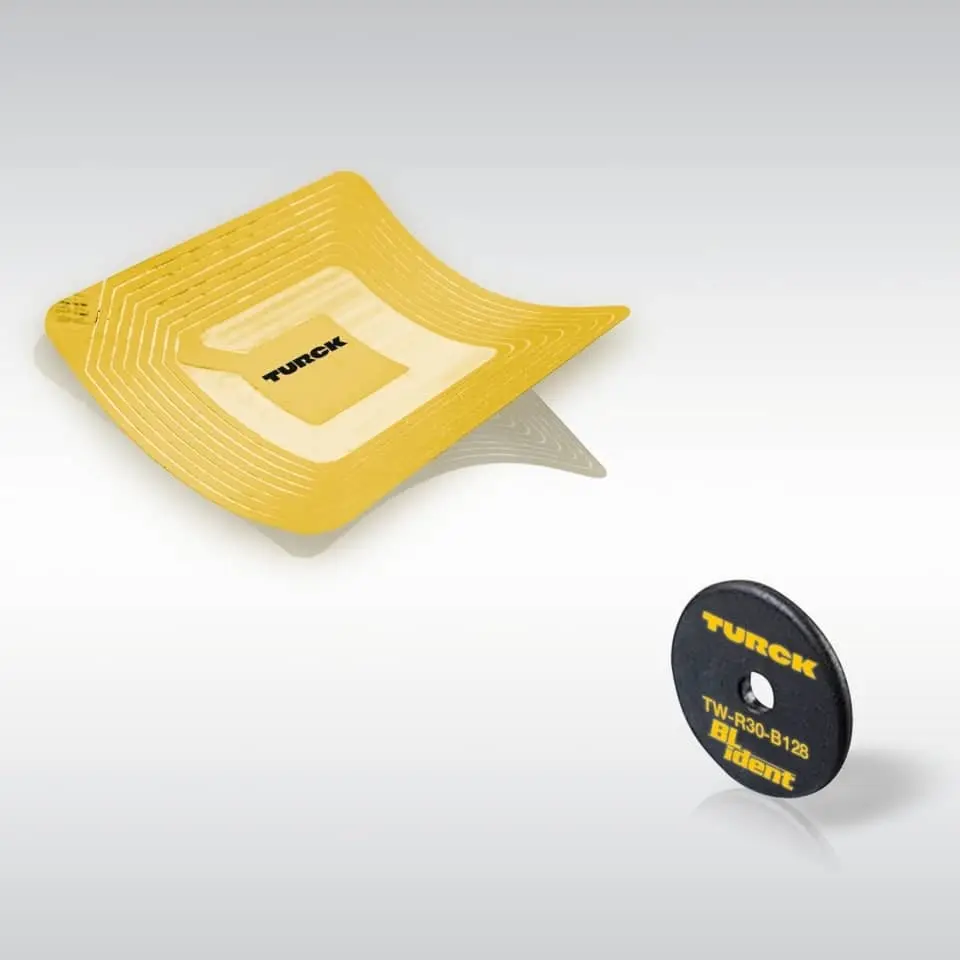

RFID Tags HF/UHF
Rugged RFID tags provide durable, versatile identification solutions for demanding industrial and logistics environments.
Passive RFID remains the leading technology for sterilization tracking
For instrument and asset identification, passive RFID remains the strongest electronic option because it removes the component most likely to fail first: the battery. A passive tag consists of a chip and antenna, powered only when it enters the field of a reader. Fewer active components mean fewer vulnerabilities under steam, pressure, and heat.
This simplicity is the reason RFID has become the practical standard in many sterilization workflows. HF RFID works well for individual instruments because it supports very small tag designs. UHF RFID is more suitable for trays, containers, and larger assets where longer read ranges and multi-item scanning improve logistics.
RFID is not dominant because alternatives are impossible. It is dominant because it offers the best balance of durability, size, and automation.
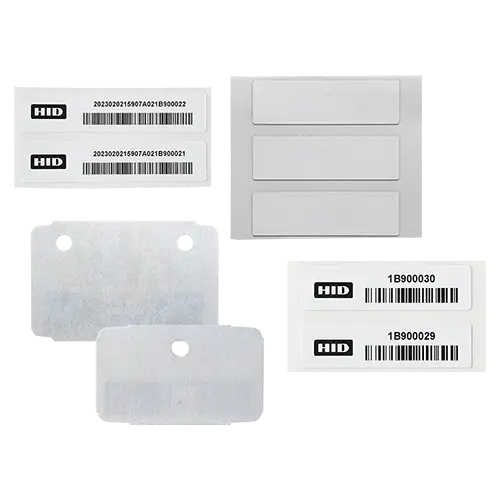

Why optical marking remains relevant
There is a reason laser-marked Data Matrix codes continue to appear on surgical instruments. They are simple, permanent, and highly resistant to sterilization stress. When the identifier is etched directly into metal, there is no package to crack, no antenna to detune, and no battery to fail.
The limitation is workflow. Optical codes need line-of-sight scanning, which reduces automation and makes bulk reading more difficult. That is why optical systems and RFID are not necessarily rivals. In many cases, they work best together. Data Matrix can provide a durable instrument-level identifier, while RFID supports faster tray-level or process-level automation.
Sterilization tracking is moving beyond identity alone
Identification is no longer the only requirement. More users now want sterilization systems to provide proof, not just presence. Knowing which instrument or container is in the cycle is useful. Knowing whether the cycle reached the right thermal conditions is better.
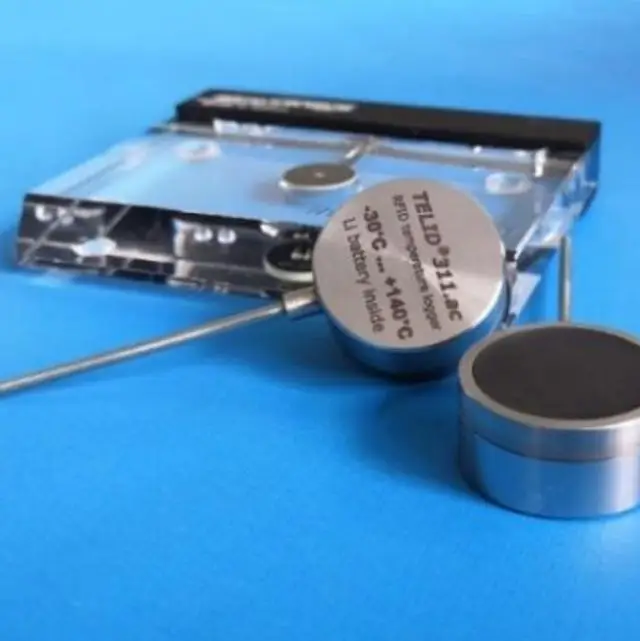
This is where sensing enters the picture. Sensor loggers and RFID-based sensing concepts can capture temperature or environmental exposure during sterilization and make that information available afterward. In quality-sensitive workflows, this creates a higher level of confidence and documentation.
Once sensing becomes part of the requirement, the system challenge grows. A passive identifier is one thing. A device that can measure, store, and later communicate process data must survive sterilization at a much deeper technical level.

BLE in sterilization tracking: useful but not for every asset
Bluetooth Low Energy often appears in discussions about next-generation sterilization tracking, and for good reason. BLE is efficient, mature, and already well established in sensing and location-based IoT. But in autoclave-related applications, its value depends heavily on where it is used.
BLE is usually not the right answer for very small surgical instruments. The issue is not just battery life. Active Bluetooth systems require more electronics, more space, and more packaging effort. On a compact metal instrument, that quickly becomes difficult to justify in terms of size, durability, and cost.
The logic changes on larger objects. Containers, trays, reusable modules, and smart medical devices can offer enough room for active electronics. Here BLE can add meaningful functionality, such as condition reporting, event logging, or location awareness once the asset leaves the sterilization chamber. In that role, BLE does not replace RFID. It extends the system around it.
Why Wi-Fi stays in the background
Wi-Fi is even less likely to sit directly on the sterilized asset. Its power needs are higher, the electronics are more complex, and the practical value is often lower than it first appears. Most sterilization-related assets do not need broadband connectivity on the object itself. They need identity, status, and in some cases compact sensor data.
That makes Wi-Fi far more useful at infrastructure level than at asset level. Gateways, readers, monitoring stations, and backend connectivity are natural places for Wi-Fi. On sterilizable objects themselves, the trade-off is usually unfavorable.
Batteries remain the main limitation for active sterilization IoT
The biggest barrier to more advanced sterilization-ready IoT has been the battery. Traditional lithium-based cells are poorly suited to repeated steam sterilization. High temperature, humidity, and pressure accelerate degradation, and once the battery becomes unreliable, the rest of the system loses value.
This is the main reason passive technologies have remained so dominant. They avoid the weakest link entirely.
Solid-state batteries and the future of sterilization sensing
Solid-state batteries could become one of the most important enabling technologies in this field. Their appeal lies in thermal stability. If a compact energy source can tolerate higher temperatures and harsher conditions than conventional batteries, active sensing modules suddenly become more realistic.
That does not mean passive RFID will be replaced. It means a new category may emerge between passive identification and fully active wireless devices. Compact sterilization-resistant sensor loggers, hybrid identity-and-sensing modules, or BLE-enabled smart containers all become easier to imagine when the battery is no longer the first failure point.
Still, it is important not to overstate the case. A better battery does not solve packaging, sealing, antenna design, memory durability, or interconnect reliability. Solid-state energy storage is an enabler, not a standalone solution.

Packaging and materials for autoclave-resistant electronics
In many harsh-environment systems, packaging deserves more attention than the communication protocol. The success of autoclave-resistant devices often depends on whether the electronics remain dry, mechanically stable, and electrically reliable after repeated cycles.
That is why materials such as ceramic, stainless steel, glass encapsulation, PEEK (polyether ether ketone), and other high-performance polymers matter so much. They are not side details. They are central to whether a product survives the real world.
The hidden story in this market is that reliable data from sterilization environments depends on materials engineering as much as on wireless engineering.


Hybrid systems: RFID, sensing and optical identification
The most realistic future for autoclave-resistant asset identification is not a winner-takes-all shift from one standard to another. It is a hybrid architecture.
At instrument level, optical marking and miniature HF RFID will remain highly practical. At tray or container level, UHF RFID supports process automation. Sensor loggers provide validation data. BLE adds higher-value connectivity where active electronics are feasible. Wi-Fi remains part of the surrounding infrastructure.
This is the direction that makes technical and economic sense. Different technologies solve different problems, and the strongest systems combine them instead of forcing one approach onto every layer.
The future of autoclave and sterilization tracking
Autoclave-resistant asset identification and sensing is no longer just a niche within RFID or medical tracking. It is becoming a clear example of what happens when IoT must operate under genuine physical constraints. Success in this space will not come from choosing the trendiest radio standard. It will come from building architectures that respect the environment.
Passive RFID remains strong because it is simple. Optical marking remains relevant because it is permanent. BLE becomes useful when assets are large enough and the added intelligence is worth the complexity. Solid-state batteries could widen the design space for active sensing. Packaging and materials remain the foundation beneath all of it.
The future of sterilization tracking will not be defined by one protocol. It will be defined by how well different technologies are combined into reliable systems that keep delivering trustworthy data under steam, stress, and repetition.