

Capacitive Sensors in Wireless IoT: From the Field to Connected Information
Capacitive sensors combined with wireless communication technologies are transforming traditional sensing into scalable, maintenance-free IoT solutions integral to digital industrial and infrastructure systems.
- Published: March 23, 2026
- By: Anja Van Bocxlaer
- Read: 8 min
- Capacitive sensors detect materials by changes in an electric field influenced by the dielectric constant, enabling detection of conductive and non-conductive materials.
- Integration with wireless technologies, such as RFID and Bluetooth Low Energy, allows capacitive sensors to function as networked IoT devices with remote data accessibility.
- Passive RFID-based capacitive sensors operate without a power source, enabling maintenance-free, long-term condition monitoring in applications like structural health and supply chain logistics.
- Active IoT systems combine capacitive sensors with microcontrollers for local data processing and energy-efficient wireless communication, expanding their use in industrial and smart environments.

Capacitive sensors have been an integral part of industrial applications for many years. They measure fill levels, detect materials, and enable contactless interactions in a wide variety of environments.
However, their role is fundamentally changing with integration into wireless communication systems. Individual measurement points are becoming networked data sources that fit into comprehensive IoT architectures.
In the context of the Wireless IoT, a clear trend is emerging. Sensor technology is becoming not only more precise, but also scalable, energy-efficient, and directly integrable into digital processes.
Operating Principle and Special Properties
Capacitive sensors operate based on an electric field between two electrodes. Physically, this is a capacitor. Capacitance describes the ability of this system to store electrical charge. It depends on three factors: the distance between the electrodes, their surface area, and the so-called dielectric constant of the material between them.
As soon as an object approaches or a medium enters the electric field, this dielectric constant changes. Materials such as water, plastics, or glass affect the electric field to varying degrees. This changes the system’s capacitance. The sensor detects this change and converts it into an electrical signal.
This physical principle explains why capacitive sensors are so versatile. They do not respond to electrical conductivity, but rather to the properties of the electric field. This allows them to detect both conductive and non-conductive materials.
By comparison: Inductive sensors are based on a magnetic field. They generate an alternating electromagnetic field that is influenced by metallic objects. Detection occurs via eddy currents, which arise exclusively in conductive materials. Therefore, inductive sensors are limited to metals in practice.
Capacitive sensors take a different approach. Since they respond to changes in an electric field, the mere presence of a material with a dielectric constant different from that of air is sufficient. This is precisely why they can also detect liquids, powders, or organic materials.
This property offers a significant advantage: the electric field can penetrate non-conductive materials such as plastic or glass. As a result, contents inside a container can be detected without direct contact between the sensor and the medium. In practice, this means that fill levels, for example, can be measured through tank walls.
This combination of physical principle and material independence makes capacitive sensors a particularly flexible solution. They are suitable for both traditional industrial applications and modern IoT systems where different materials and environments must be reliably detected.
Established Technology in Industry
In industrial applications, capacitive sensors have long been the standard. Companies such as Balluff, Pepperl+Fuchs, and SICK use them in numerous scenarios, such as level measurement, material detection, or process monitoring. The sensors operate reliably even under demanding conditions and can be flexibly integrated into existing systems.
At the same time, however, a clear limitation of traditional systems becomes apparent. Sensor technology often remains locally integrated; data is processed directly on-site or transmitted via wired interfaces. With increasing digitalization and the need for networked data, this approach is reaching its limits.
From Sensor to Networked Unit
Integration with wireless technologies is fundamentally changing the use of capacitive sensors. Measurement values are no longer recorded in isolation but are integrated into higher-level systems. Data is available centrally and can be analyzed in real time.
Wireless communication also enables flexible installation. Sensors can be placed independently of existing infrastructure and integrated retroactively. This creates significant added value, particularly in distributed systems such as logistics networks or large-scale industrial facilities.
RFID-based sensor technology without a power source
A particularly efficient combination is achieved by integrating capacitive sensor technology with RFID technology. In this setup, the sensor, IC, and antenna are integrated into a compact tag. The measured capacitance influences the radio signal, allowing an RFID reader to capture sensor data in addition to the identity.
The key advantage lies in passive operation. The tags do not require their own power source and are activated by the reader’s signal. This eliminates maintenance requirements, and the sensors can be integrated into objects for the long term.
Such approaches can be found in developments by companies such as E-Garde. Capacitive sensor ICs enable applications such as monitoring humidity in packaging or condition monitoring along the supply chain. Sensor technology thus becomes a direct part of the product and continuously provides data on its condition.
Related Suppliers




Structural condition monitoring as an application example
A particularly relevant field of application is the structural condition monitoring of infrastructure. Bridges, tunnels, or industrial facilities must be reliably monitored over long periods to detect damage early on.
Battery-free, sensor-based UHF RFID tags open up new possibilities. These systems continuously collect condition data and store it until it is read by a reader. Since no battery is required, the sensors can operate maintenance-free for many years.
One example is the so-called Infrastructure Health Tag. This detects changes in metallic structures, such as those caused by corrosion, cracks, or leaks. The technology relies on measuring electrical properties within protective coatings or materials. Changes in these values indicate structural damage.
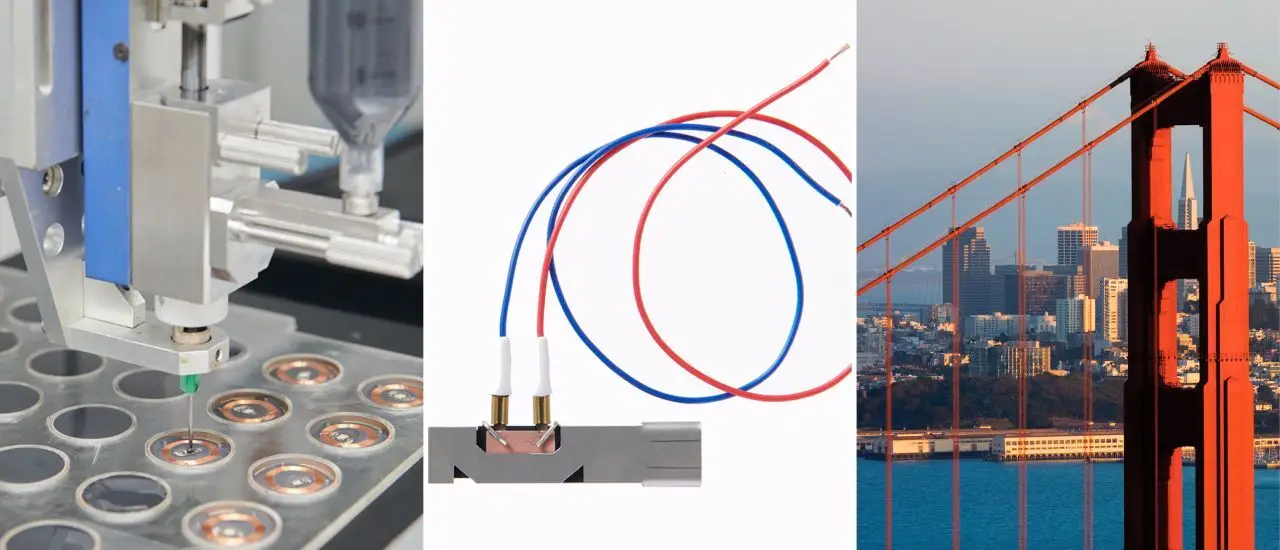

Such systems are already being used in critical sectors, such as aerospace or in infrastructure applications. The ability to monitor conditions remotely reduces the need for manual inspections and significantly improves the predictability of maintenance measures.
This form of monitoring is becoming increasingly important, particularly in regions where infrastructure is under high stress, for example due to environmental or mechanical influences.
Smart Labels in Healthcare
The potential of capacitive sensor technology in combination with wireless technologies is also evident in the healthcare sector. One example is a smart label for autoinjectors developed by Identiv in collaboration with Eli Lilly.
The label combines NFC with capacitive sensors to detect the condition of an injector before and after dosing. This is based on measuring mechanical changes within the device that affect the electric field. This allows real-world usage data to be captured without having to modify the device itself.
This approach demonstrates how sensor technology can be directly integrated into packaging. The system is battery-free, thin, and readable by smartphones. At the same time, it enables scalable and cost-effective monitoring of treatment adherence.
Active IoT Systems with Integrated Sensors
In addition to passive RFID solutions, active IoT systems are gaining increasing importance. Here, capacitive sensors are combined with microcontrollers and wireless technologies.
Manufacturers such as STMicroelectronics integrate capacitive sensor capabilities directly into their microcontrollers. This allows measurement and data processing to be performed within a single system. Nordic Semiconductor complements this approach with energy-efficient wireless technologies such as Bluetooth Low Energy, resulting in compact and long-lasting sensor solutions.
These systems are flexible and enable not only data collection but also local data processing. They are used in industrial sensor nodes, building automation, and mobile devices.
Custom RFID ICs and New System Architectures
Another step forward is the combination of RFID, NFC, and sensor technology at the IC level. Semiconductor manufacturers such as EM Microelectronic are developing customized solutions that integrate sensor functions directly into RFID chips.
One example is an RFID IC that combines capacitive sensor technology with UHF RFID. Such solutions make it possible to capture environmental parameters such as humidity, temperature, or proximity directly via existing RFID infrastructures. The sensor technology thus becomes part of a standardized system and can be seamlessly integrated into existing processes.


The combination of different frequencies is particularly relevant here. Dual-frequency solutions combine UHF RFID for range with NFC for interaction. This allows industrial applications, maintenance processes, and user interactions to be mapped within a single system.
Applications in a connected environment
The combination of capacitive sensor technology and wireless technology opens up numerous fields of application. In logistics, packaging can be equipped with sensors that monitor its condition throughout the entire supply chain. In industry, sensors continuously provide data for process monitoring and enable more precise control of operations.
In agriculture, too, capacitive measurement of soil moisture is increasingly being combined with wireless technologies to use resources more efficiently. In buildings, capacitive sensors enable new forms of interaction as well as the monitoring of materials and systems.
Challenges and Development
Capacitive sensors are sensitive to environmental conditions such as temperature or humidity. Additionally, calibration requires adaptation to the specific application.
Current developments therefore focus on improved signal processing and adaptive systems. By integrating software and edge technologies, interference can be compensated for and reliability further increased.
Conclusion
Capacitive sensors are becoming an increasingly important part of connected systems. In combination with wireless technologies, they enable solutions that collect data directly at the object and provide it over the long term.
Whether as a battery-free RFID sensor in infrastructure monitoring or as an active IoT node in industrial applications, the technology is continuously expanding its scope of application. Sensors are increasingly taking a backseat, while their data becomes the foundation of digital processes.
This makes capacitive sensor technology a central component of the Wireless IoT.