

BLE sensing: Status data and location context from the loading dock to the shelf
BLE sensing transforms supply chain labels into active process instruments by integrating continuous status data and location context, thereby enhancing traceability and operational decision-making beyond discrete scan points.
- Published: February 04, 2026
- By: Anja Van Bocxlaer
- Read: 5 min
- BLE sensing extends traditional scan data to include continuous status monitoring such as temperature and humidity.
- Data availability depends on infrastructure coverage, with tags transmitting either real-time or stored data upon contact.
- Location context is derived from signal reception zones and refined through tag-receiver calibration.
- Operational effectiveness hinges on the integration of BLE sensing into comprehensive platforms, not isolated pilots.
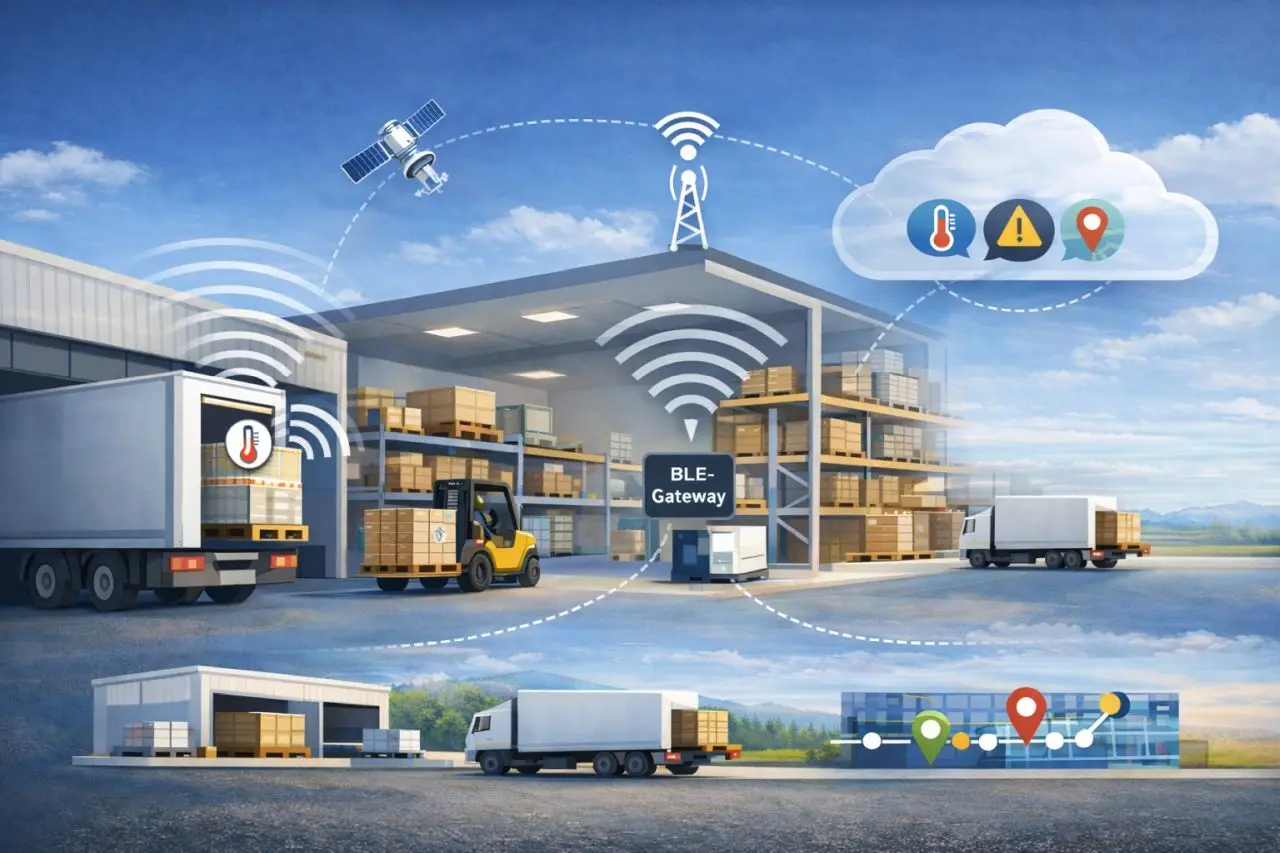
From scan to true status
Supply chain data is traditionally generated at the point of process: during scanning, at the gate, upon receipt of goods. This is efficient, but selective. In between, there are often phases in which quality deteriorates, conditions are violated, or assets "disappear" without the system recognizing it in a timely manner.
BLE sensing fills this gap. It expands pure identification to include status data such as temperature and humidity, making visible what happens between two scan moments.
Essentially, this means that a label is no longer just a carrier of an ID, but a small sensor point. It measures continuously or event-based and can send measured values wirelessly together with the label ID. The benefit does not come from "more data," but from the shift from snapshots to reliable trends.


Retailer Shufersal First to Use IoT Pixel for Temperature Control
The integration of battery-less Bluetooth IoT Pixels enables Shufersal to effectively manage cold chain logistics, enhancing produce freshness while reducing food and plastic waste.
From sensing to data flow: availability with radio contact
In practice, BLE sensing is rarely a continuous live stream. The data typically becomes visible when the label is within range of an infrastructure that can receive BLE signals.
Within this coverage, statuses become available in real time; outside of coverage, it depends on the tag design: Some tags only transmit when they are "heard"; others store measured values locally and transmit them the next time contact is made. This distinction is crucial because it determines whether a system is designed for fast response within zones or for gap-free detection over a distance.
The path to the cloud follows a simple logic: measured values become time series, time series become events, and events only become valuable when they are linked to rules, thresholds, and processes. BLE sensing is thus less a "radio technology" than a mechanism for reliably bringing status information into a system of workflows and verifiability.
Location as context: When reads become zones and locations
With BLE sensing, localization is not a separate promise, but an additional context that arises from reads. As soon as a receiver picks up a signal, an observation is created with a timestamp and reception location. Many applications deliberately start with zone logic because it is economically and operationally robust: "in the cooling zone," "at the ramp," "in the truck area." This allows cause chains to be analyzed effectively, for example, when temperature deviations correlate with downtimes at certain transfer points.
BLE–Wi-Fi gateways or bridges are the typical industrial bridge: they receive BLE signals and transport the data to the cloud via existing Wi-Fi (or alternatively Ethernet/cellular).
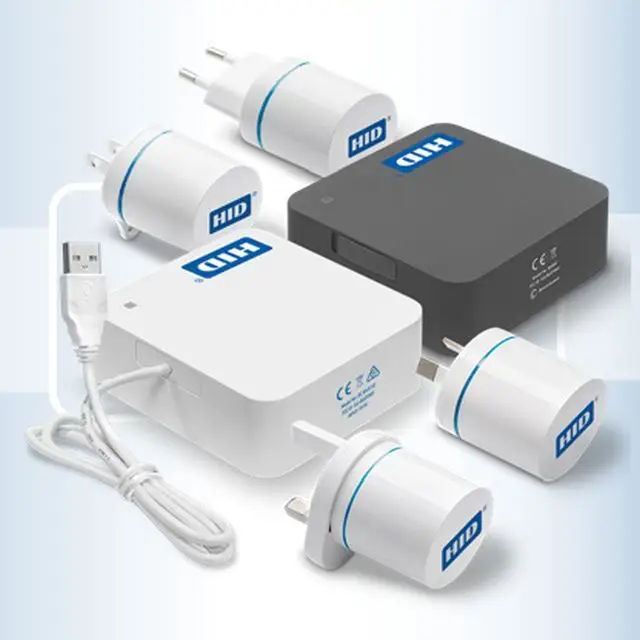

At the same time, location is often considered across technologies because indoor and outdoor environments have different physics: Wi-Fi-based methods can use existing access point infrastructure, GNSS provides the reference outdoors, and LPWAN can serve as backhaul or a supplement. The decisive factor is not the standard, but the continuity of visibility along real stations.
When higher precision is required, simple signal strength heuristics are no longer sufficient. This is when direction- and distance-based methods come to the fore, turning "within range" into a more reliable location statement. It is important to note that precision is achieved through the interaction of tag, reception infrastructure, and calibration – not through the label alone.
Energy and form factor: Design determines cost-effectiveness
Whether BLE sensing is convincing in operation depends on energy, clocking, and form factor. The more frequently measurements are taken and transmitted, the more dominant the energy budget becomes. Battery operation delivers predictable performance, is stable in demanding environments, and facilitates clear life cycle planning.
-v2-responsive.webp)

Energy harvesting aims for maintenance-free operation and scalability, but makes availability more dependent on the environment and infrastructure. In both cases, the crucial question is not "battery or harvesting," but which measurement and transmission profile fits the risk and cost model of the process.

This is precisely why BLE sensing is not a "one-size-fits-all" solution. A system for cold chain and compliance is designed differently than one for reusable assets or retail inventory because the frequency, coverage, and detection logic are different.
Platform instead of pilot: operating models and classification compared to RFID
BLE sensing only delivers real benefits when it is operated as a system. This includes device and identity management, clean data models, rules for events, alerts, and integrations into operational systems.
In practice, there are various archetypes: platform-centric smart label approaches such as Truvami, thin BLE label setups from the industrial environment such as Identiv in combination with InPlay chips and platform logic from Tag-N-Trac, service-oriented rollout models such as Connected Load Carrier, and battery-free item-level concepts such as Wiliot. These examples represent not so much "better wireless technology" as different answers to the same question: Who operates the system, how is it scaled, and how are measured values turned into process decisions?
Compared to RFID, it is rarely a question of either/or. RFID is extremely powerful when identity at the process point is sufficient and mass collection at defined locations is important. BLE sensing plays to its strengths where status changes between process points are relevant and where coverage-dependent availability is sufficient to better manage quality, circulation, or losses operationally. In many target scenarios, the two complement each other: RFID as a cost-efficient identity layer, BLE sensing as a status and context layer.


Conclusion: The label becomes a process instrument
BLE sensing makes the time between scan points usable. Not because every object is "live" at all times, but because states become automatically available as soon as infrastructure is within range, and because processes, events, and rules can be derived from this. This turns the label into a process instrument: it reduces surprises, improves traceability, and brings decisions closer to the point where deviations occur.
The key question for implementation is therefore not whether BLE sensing is possible, but where the operational leverage is great enough to systematically close the gap between process points.