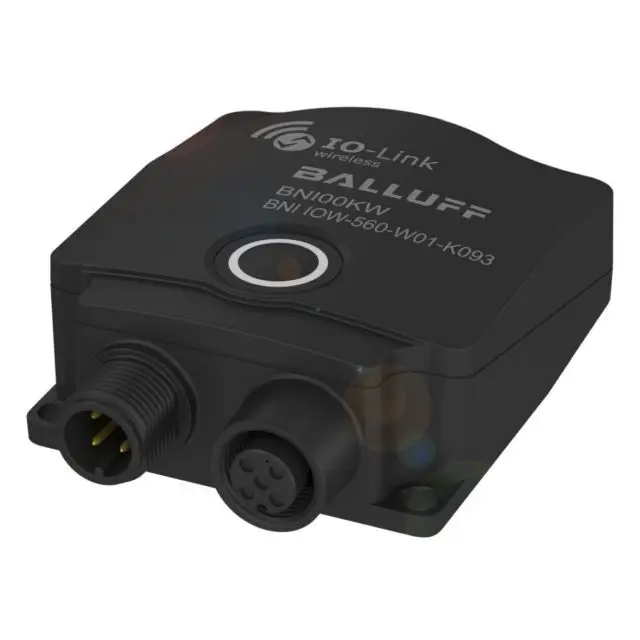

Key takeaways
- Enables wireless communication for standard IO-Link devices
- Supports IO-Link Wireless 1.1 and IO-Link version 1.1 protocols
- Ensures fast data transfer with 5 ms cycle time
- Features robust IP67-rated housing for harsh environments

Talk to the product expert
Rainer Traub, Product Cluster Manager Identification
Detailed product information
Connecting standard IO-Link devices to wireless automation
The Balluff IO-Link Wireless Bridge BNI00KW enables wireless communication between standard IO-Link devices and an IO-Link Wireless system. Acting as the link between wired sensors or actuators and the wireless network, the bridge allows machine builders and plant operators to integrate existing IO-Link devices into cable-free automation architectures without changing the devices themselves.
Designed for flexible industrial use, the bridge connects directly to a conventional IO-Link device and transmits its data wirelessly to an IO-Link Wireless master. This makes it possible to extend proven IO-Link installations into machine areas where cabling is difficult, exposed to mechanical stress, or simply impractical.
The result is greater flexibility in machine design and improved reliability in dynamic applications such as robotics, transport systems, and rotating equipment.
With support for IO-Link Wireless and IO-Link version 1.1, the BNI00KW ensures compatibility with established IO-Link environments. It enables real-time bidirectional communication between devices and the PLC while maintaining the familiar IO-Link configuration workflow. Process data exchange supports up to 32 bytes input and 32 bytes output with cycle times as low as 5 milliseconds, ensuring fast and reliable data transmission.
The compact and lightweight device is built for industrial environments. Its robust housing, IP67 protection rating, and resistance to shock and vibration make it suitable for demanding applications on machines and production systems. With a supply voltage of 18 to 30.2 V DC and standard M12 connectors, integration into existing automation systems is straightforward and reliable.
By bridging the gap between wired IO-Link devices and wireless communication, the BNI00KW IO-Link Wireless Bridge expands the possibilities of sensor connectivity. It helps manufacturers reduce cable wear, simplify machine layouts, and bring IO-Link communication into dynamic or hard-to-reach areas where traditional wiring reaches its limits.
Key Features
IO-Link Wireless 1.1.3 interface
Compact housing made of semitransparent PA 12 material
High protection rating with IP67 for harsh environments
Wide operating voltage range (18 to 30.2 VDC)
Simple installation with M12 connectors and M4 mounting screws
Compliance and approvals: CE, UKCA, cULus, WEEE, FCC (Radio), IC (Radio)
Application
Designed for wireless IO-Link communication, this device supports fast response times with a minimum cycle time of 5 ms, suitable for sensing and actuator control in demanding industrial environments.
Environmental & Safety
IP67 protection ensures operation in dusty and wet conditions
Shock resistance: 100 g impact for 6 ms
Vibration resistance: 15 g, 10–500 Hz
Functional safety with an MTTF of 111 years at 40 °C
- Rated Operating Voltage
- 24 V DC
- Maximum Output Current
- 3 A
- Operating Temperature
- -5...50 °C
- Shock Resistance
- 100 g, 6 ms (25 pulses per axis, XYZ)
- Vibration Resistance
- 15 g, 10–500 Hz (20 cycles, XYZ axis)
- Ingress Protection Rating
- IP67
- Dimensions
- 53 x 22.5 x 70.9 mm
Balluff IO-Link-Bridge Datasheet BNI00KW 299196 en.pdf
PDF, 122.42 KB
Product Images