HID’s 2026 Security & Identity Report Highlights Trust, Protection and User Choice
New global research reveals seven defining trends shaping identity, access and trust strategies across converged physical and digital environments
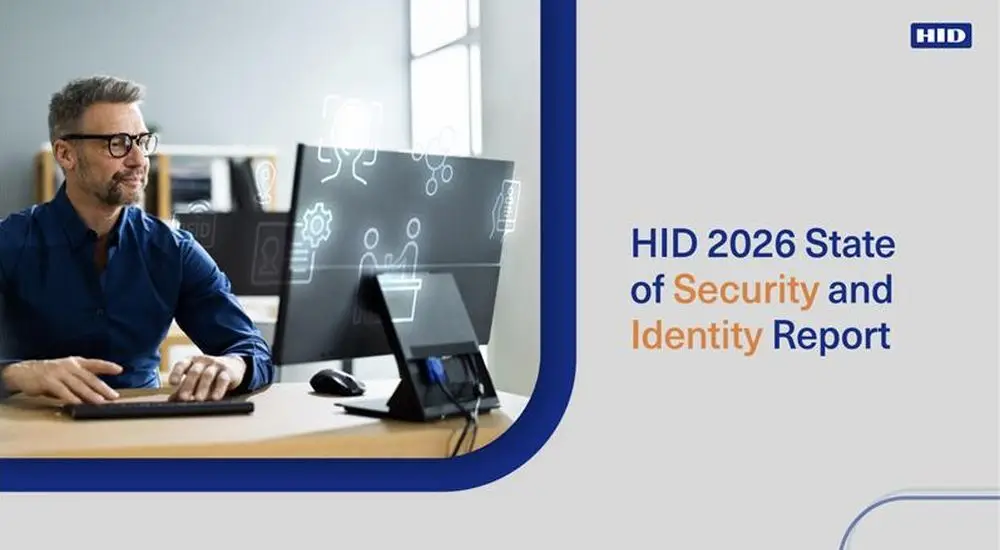
HID, a global leader in trusted identity solutions, has released its 2026 State of Security and Identity Report, highlighting how organizations worldwide are redefining identity management to build trust, strengthen protection and preserve user choice.
Based on insights from more than 1,500 security and IT professionals, end users and industry partners, the report provides a comprehensive view of how identity now sits at the center of security strategy in increasingly converged physical and digital ecosystems.
“Security leaders are clearly under pressure to modernize access and identity infrastructure, but our research shows they're equally focused on the governance, protection and transparency that build lasting trust,” said Ramesh Songukrishnasamy, Senior Vice President and Chief Technology Officer at HID. “The organizations succeeding in 2026 are those giving stakeholders meaningful solution choice while maintaining robust security.”
Seven Trends Defining the Future of Identity and Security
The report identifies seven interconnected trends that collectively define the next phase of identity-driven security strategy:
1. Identity management dominates strategic planning
Nearly three-quarters (73%) of respondents cite identity management as a top priority — the highest-ranking category in the study. Organizations are shifting from standalone credential systems to unified identity governance spanning both physical and digital domains.
2. Mobile credentials reach critical mass
Mobile credentials adoption is increasingly driven by security benefits (50%) rather than convenience (34%). However, hybrid credential environments remain the norm, with 84% of end users maintaining physical credentials alongside mobile deployments.
3. Biometrics move beyond MFA into core access control
Biometric technologies are gaining strategic importance (45%), led by fingerprint (71%) and facial recognition (50%). At the same time, ethical and privacy concerns have more than doubled year-over-year, rising from 31% to 67%.
4. Real-Time Location Solutions (RTLS) expand into mainstream use cases
RTLS adoption is accelerating across healthcare, manufacturing and logistics. While 42% of end users identify RTLS as a strategic priority, cost, integration complexity and privacy concerns continue to present challenges.
5. Physical and digital identity convergence accelerates
Unified identity solutions are entering the mainstream, with 75% of organizations having deployed or actively evaluating integrated identity platforms spanning buildings, networks and applications.

HID M1 Transparent Gateway

HID M1 Transparent Gateway enhances security by adding a cryptographic layer without disrupting existing access control systems.
6. RFID becomes foundational infrastructure
RFID adoption continues to grow steadily, with 54% of respondents reporting active use. Once considered niche, RFID is now viewed as core infrastructure for asset tracking, inventory management and operational intelligence.
7. Investment shifts toward integrated platforms
Organizations are moving away from point solutions and toward integrated identity and security platforms to improve visibility, efficiency and resilience. Integration complexity remains the primary barrier.
Ethics and Privacy at the Forefront
Beyond technology adoption, the 2026 report underscores a defining theme: ethical and privacy considerations are at an all-time high.
For biometrics alone, 67% of end users express moderate to high concern regarding ethical implications and data protection. Organizations are responding with stronger governance frameworks, transparency measures and compliance strategies — signaling a broader maturity in how identity-driven security decisions are made.
The research spans industries including healthcare, education, government, finance, manufacturing and critical infrastructure, offering a dual perspective from both end users and implementation partners. This combined insight highlights where strategy aligns with execution — and where operational gaps remain.
Identity at the Center of Trust
The 2026 State of Security and Identity Report presents a clear snapshot of how organizations are prioritizing investment, managing risk and preparing for a future where identity convergence defines resilience and trust.