Is your supply chain PPWR-proof?

Are you ready to make your supply chain PPWR-proof?
The modern supply chain is entering a new era driven by intelligence rather than just scale. With the introduction of the Packaging and Packaging Waste Regulation (PPWR), circularity has shifted from a visionary ambition to a binding legal requirement for packaging across the EU.
In this landscape, being sustainable must be proven with verifiable, auditable data. The goal of a circular supply chain is to keep resources in use for as long as possible through reuse, recycling and controlled material flows. However, turning that ambition into impact requires a digital foundation that replaces assumptions with facts.
The circular mandate
The traditional linear supply chain was built for speed and cost. Today, rising emissions and stronger regulations like the PPWR are pushing businesses toward a circular model. Rather than seeing these regulations as a hurdle, forward-thinking organizations are using them as a stimulus to build more transparent operations.
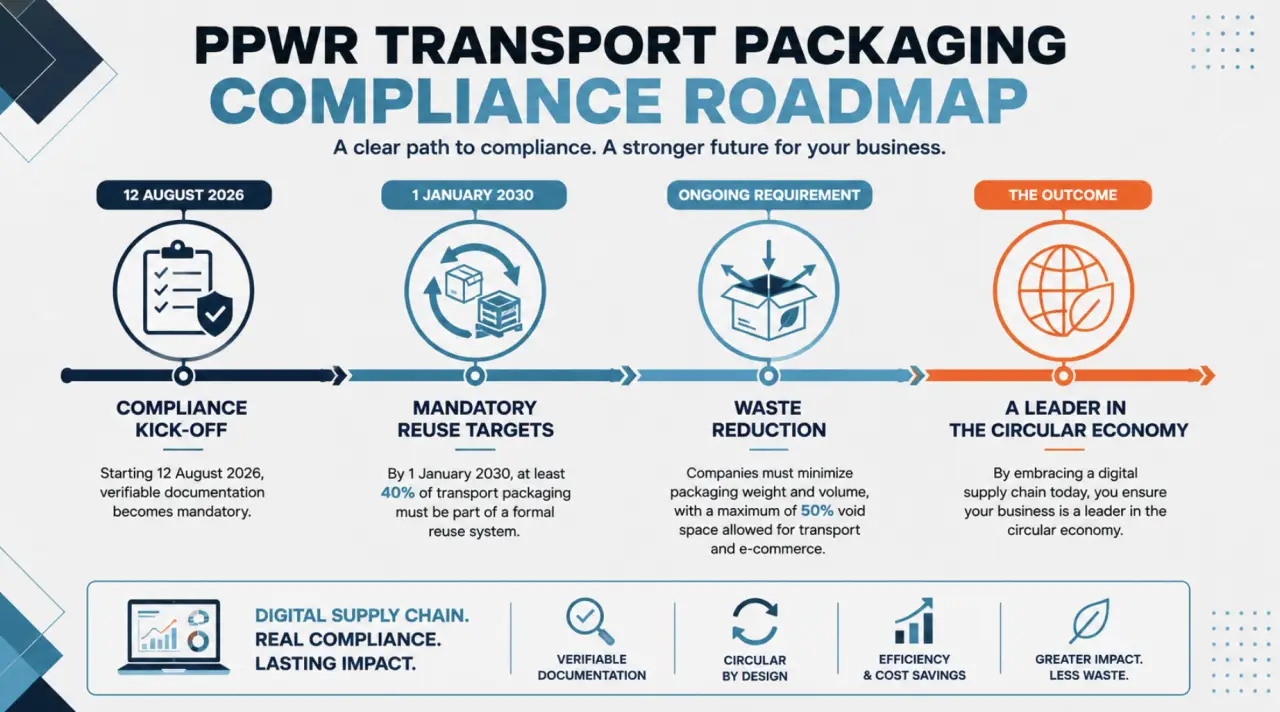
Under the PPWR, transport packaging must follow a strict roadmap:
Compliance kick-off: Starting 12 August 2026, verifiable documentation becomes mandatory.
Mandatory reuse targets: By 1 January 2030, at least 40% of transport packaging must be part of a formal reuse system.
Waste reduction: Companies must minimize packaging weight and volume, with a maximum of 50% void space allowed for transport and e-commerce.
By embracing a digital supply chain today, you ensure your business is a leader in the circular economy.
Closing the visibility gap to stop RTI loss
The true potential of a circular supply chain is unlocked through data-driven visibility. Currently, many companies face an information gap where visibility disappears the moment a returnable transport item (RTI) (such as a pallet, crate, or roll cage) leaves the gate.
This is what we've created at Connected Load Carrier (CLC). With our Solution-as-a-Service we are able to connect every handover point in the supply chain to ensure total asset visibility.
Connecting these points is essential for several reasons:
Securing asset longevity: By knowing where your RTIs are at all times, you move away from costly replacements and protect your investment.
Optimizing stock with confidence: Reliable data allows you to operate leaner, reducing your environmental footprint through smarter asset management.
Proactive lifecycle management: Visibility allows for planned maintenance, ensuring RTIs stay in the loop longer and waste is designed out of the system.
Seamless compliance: Digital data makes reporting for the Declaration of Conformity effortless, turning legal obligations into a documented success story.
Audit-ready data
To fulfill PPWR requirements, the industry's silent assets must be given a digital voice. Using IoT-driven traceability creates a Digital Twin of your assets, ensuring that information travels as fast as the physical goods.
Our platform brings this to life through a single dashboard that gives your team valuable insight into every asset across the chain: cycle times, return rates and compliance data, all in one place.
This digital identity provides:
Verifiable performance: Instant proof of return frequency and cycle times to meet PPWR quotas.
Full lifecycle history: A transparent log from origin to end-of-life, capturing every maintenance milestone.
Inventory intelligence: Real-time monitoring that eliminates blind spots and protects capital by maximizing the capacity of your existing fleet.
Master the circular loop
The introduction of the PPWR is a turning point. It’s an invitation to move beyond manual tracking and lead with hard data. By digitalizing your supply chain you build a more resilient and profitable operation and by doing so, you adhere to new regulations like PPWR.
Is your supply chain ready? The clock is ticking toward August 2026. Don't wait for the audit to find the gaps. Let's build your PPWR-proof supply chain together. Contact us.