Turning Load Carrier Visibility into a Network Advantage

Manual inbound handling, scan-based loading and missing roll cages still create hidden costs in many distribution networks. Carl McInerney, Regional Commercial Director GB & Ireland at Connected Load Carrier, explains why end-to-end asset visibility can improve labour efficiency, reduce disputes and strengthen supply chain performance.
By Carl McInerney | Regional Commercial Director GB & Ireland, Connected Load Carrier
Manual inbound handling remains a hidden cost
In many distribution centres, manual inbound handling has become part of daily operations. Trailers arrive, teams confirm ETAs, assign docks, unload, scan, check and complete administrative sign-off. Each step is familiar, but together they create avoidable time loss.
At Connected Load Carrier, we see this pattern across retail and logistics networks. Based on our modelling across several retail distribution centre networks, an average inbound trailer can take 45 to 60 minutes to process. When the non-physical process steps are digitised, this can typically be reduced to around 35 to 40 minutes.
A saving of 15 to 20 minutes per trailer becomes significant at network scale. In a mid-to-large retail operation with 25 to 35 depots and dozens of inbound trucks per day, this can represent annual labour savings of approximately £2.5 million to £4 million, depending on network size and staffing costs.
Scan-less loading reduces errors at dispatch
The loading dock creates another visibility gap. In many operations, trailer loading still depends on manual scanning, cage by cage or pallet by pallet, to confirm what is placed on the vehicle.
When this process fails, the effect is felt downstream. A missed scan, a wrongly loaded cage or incomplete confirmation can lead to store-side mismatches, disputed deliveries and investigations that consume time without creating operational value.
At Connected Load Carrier, we focus on automatic detection across these handover points. The goal is to know which assets pass through a loading door without adding extra steps for warehouse teams. Scanning then becomes confirmation rather than discovery.
Roll cage loss is not only a replacement problem
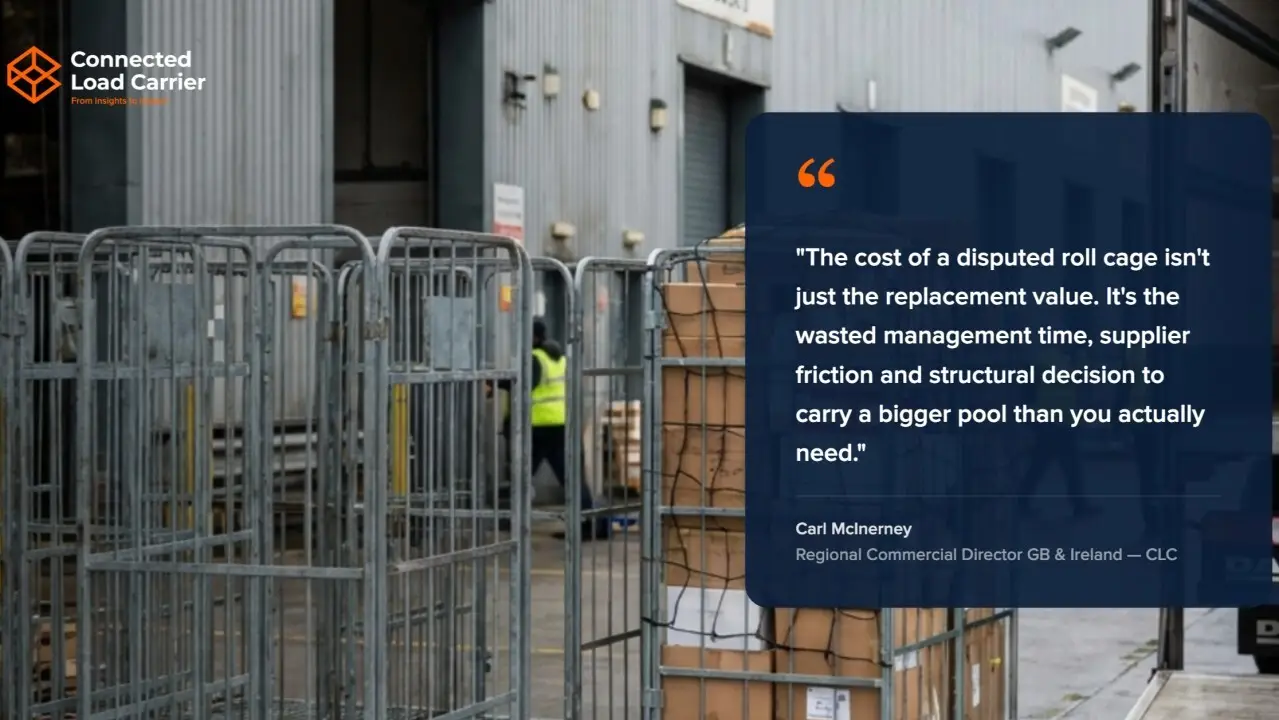
Roll cage loss is often treated as a simple asset replacement issue. If enough cages go missing, more are purchased. But the larger cost sits elsewhere.
The real burden comes from investigations, supplier communication, manual checks, management time and uncertainty about whether the asset pool is correctly sized. Dwell time adds to the problem. When cages remain at stores or other locations longer than necessary, more assets are needed to keep the network running.
With end-to-end visibility, operators can see where cages are, how long they dwell and where movement slows down. This helps reduce unnecessary asset buffers, improve rotation and make asset pools more accurate.
Asset flow affects shelf availability
Load carrier visibility is not only a logistics topic. It also affects product availability.
When assets are delayed, held up in disputed deliveries or slow to return into circulation, the goods they are meant to carry may not reach the shelf on time. In retail, this can contribute to out-of-stock situations and lost sales.
This connection is often overlooked because asset management, transport, store operations and commercial availability are usually handled by different teams. Better asset visibility helps connect these areas. Faster asset rotation supports more reliable replenishment and gives teams a clearer view of what is actually happening in the network.
Point solutions are not enough
Tracking assets inside one site or one organisation does not solve the full problem. Load carriers move between distribution centres, hauliers, stores, suppliers and return flows. Visibility often breaks down exactly where responsibility changes.
These handover points are where the operational risk is highest. They involve different systems, different processes and different incentives.
For visibility to work at scale, data capture must be automatic and integrated into daily workflows. Any solution that requires additional manual scans or extra steps is likely to degrade under operational pressure. Teams in warehouses and transport operations are already under time constraints. The technology must reduce workload, not add to it.
What changes when the full chain becomes visible
When load carriers are visible across the full chain, inbound handling becomes more predictable. Distribution centres can know what is arriving and when before a trailer reaches the yard. Dock assignment becomes more proactive, and manual checks can be reduced.
Digital handover records also reduce delivery disputes. If every asset movement is timestamped and linked to the actual load carrier, proof of delivery becomes easier to establish and investigations become shorter.
Asset pool management also improves. Operators can identify dwell time, reduce empty return journeys and avoid carrying more load carriers than needed. This supports lower capital lock-up, lower fuel use and better network efficiency.
Where to start
This does not require a large transformation programme at the beginning. The most effective starting point is often one distribution centre, one flow or one measurable pain point.
That could be inbound processing time, scan-less loading, roll cage dwell time, disputed deliveries or asset losses. The objective is to prove measurable improvement within weeks rather than months.
The key question is simple: What would it change if you knew, right now, how many cages were in your yard, where each inbound trailer was and where handovers were slowing down the network?
For many retail and logistics networks, the answer is enough to begin.
Is your supply chain still running on assumptions instead of real-time asset data? Contact Connected Load Carrier to discuss how end-to-end load carrier visibility can reduce manual effort, cut disputes and turn moving assets into a measurable network advantage.