Hundreds of thousands of roll containers & nobody knows where they are

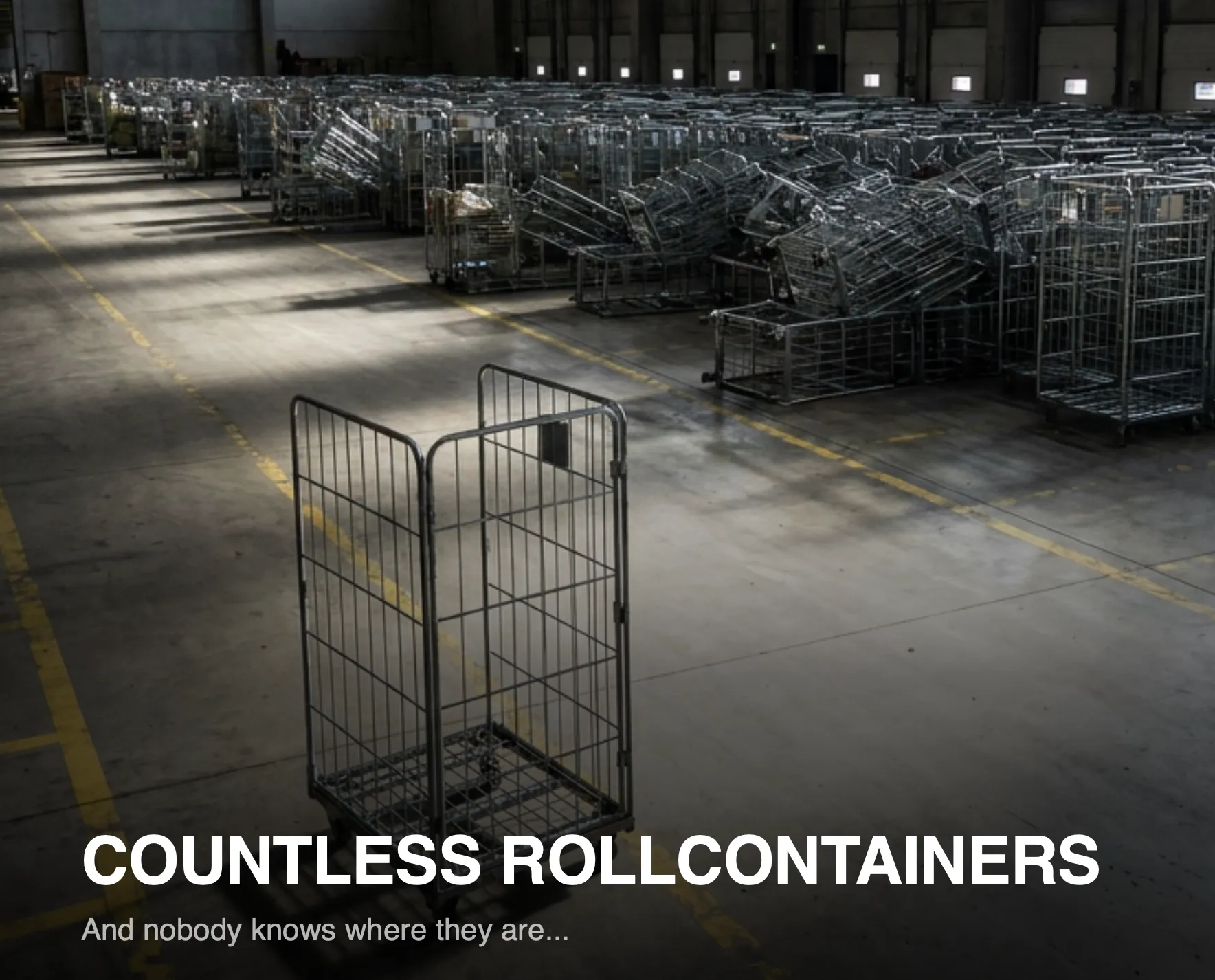
Ask a European retailer how many roll containers are actually circulating in their network right now and you'll be met with an unsettling silence.
This is because nobody knows the amount for sure. Day in, day out, roll containers and pallets move between DCs, carriers and stores. There's usually a rough idea of where things are, but no one can say with certainty. And that comes with plenty of unwelcome surprises.
The reason is that our most advanced ERP, WMS, and TMS systems were built to manage processes, not to continuously track physical objects. For their status updates, they rely entirely on manual scans and data entry by staff. The moment a human error creeps in, the records immediately fall behind reality. The result is a large, hidden cost item made up of manual counts, lost carriers and disputes with partners. And with the arrival of CSRD sustainability legislation, this data gap is about to become a real problem.
In this article, Sjoerd Janssen, Sales Manager at Connected Load Carrier explains why the current systems can't solve this, where the hidden costs are actually going and how forward-thinking retailers are now turning the load carrier itself into the ultimate data source.
A pool nobody fully oversees
A retailer operating at European scale runs dozens of supply chains that operate simultaneously, intersect with one another and depend on the same physical load carriers to function.
Roll containers, pallets, crates — all of these carriers move day after day from distribution center to store, from store back to DC, via external carriers, via regional hubs, via suppliers who deliver their goods on those very same assets.
We're talking about hundreds of thousands of units, spread across a network stretching from the Netherlands to well beyond the original home market. All part of a closed logistics system that, in theory, is well organized, but in practice constantly struggles with a fundamental information problem.
Nobody knows:
Where exactly all those load carriers are at any given moment;
What condition they're in and how long they've been sitting at a given location;
Or whether the numbers in the system match what's actually on the floor.
And that's precisely the core of the problem: a lack of information.
Why ERP, WMS, and TMS don't solve this
Over the past decades, most retailers have invested heavily in systems to support their supply chain: ERP for the financial and administrative layer, WMS for managing warehouse operations and TMS for transport planning. Each of these is a mature system, well configured, full of data and managed by teams who work with it daily.
But there's something all these systems structurally fail to do and were never designed to do: they don't provide continuity for the load carrier itself. For the physical object that moves straight through all these systems, changing owners at every handover, changing the party responsible for it, jumping from system to system without carrying along anything of what it has experienced.
→ When a roll container leaves the DC, an employee logs the outbound order in the WMS, but what happens to that roll container afterward falls outside that system's field of view.
→ When the same roll container arrives at a store, a new registration may begin there, but it's disconnected from the previous one.
→ When an (external) carrier picks up the roll container for the return trip, there's yet another new administrative moment, again with no link to what came before.
All kinds of systems and records, but no shared truth about the same object.
And what happens in between those registrations — how long the roll container sat somewhere, whether it was picked up by the wrong party, whether it got damaged, whether the numbers add up — nobody knows for certain.
This leads to something I encounter in virtually every operation: manual counts and periodic reconciliations; disputes with partners over quantities; load carriers quietly written off because searching for them costs more than they're worth.
The hidden costs nobody adds up
What has struck me in conversations with operations managers and supply chain directors is that the costs of this problem are rarely added up in full. That's because they're scattered across different cost categories, making each one look acceptable in isolation.
The labor hours spent on manual counts at the DC are seen as part of normal operations. The extra assets ordered because certain locations appear to be running short are booked as a regular investment in the pool. The time supply chain teams spend resolving disputes with transport partners over missing quantities is recorded as operational inefficiency. The losses written off against the asset pool every year are treated as a given — a percentage that simply comes with the territory.
But add up all those costs together — the labor, the unnecessary replenishments, the losses, the inefficient routing that results from nobody knowing exactly where the assets are — and you quickly arrive at a figure worth taking seriously. Especially at the scale at which large European retailers operate.
The sustainability agenda demands data you don't currently have
On top of all this, there's something increasingly pressing on the agenda: sustainability reporting.
European retailers are preparing for CSRD compliance and reporting on Scope 3 emissions, on material reuse, on the ecological footprint of their logistics operations.
But data you don't have because your load carriers aren't tracked is data you can't report. No matter how good your intentions are or how ambitious your climate targets.
What becomes possible when the load carrier itself becomes the source of truth?
At Connected Load Carrier (CLC), we work on exactly this problem. What sets us apart is this:
We're not adding yet another system to an already complex stack — we're creating a layer that should have existed all along: a layer that safeguards the continuity of operational context at the level of the physical object itself, so the roll container is no longer an anonymous piece of metal that disappears the moment it crosses a system boundary, but an asset that carries its own operational history with it, regardless of which system sits on the other side of the handover.
In practice, for a distribution center, this means manual counts largely become unnecessary. An independent system automatically registers when an asset enters or leaves a location, creating a single objective source of truth. Discrepancies become immediately visible, and disputes with suppliers can be resolved based on shared facts instead of conflicting records.
For stores, this finally makes inbound flows predictable. The receiving employee knows exactly what's arriving and when, and goods-in administration runs largely automatically. What's more, asset shortages that disrupt store operations become visible in advance, instead of only once the roll containers have already run out.
For logistics, it means that utilization rates and route efficiency are no longer based on assumptions about what's in a trailer or where an asset is located, but on measured reality. This allows routing and dispatching to be automated based on data that is actually accurate.
And for sustainability reporting, it means that turnover rate, loss reduction, and reuse are now verified figures — exactly the kind of data that auditors, regulators, and executives are increasingly asking for.
What I notice in practice is that many providers in this space come in with a standard package and then tell you where the value lies — as if every operation has the same problem and every organization stands to gain the most in the same place.
At CLC, we work differently: we always start by asking where in your specific chain the value can actually be captured, and build the solution from there, tailored to the processes, the partners, and the scale that fit that organization. Simply because a solution that doesn't align with the real pain points won't deliver real impact either.
On top of that, we deliver everything as a service: no hardware to purchase, no technology decisions to make, no major upfront investment. That makes it manageable to take the first step, and keeps costs under control as the scope grows. You can start small — the ROI speaks for itself. Scaling up then becomes an easy choice.
Scale makes the problem more urgent, not simpler
For retailers operating across multiple European countries, entering new markets every year, opening new distribution centers, and adding hundreds of new stores to their network, every one of those steps makes the underlying problem bigger, not smaller.
Every new market brings a new set of transport partners handling the load carriers. Every new DC is a new link in the chain where operational context can once again disappear. Every new store is an additional endpoint where assets can pile up, disappear, or fall out of normal rotation without it being visible in the central systems.
What might still seem manageable at the scale of a single country, with periodic counts and manual reconciliations, becomes a structural cost issue at European scale — one that digs itself deeper into the operation every year. The costs don't suddenly become visible; they grow gradually, as something that always seemed to be part of the deal.
At the same time, these same retailers are investing heavily in digitalizing their planning, finance, and transport systems, right at the moment when the demand for reliable, real-time operational data is at its highest. That makes the missing layer — the one that connects the load carrier itself to all these systems — only more urgent.
Where to start?
The question I eventually get in most conversations is where to begin in an operation that's already complex, where multiple systems are running, where partners depend on existing processes, and where major changes need to be carefully planned.
My answer is always the same: you start where you have control yourself — in your own DCs, in your own logistics flows, in the stores you manage directly. That way you can validate all the value in an environment you know and control.
From there, you build outward, step by step, toward the partners who share your supply chain with you: the carriers, the suppliers, the pool managers — so that the shared operational truth that starts within your own walls gradually extends into the broader supply chain. That way, the benefits become visible not just internally, but also in collaboration with the parties who have just as much at stake as you do.
I'm curious how you see this in practice: does this problem sound familiar, and what are the biggest obstacles you experience in keeping track of your load carrier pool?
Sjoerd Janssen is Sales Manager at Connected Load Carrier, specializing in the digitalization of load carrier pools for European retailers.